






What does constant headphone usage mean for students?
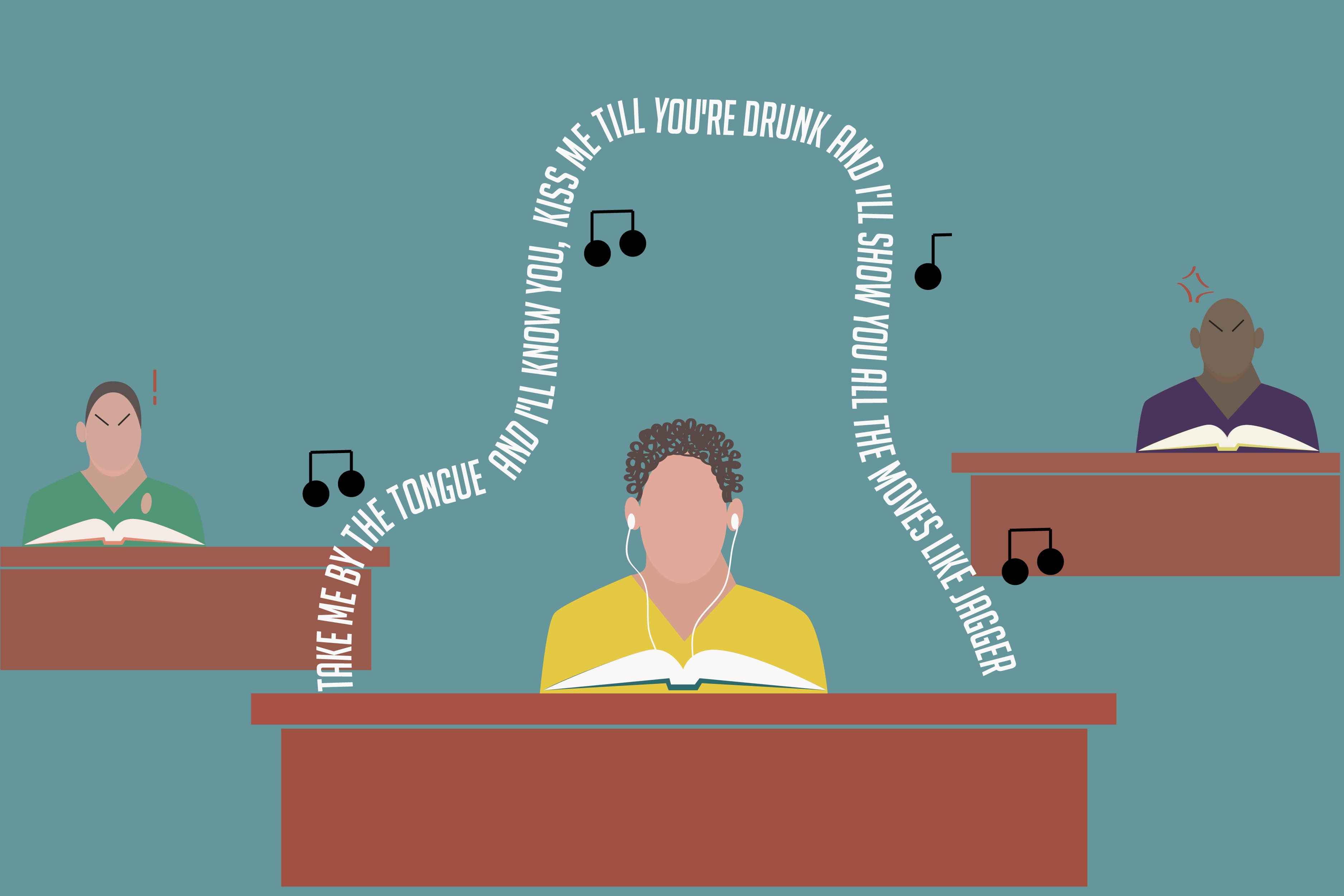
Students and faculty discuss the implications of widespread headphone use
By GRACIELA TIU — features@theaggie.org
On an early Monday morning, you hop off the bus and start walking toward your first class. As you hear the soothing beat of your favorite song playing in your AirPods, you cross the street and navigate your way through the crossing bikes and electric scooters. An athlete on a scooter nearly clips a pedestrian. A prospective student tour gathers near the benches ahead of you, the tour guide beginning to engage with the group. Three friends walk past you, talking enthusiastically. So much is happening around you, and yet, none of it really reaches you.
You see all kinds of students as you pass through campus, nearly all of them also wearing some form of earbuds or headphones as they walk through the space — unless conversing with friends or within a group.
More often than not, students will choose to listen to some sort of mediated sound, playing through earbuds or headphones, while walking alone through campus. While this behavior may be seemingly innocuous, what does it show about our campus culture? What motivates students to use earbuds and headphones so consistently that people rarely walk alone without them?
“I am almost always wearing headphones,” Sophie Cabrera, a third-year art history major, said. “I can’t lie, I like to romanticize my life, and having a constant stream of Taylor Swift makes it easier to do so — otherwise, I’m just listening to the ambient sounds of people almost getting into electric scooter accidents and Unitrans trying to navigate around campus.”
Cabrera elaborated on how a desire for comfort typically leads her to wear headphones, especially since choosing not to would mean feeling like the odd one out.
“During the day, I feel more comfortable with headphones,” Cabrera said. “Everyone around me is wearing them, so I would feel awkward sitting on the bus and being the odd one out without music.”
Additionally, Cabrera expressed that having a source of music or media to listen to during the day can work as a stress reliever and distraction: a form of control.
“I would probably be more stressed than anything without them,” Cabrera said. “When I’m not listening to music, a lot of my thoughts revolve around my studies or my social life, and it all builds up so much that I feel like my to-do list for my life is inescapable. I feel overwhelmed instead of motivated. The stimulation helps me distract myself from my other responsibilities. Unlike my classes or my day-to-day, the music I choose to listen to is controllable. It’s a very small way that I can have control while I’m trying to navigate my way through the quarter.”
Cassandra Lee, a second-year cognitive science major, also described how wearing headphones can give her a sense of safety while walking through campus.
“I do feel safer when wearing headphones because it kind of gives off a memo that I am incognito, so I get to be in my own headspace,” Lee said. “Without them, I would feel a little anxious because I often overthink, so if I have no distractions, my mind will keep running, and I would be a little bored since I have nothing to keep my mind occupied.”
Wearing headphones can make a solo walk feel entertaining, comfortable and socially safe, according to students. Headphones or earbuds can also nonverbally communicate a boundary to others who may wish to interact with them, acting as an indicator of conversation avoidance.
“Wearing the headphones can put [the person] in an antisocial mindset, in my opinion,” Virginia Hamilton, a UC Davis professor in the Communication Department, said. “And the person outside of it has the choice of caring whether they have something in their ears, or making what I think could be a false assumption that they don’t want to talk to you because they’re listening to something.”
Choosing whether or not to read headphones as a social cue depends heavily on the context of the relationship and the external environment, according to Hamilton.
“You could have nothing in your ears and be thoroughly uninterested in meeting people,” Hamilton said. “I never have anything in my ears, and I’m thoroughly uninterested in meeting people, usually. I’ve changed over the years — I’m much more friendly to strangers than I used to be — but having anything in my ears has never impacted that feeling. If you talk to somebody who has something in their ears, they’re often very friendly. It depends on the person.”
Headphones, then, may not truly cause social withdrawal, but they can still shift perception, even subtly. Hamilton also echoed students’ accounts of wearing headphones in order to look occupied and avoid being perceived as lonely — a similar behavior to scrolling aimlessly on your phone in a socially stressful situation.
“Maybe some people are using it to ease loneliness or make themselves feel socially comfortable,” Hamilton said.
Media scholars have performed research dating back to the 1980s on the “Walkman effect,” which describes how personal audio devices allow people to curate their own experiences within a public space, layering their individually chosen sound over shared environments. This might not necessarily indicate antisocial behavior, but more of a broader trend that people are choosing curated solitude over ambient presence and mindfulness.
Research on media consumption and the uses and gratifications theory suggests that people actively choose media to fulfill specific needs, such as distraction, mood management or identity reinforcement. In viewing this campus phenomenon from this lens, one can see how headphone usage can function as a tool for self-regulation and instant gratification.
“It’s generational, but it’s also human,” Hamilton said. “Some people can meditate, and others think that’s torture. What would I do with my mind if it’s not stimulated by something external? It’s candy. It’s dopamine. Scholars study this. It moves our hormones in feel-good directions.”
The concern, for Hamilton, is not that this widespread headphone usage prevents interpersonal relationships outright, but rather that it signals a broader cultural shift beyond campus.
“Is it getting in the way of making friends? I’d say no, not so much,” Hamilton said. “But it’s not helping, because we’ve become so entertained in other ways. The issue is whether people even want relationships. They’ve got their parasocial connections, the celebrities they track. There are so many electronic sources that make us feel connected to society, and it isn’t a warm body doing that. That has huge implications, even for survival. We’re getting information about relationships and identity from concepts, not people. It makes us live in fantasy worlds instead of experiencing another human being.”
Hamilton noted how there’s always value in communicating with another human being in a real way, even — and sometimes especially — through involuntary interactions, which can sometimes be partially inhibited by headphone usage.
“In the workplace, you’re forced into relationships with people you didn’t choose,” Hamilton said. “That’s where you realize how cool it is to engage with people you wouldn’t have otherwise. That’s what makes us grow and feel deeply satisfied in a social world. We are more dogs than cats, and we’re acting like cats.”
Still, the heavy AirPod usage might not truly signal a social decline so much as a shift in how solitude is experienced, according to Hamilton. Walking alone, in the past several decades, has no longer become a time for silence, mindfulness or a focus on everyday ambience. It means a podcast playing in your ears, a comfort album on repeat and an overall curated emotional state. This ubiquitous headphone usage may not directly make us antisocial, according to students, but it does normalize a form of curated solitude that could subtly reshape how we experience shared spaces, how available we are for spontaneous connections and how present we can truly be.
Written by: Graciela Tiu — features@theaggie.org