







Laurelin Gilmore stuns with ‘Migration’ exhibition at John Natsoulas Gallery
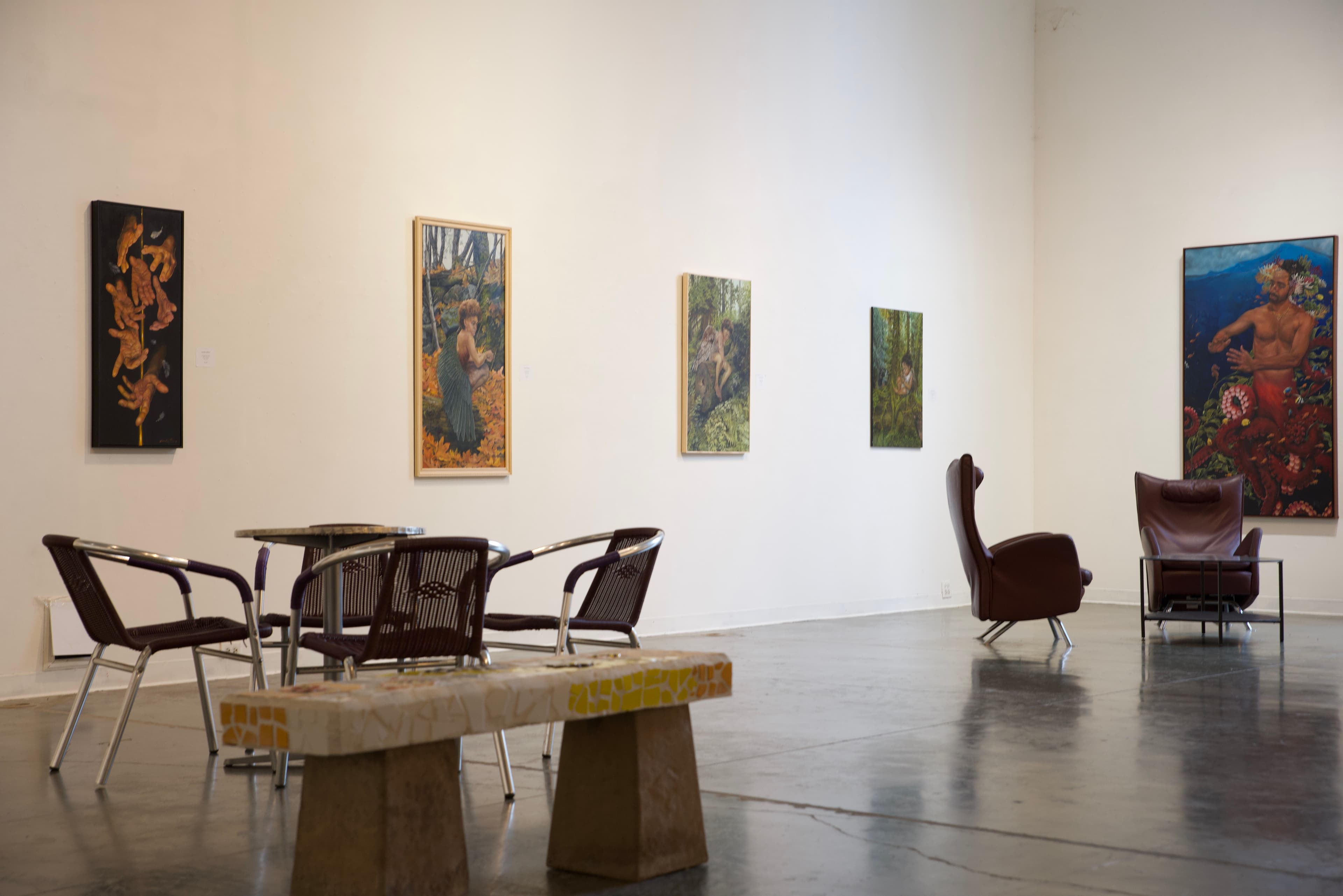
The artist discussed her solo-show — rich with natural forms and personal imagery
By BELLA PETERSON — arts@theaggie.org
John Natsoulas Gallery’s newest exhibition “Migration” incorporates the personal experiences of Sacramento-based artist Laurelin Gilmore with organic imagery found in nature.
“I’ve always felt we can learn most of what we need by paying close attention to the natural world,” Laurelin Gilmore said, as noted in the exhibition’s wall text. “Our seasons stretch over the course of a life, and those too dictate our movements.”
A standout trait of the exhibition, which opened on Feb. 13, is the personal relationships depicted in each of Gilmore’s paintings. The exhibition utilizes imagery of birds, which came from Gilmore’s complex emotions surrounding her daughter’s passage through life and into college.
“I was working through the feelings of empty nesting with my kid having left for college; it can be deeply painful, terrifying and hopeful all at once, but it’s a natural part of life,” Gilmore said. “I started to paint her as this bird off on her own finding her place in the world, envisioning her on the adventure of life as something beautiful. It got me thinking about the natural instinct to move that so many animals on the planet share.”
Gilmore’s piece, “Regrown” (2025), encapsulates the thematic approach she took to the exhibition as a whole. The painting depicts her daughter in youth, adorned by a pair of feathered wings, sitting atop a log with surrounding vegetation that further emphasizes the painting’s focal figure: that her daughter is a hybrid creature — simultaneously a bird and a human child.
“Birds obviously migrate, but so do elephants, butterflies, whales and lots of other species, including people,” Gilmore said. “Like anything else, we move from scarcity toward abundance, from fear toward safety, sometimes just from a small pond to a bigger pond, and usually in the hope that we’re met with some grace when we arrive. Nature would tell us to get in rhythm with our instinct. I wanted to honor that.”
Gilmore’s oil on wood piece, “See Jay” (2026), presents beautifully amongst the other works of art. With the bird’s human-like eye staring right back at the viewer — while every other aspect of the piece is presented as regularly expected for a blue jay — the image invites the viewer to reflect on themselves.
Gilmore explained the bold pattern she often utilizes in not just the pieces seen in the exhibition, but in her works overall.
“I often combine animal or insect or environmental elements with the human body to drive the narrative that we are deeply connected to our natural world,” Gilmore said. “It can be empowering to understand that something so wild and resilient is also a part of us.”
“Caliscape: Central Coast” (2023) drives this narrative home with the image of tree and stone figures taking on the human form as they meld into one another. The lively colors and inclusion of flying creatures such as butterflies and birds highlight the resilience of nature.
“Nature tells us wounded trees can regrow, that mycelium can create entire underground networks to keep strong, that all things move in cycles,” Gilmore said. “Ultimately, the challenge is to create something that the viewer recognizes as a part of their own story while expressing something deeply personal to me. These are shared experiences.”
Gilmore believes that humans in our organic forms are not so dissimilar from the natural forms that coexist alongside us. In their own desire to migrate, humans too cannot deny the inevitable journey and call for movement, according to Gilmore.
“[It was] not just about the absence of my daughter in my home, but I had also recently exited small business-ownership — another move,” Gilmore said. “All this was happening at the same time friends and loved ones who’ve migrated to the U.S. are being horribly denigrated and made to feel terrified for following their natural instinct to move. I needed a release valve for this enormous sense of sadness, anger and love all trying to coexist in me.”
“Make Like a Tree” (2025) significantly imagines all of these personal and shared experiences Gilmore aimed to depict. The floating hands that scatter across the painting immediately calls for the viewers’ attention, along with the striking, brooding clouds in the background. The dark weather, brightly colored uncontrollable leaves in the wind and the hands shaped like birds flying juxtapose one another as unstoppable forces of nature.
“Ultimately, I hope you’re reminded of your own place in the natural world,” Gilmore said. “You are wild at heart, and your life is reflected in the big trees, in the wide ocean, in fire, in beehives, in stars, in little seeds or tiny spiders that travel on the wind.”
Gilmore further explained just how vital her message is and what it can mean for others.
“Life on earth can sometimes be not just hard, but really cruel,” Gilmore said. “Nature reminds us to find community, that storms pass, that flowers grow through cracks in concrete.”
“Migration” at The John Natsoulas Gallery in Davis is a testament to the artistic talent that is Laurelin Gilmore and the beauty of our natural instincts as humans. Gilmore’s stunning and honest visuals will remain on display until March 28.
Written by: Bella Peterson — arts@theaggie.org