







The Iranian Student Organization’s Nowruz celebrate the Persian New Year
Students marked the event with music, community and reflection
By IQRA AHMAD — arts@theaggie.org
On March 7, the Iranian Student Organization (ISO) welcomed students, families and community members to celebrate Nowruz, the Persian New Year, in an evening that showcased performance and tradition at the Walter A. Buehler Alumni Center. ISO also recognized the Cross Cultural Center in their support and commitment to sharing the Nowruz celebration with the UC Davis community.
Observed on the spring equinox, Nowruz — which translates to “new day” — marks the arrival of the season and is celebrated across Iran and by many communities throughout the region and Iranian diaspora.
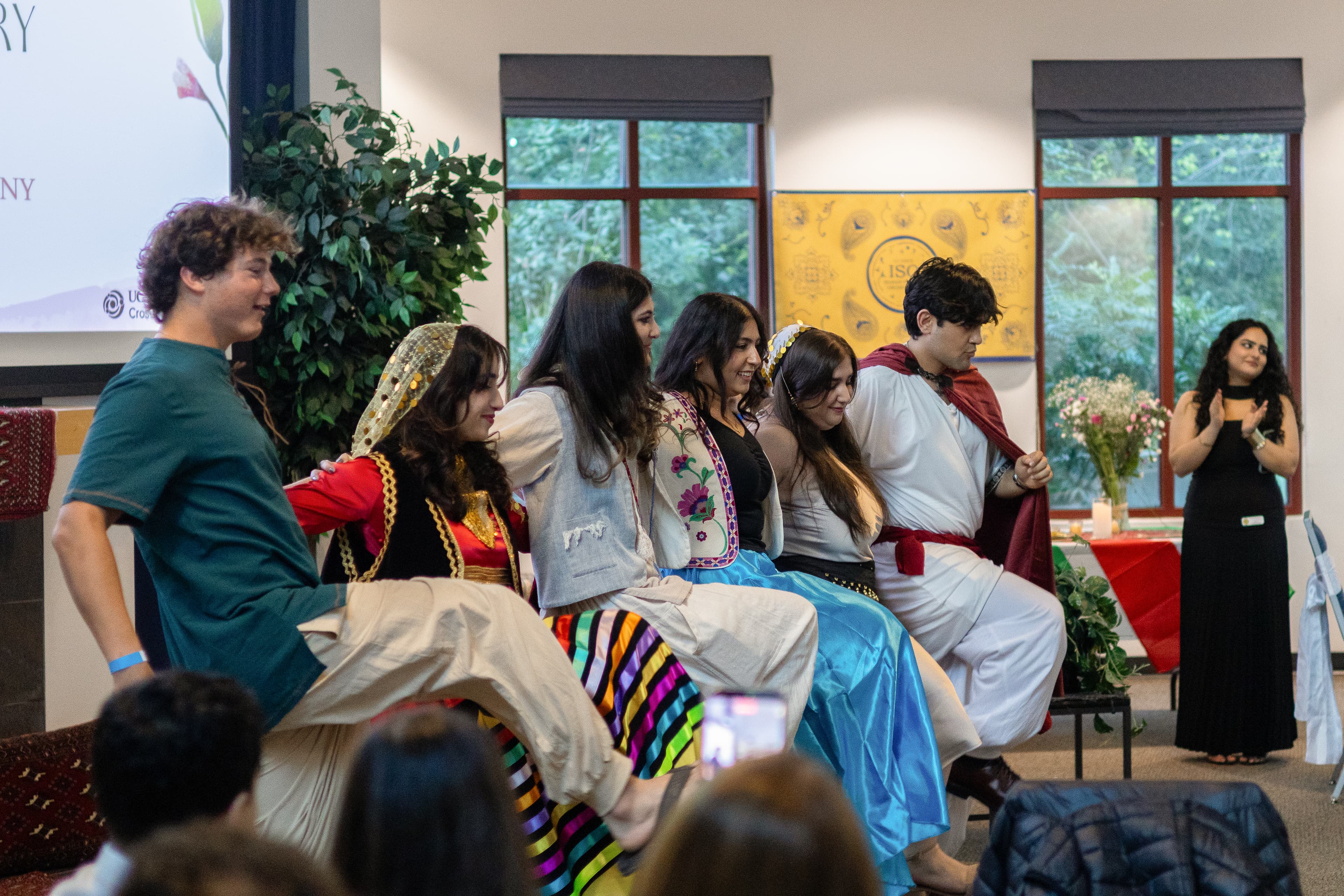
The ISO event offered students and community members the opportunity to engage with Iranian music and culture through live entertainment. Reaching capacity, the event had over 100 attendees and featured performances by board members and local music ensembles.
ISO partnered with Uncle David’s Grill House and Bostantea to provide dinner to attendees, including authentic Persian dishes such as khoresh ghormeh sabzi (Persian herb stew), khoresh gheymeh (split pea stew), kabob koobideh (grilled beef kabob), joojeh koobideh (chicken kabob), saffron rice, grilled tomatoes and salad shirazi (Persian cucumber and tomato salad).
For ISO President Ava Jabbari, a fourth-year environmental policy analysis and planning and international relations double major, Nowruz has long been one of the most meaningful ways she connects to her heritage. Raised in North America but closely tied to family in Iran, Jabbari described Nowruz as deeply personal and rooted in community.
“It was always something that stayed at home,” Jabbari said. “But that’s why I think my mom wanted us to go to Iran so often during those months, usually March to April, so that we could have that time and connection and authentic experience.”
She recalled childhood traditions centered around the haft-sin, a ceremonial display featuring symbolic items of renewal and abundance for the new year.
“haft-sin translates to ‘seven seen,’ seen is the letter for ‘S’ [in Farsi],” Jabbari said. “[On the haft-sin] there’s samanoo (wheat pudding), somagh (sumac), serkeh (vinegar), senjed (dried oleaster fruit), sabzeh (sprouted wheat or lentils), seer (garlic) and sekke (coins).”
Jabbari shared that the haft-sin is an important and personal tradition that has allowed growth and reflection of the items displayed on the altar. In particular, Jabbari touched on the tradition of having a goldfish on the haft-sin as a symbol of movement and vitality in the new year.
“Every family makes their own [haft-sin],” Jabbari said. “The one thing that was always the most fun for me was the fish. I’ve always loved the ritual of that. But, nowadays, I have another perspective on the fish because it’s supposed to [represent] movement or being active. I [also] value the mirror because it’s supposed to be for you to reflect and see yourself in it — your future and who you want to be in the new year.”
Among the many Nowruz traditions, Jabbari shared more about Chahārshanbe Suri, the festival of jumping over fire that is observed on the eve of the last Wednesday before the Persian New Year.
“It’s the festival of fire, and it’s supposed to be a way for people to let go of their past and jump into the new year,” Jabbari said. “The fire cleanses you. There’s a saying, ‘zardi-ye man az to, sorkhi-ye to az man’ which basically translates to ‘take my jaundice to you (the fire), and then to the fire, give me your health, your redness for me.’”
That spirit of renewal and vitality carried into ISO’s consideration when planning the event this year. While the celebration included food, tea, live performances and traditional music, organizers also framed the event to reflect the heaviness many in the Iranian community are carrying.
“We debated canceling Nowruz this year two or three times,” Jabbari said. “Because there is so much going on geopolitically, we don’t want to offend anyone, but we also don’t want to shy away from being there for people.”
Rather than cancel the event, ISO chose to move forward with thoughtful planning. The organization incorporated an altar honoring the lives lost in the U.S.-Israel-Iran War and featured a fundraiser for the nonprofit Moms Against Poverty. The event was also reworked to better reflect the purpose and tone organizers hoped to impart: one rooted in cultural pride, empathy and reflection.
“We gave [the event] a theme: ‘Be Omid E Piroozi ye Iran,’ or ‘To Hope for a Free Iran,’” Jabbari said. “We want this event to still feel celebratory, but we also don’t want to make it a celebration that’s ignoring or dismissing any of the tragedies.”
In considering the theme, board members wrote and performed a play to spread awareness about the events occurring in Iran.
“Given our theme, my fellow board member Bamdad [Borhany] and I decided to write a play which spreads awareness about Iranian people protesting against an oppressive regime, while also incorporating the beautiful elements of Nowruz,” ISO Director of Outreach Ayla Ajdari, a fourth-year biomedical engineering major, said. “In short, our play revolves around Cyrus (Koorosh) the Great and people from different parts of Iran including Kords, Turks, Lors and Gilaks coming together and speaking up in order to gain their rights, leading to the creation of the Cyrus Cylinder, the world’s first charter of human rights.”
Ajdari shared that the play was intended to inform the audience and create a space of reflection.
“We put an incredible amount of hard work, from late night practices [to] costuming, and it totally paid off seeing people in tears and clapping,” Ajdari said. “Given that there were a lot of non-Iranians in the audience, I think both Nowruz and this performance was very important in terms of educating people about Iranian culture and history.”
The balance between joy and remembrance resonated with attendees. For Ava Mehr, a first-year neurobiology, physiology and behavior major, Nowruz is a time for family.
“Personally, I think Nowruz is a great way for families to come together,” Mehr said. “It’s a great time to reconnect with family and talk about our goals for the new year.”
Mehr explained that one of her favorite traditions is Chaharshanbe Suri, which she tries to celebrate every year with family. Coming to UC Davis, Mehr found comfort in seeing a student organization that could recreate a sentiment of home.
“It was great to see that, first of all, there is an Iranian Student Organization and that they’re hosting events like this,” Mehr said. “Meeting all these people and getting close to them has helped me find not only a new group of friends, but a new community that I can integrate myself into.”
ISO Event Coordinator Hasti Sharif, a second-year international relations and Middle East/South Asia studies double major, also emphasized the importance of community as someone who did not grow up surrounded by a large Iranian population.
“At UC Davis, this is the first experience I had celebrating in a big community,” Sharif said. “It means a lot to me because it brings our community together, and I think it’s one of those traditions that every Iranian has special memories with.”
Sharif shared that cultural celebrations like Nowruz are especially important on diverse college campuses.
“I think Nowruz is just one of those things that showcases the beauty of Iranian culture,” Sharif said. “What my family does is we would walk to a canyon where there was some sort of water or lake, and we would tie wheat, throw it in the water and make a wish. The idea of it is that if it circles back around, then your wish comes true.”
For many Iranian students, Nowruz traditions are tied to vivid childhood memories.
“I was lucky enough to experience Nowruz as a child in Iran and I remember walking the streets of Tehran with my mom and smelling fresh hyacinths, seeing the cutest haft-sin decorations and, best of all, picking out a goldfish to place on the haft-sin,” Ajdari said. “Some of my favorite parts about Nowruz have always been painting the eggs, getting money (eidi) from family members and eating noon nokhodchi, which is a chickpea cookie commonly made during Nowruz. I loved them so much; I used to sneakily eat some before guests arrived at our house.”
The desire to showcase celebration and culture influenced the musical performances at the event. Among the evening‘s guests was Nariman Assadi, a daf and tombak teacher whose ensemble of students performed at the celebration.
He noted that events like ISO’s Nowruz celebration can be especially meaningful for generations of Iranian American students, many of whom may be seeking ways to remain connected to the language and culture.
“For me, as a person and an ambassador of Iranian culture, I want to show the joyful parts,” Assadi said. “Sharing that culture, especially with non-Iranians, is a very big feeling.”
Jabbari also explained that publicly celebrating Nowruz matters, especially on American college campuses.
“Holidays like this shouldn’t live in your home,” Jabbari said. “They shouldn’t be confined to your living room. People should be able to come out and celebrate with nature, with the spring and be with others who also want to celebrate it with you and learn about it.”
For Jabbari, that openness is central to the meaning of the holiday itself.
“Nowruz is a holiday that is open to anyone and everyone,” Jabbari said. “The direct translation of Nowruz is ‘new day’ — it’s for anyone who wants to have a new day.”
Written by: Iqra Ahmad — arts@theaggie.org