







Public bathrooms are designed poorly because they’re gross
And they’re gross because they’re poorly designed
By MILES BARRY —mabarry@ucdavis.edu
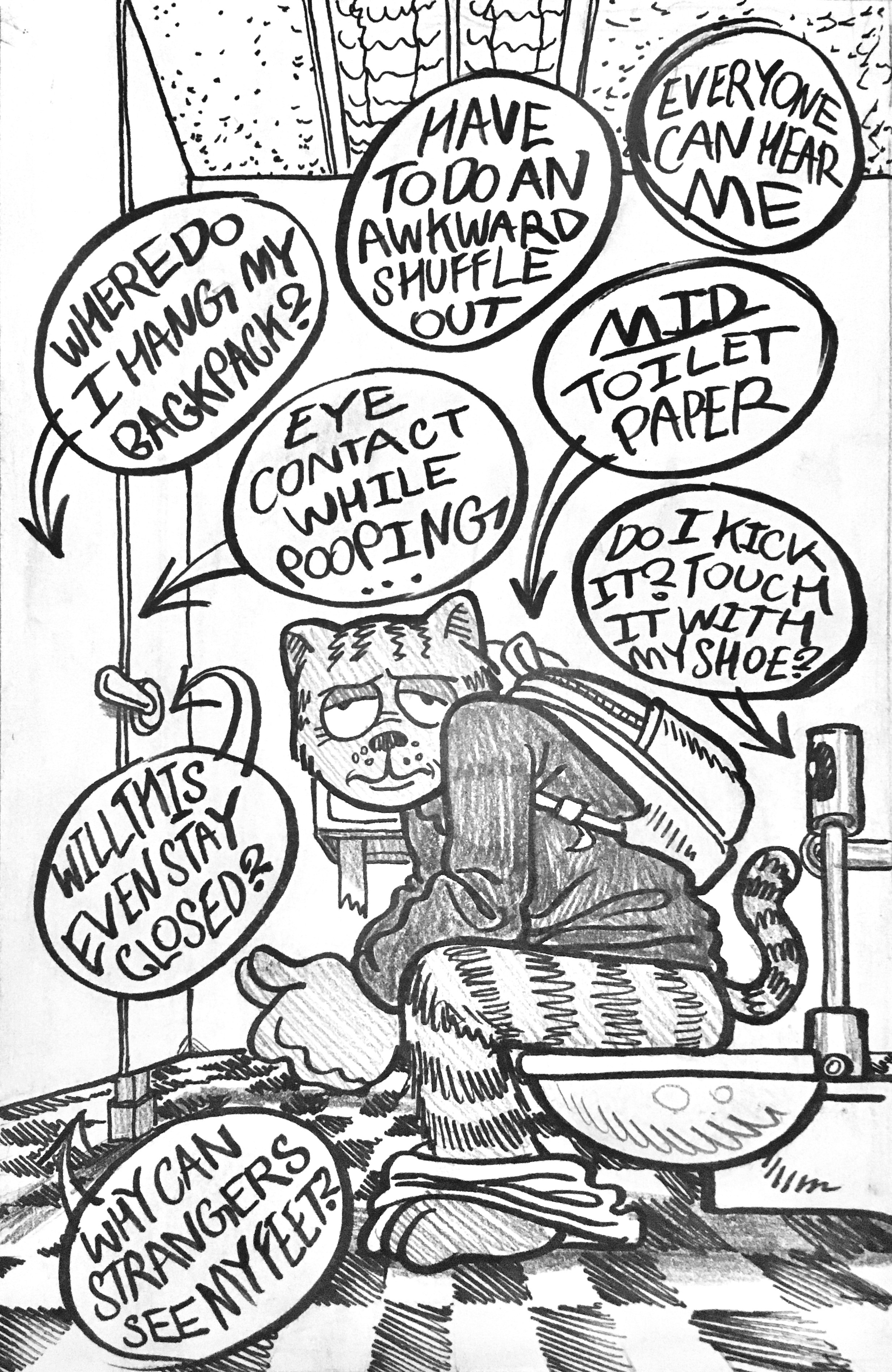
On the whole, public restrooms are unpleasant spaces. Between thin, gray-blue walls, strangers perform the private and intimate acts of daily maintenance — relieving themselves, managing menstrual products, changing clothes, injecting insulin, adjusting medical devices, changing colostomy bags — all while hyperaware that a gap in the door might reveal their all too recognizable shoes. Loud hand dryers, fluorescent lighting and astringent chemical cleaning agents bombard the senses. Women’s restrooms have fewer toilets per capita due to their lack of urinals, creating longer queues — especially given women’s more frequent caregiving responsibilities for children and the elderly.
Sociologist Norbert Elias argues that modern society has developed increasingly strict rules about bodily functions and privacy. What medieval people did openly — relieving themselves, discussing bodily processes — has become progressively more shameful and “disgusting” to us. This “civilizing process” means that even as our world becomes objectively safer through scientific advances, our disgust with our own bodies intensifies. If you’ve visited the San Francisco exploratorium and hesitated to drink from their water fountain made from a toilet bowl, you’re familiar with this feeling. You wouldn’t pack your lunch in a bag intended for dog poop, even if it was pristine; the cleanest public restroom is a culturally dirty space.
Yet, despite our increased disgust with bodily processes, I’ll admit that cultural taboos about grossness don’t explain all of the discomfort we (germaphobes at least) feel when stepping into the Olson Hall public restrooms, touching a trash can’s lid while disposing of waste or watching a trumpet player empty her spit valve onto the concert hall floor. When products and spaces are designed for actions deemed culturally gross — bodily excrement and waste disposal — poor design and disgust have a chicken-and-egg relationship embodied by public restrooms.
Poor public restroom design stems from disgust — no one wants to engage seriously with bathrooms as a design challenge. One architect noted that “clients often view these spaces as 150% utilitarian, which can also limit your design options.” But the relationship runs both ways. Poor design also reinforces disgust — public restrooms could be far less hostile if designers weren’t operating under the assumption that these spaces don’t deserve careful thought.
Toilet paper is a great example of this design conundrum. In its cheap, public restroom form, it’s abrasive, prone to tearing and requires constant refilling. We require our hand soap to be antibacterial, yet don’t hold toilet paper to even this low bar. These design flaws are fundamental to toilet paper, in part because it’s viewed culturally as an accessory to a gross action. Yet it remains the predominant form of post-toileting sanitation, partly because thinking about alternatives is also gross. No one wants to suggest sanitary wipes or bidets, even if they’re more sanitary and (in some cases) cheaper. Poor design produces disgust, just as disgust produces poor design.
My own neuroses about germs aside, the harms produced by this relationship between grossness and design tend to affect marginalized groups most strongly. Gender-nonconforming individuals face surveillance and harassment in gendered bathrooms, yet proposals for gender-neutral multi-stall facilities — with floor-to-ceiling doors that would improve privacy for everyone — are met with resistance because they force people to confront bathroom design as a serious problem.
Parents struggle with flimsy, unsanitary fold-down changing tables — often relegated to only women’s restrooms — because infant waste management is treated as an afterthought. Insulin users require shelves for their syringes and adequate lighting to see their veins — both hard to come by in public restrooms. Disabled individuals navigate facilities where accessible stalls are frequently repurposed for storage or cleaning supplies. Sanitation workers face dangerous conditions and toxic chemical exposure, with the harm exacerbated by poor ventilation and inadequate safety equipment that a better design could address.
New York University Professor Harvey Molotch noted that “silence about the issue persists, largely because of cultural taboos that discourage any discussion about alleviating design flaws.” These people are abandoned to the consequences of our collective squeamishness.
This recursion between poor design and disgust isn’t inevitable. Japan’s high-tech toilets show that public facilities can be luxurious when more effort is allocated towards them and European restrooms with floor-to-ceiling stalls demonstrate that privacy is achievable. But producing this change requires us to do something incredibly uncomfortable: think seriously and at-length about something we’ve been taught to avoid. Worse, we’ll be required to speak publicly about actions we usually refer to through euphemism — people don’t just go into the restroom to “rest.”
Disgust, however visceral it feels, shouldn’t dictate how we design spaces that everyone needs. The solutions exist; we just need to get over ourselves long enough to implement them.
Written by: Miles Barry—mabarry@ucdavis.edu
Disclaimer: The views and opinions expressed by individual columnists belong to the columnists alone and do not necessarily indicate the views and opinions held by The California Aggie.