






New murals highlight the insect and plant diversity in California’s ecosystems
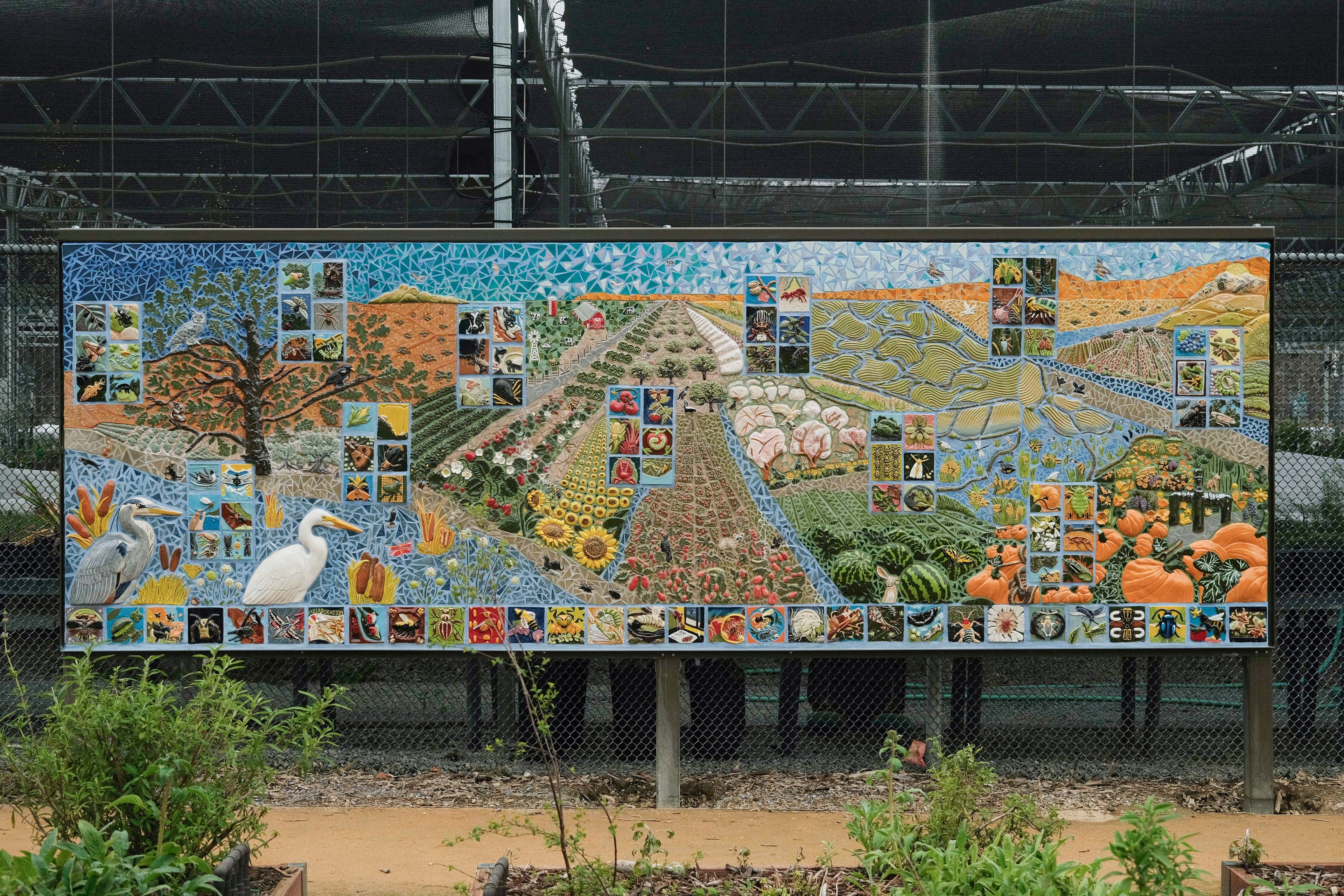
Assistant Professor Emily Meineke led the project with the help of students and volunteers
By JONAH BERMAN – arts@theaggie.org
On Feb. 21, the UC Davis Arboretum Teaching Nursery unveiled a new artwork: a pair of panoramic murals depicting coastal California and the Central Valley, intended to represent the biodiversity of both regions. The unveiling took place on Biodiversity Museum Day, an annual celebration of the university’s many nature-centered museums and collections.
The creation of the murals was led by Emily Meineke, an assistant professor of
Urban Landscape Entomology. Within the nursery, the artwork can be found behind another of Meineke’s projects: the Climate Adaptation Living Lab (CALL) Garden, which seeks to examine how different flora will react to decreasing water levels as climate change accelerates.
She worked to create the piece with the assistance of volunteers and students in the entomology (ENT) 001 course, aptly titled “Art, Science & the World of Insects.”
“If you imagine a traditional entomology lab, you might learn what a butterfly is versus a beetle versus a fly,” Meineke said. “And those are really important things for people who are going into entomology. But this is a non-major class, so really the goal we have is to have students appreciate insects and find ways to interact with them positively.”
For the murals, students were assigned to work on specific insect species, with an emphasis on species studied at UC Davis. One of these students was Yaretzi Arias-Luna, a second-year sociology and psychology double major. Her assigned species was Triops longicaudatus, also known as the tadpole shrimp.
“I wanted to find a class that would help me get in touch with my creativity again,” Arias-Luna said. “When I found the class, it seemed interesting because it incorporated insects, and I had never really learned about insects before. Honestly, I felt like it was a really good time for everyone to get in tune with themselves and their creative skills.”
The students used the lab portion of the class to learn techniques for working with clay materials. The introduction of artistic skills was deliberately paired with education about these unique species that are emblematic of California’s rich biodiversity.
“Those students are teaching each other about their insects,” Meineke said. “And then they use that knowledge to create some sort of design.”
The students finished their designs by adding underglaze to color their 5-by-5 inch square tiles, which were then placed adjacent to plants associated with those insects. The intersection of entomology education with this artistic process aimed to benefit the students’ learning experiences. Meineke noted, for example, that many students who end up being the most passionate do not have an extensive background in claymaking or visual arts at all.
“We believe these art projects help to teach students the science in a way we’re not going to get in a traditional science lab,” Meineke said. “This type of learning emphasizes a lot of agency, and the students get a lot more than just the science education.”
After the class concluded and the students finished their tiles, volunteers took over to complete the remaining mural design.
“The volunteers really have a very strong role in our program,” Meineke said. “They help us design the mural, they install things, they grout, they create. So they really are artists in their own right.”
A volunteer who significantly assisted with the design was Gale Okumura, a former lecturer in the UC Davis Design Department. She worked for over a year to draft and coordinate the color palettes for the murals, which are 15 feet wide and 5 feet tall.
Distinguished Professor Emerita of Entomology Diane UIlman, who contributed to the mural process, remarked on Okumura’s contributions.
“When you look at [the murals] and you see the professionalism that is represented in the designs, we can turn to [Okumura] and thank her for that,” Ullman said. “She leads us through a whole collaborative process in making those designs a reality.”
Meineke’s plans for the murals extend to more in-depth educational opportunities, which could allow visitors to form a better understanding of California’s biodiversity.
“What we want for the murals is for people to be able to go up to them and put their phone up and click on individual insects and have information about them pop up,” Meineke said. “We don’t have that quite yet, so for right now we’re coming up with signage that describes the mural and the garden.”
In the future, Meineke plans to install two additional murals, which will represent the Sierra Nevada mountain range and climate-ready plants. When completed, this quartet will represent a kaleidoscopic view of insect and plant species diversity across our state.
“Insects go pretty unnoticed, and some of them that we have on the murals are not that common anymore,” Meineke said. “They hopefully serve the purpose of getting people excited about the diversity we have in our state that you can’t see. The diversity here is really, really, special.”
Written By: Jonah Berman — arts@theaggie.org