






Students, sexual assault survivors hold Oct. 8 protest against campus rape culture
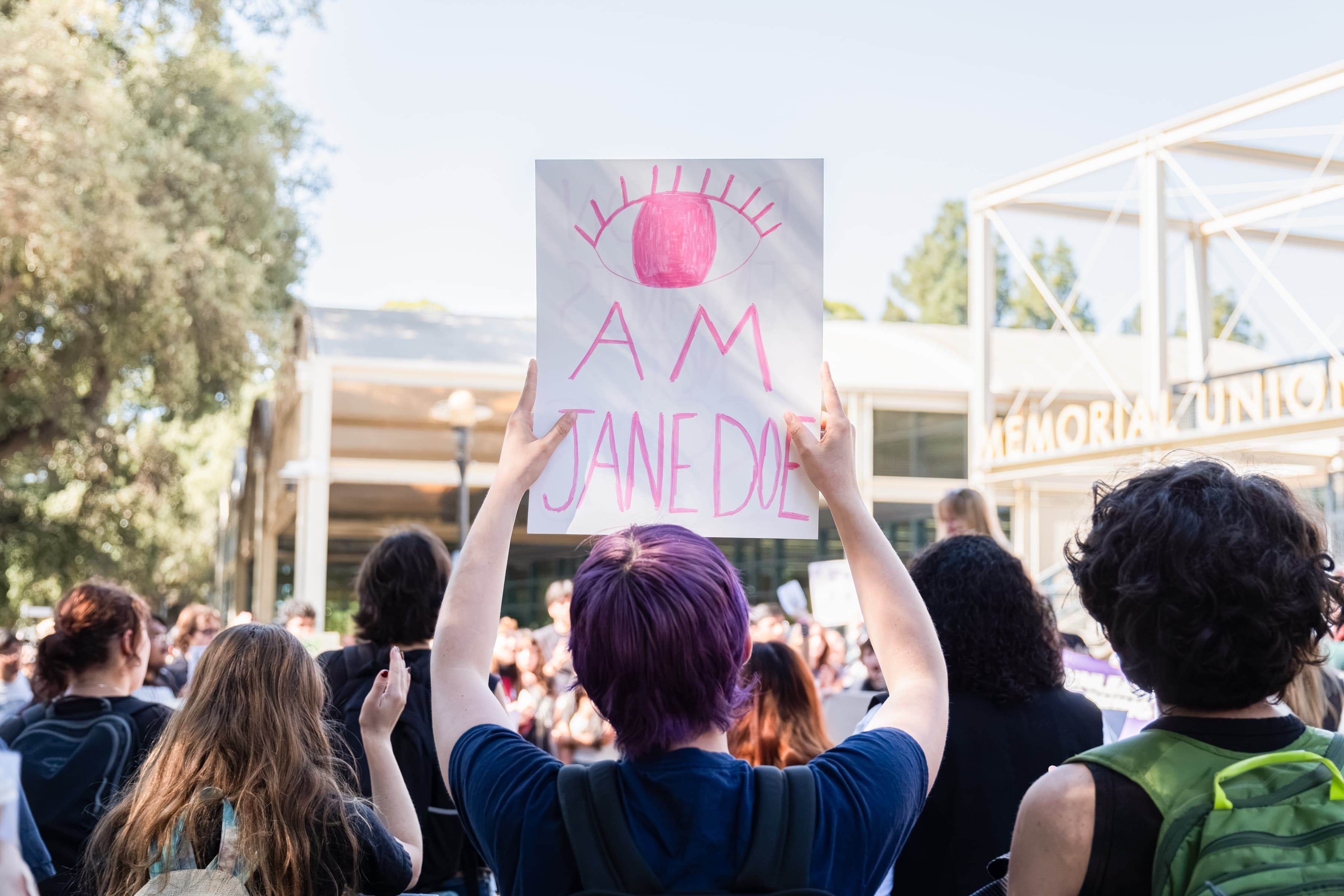
UC Davis students joined nationwide demonstrations in the wake of the Cornell Seven case
By KHADEEJAH KHAN AND VINCE BASADA — campus@theaggie.org
Around 150 students gathered at the Memorial Union’s South Patio for a demonstration and march Thursday, Oct. 8, protesting sexual violence at college campuses in light of the Cornell Seven rape case.
The rally began at noon, with protestors chanting, “Women hold up half the sky, Hear a revolution cry,” and, “One struggle, One fight, Women’s struggle, Women’s rights.” Several speakers — from student leaders to sexual assault survivors — took turns addressing the crowd, including CJ Barles, a third-year psychology and sociology major on the board of Students for Reproductive Freedom (SRF).
“I've gained this weight of having to carry this burden of not knowing whether my body is truly my own,” Barles, who has faced sexual abuse in the past, said. “I thought I was doing something wrong each time, and I thought it was a normal thing to encounter.”
Thursday’s protest was one of several demonstrations at universities and colleges across the country spurred by the Cornell Seven. The case centers around the allegations of an anonymous former Cornell student, referred to as Jane Doe, who says that seven members of Cornell’s Chi Phi fraternity drugged and gang raped her in October 2024.
While several members of the fraternity were either suspended or expelled, no criminal charges were brought against the men at the time the incident was first reported. The case came to national attention after Doe filed a civil suit against Cornell and the seven fraternity members last month.
UC Davis’ protest was primarily organized by SRF, with several other groups — including the ASUCD Gender and Sexuality Commission, Students for Justice in Palestine, Revolutionary Student Organization and the Davis College Democrats — serving as co-organizers.
“It was really powerful to see so many people show up to rally against sexual violence,” SRF President Elise Pardue, a fourth-year political science and gender, sexuality and women’s studies double major, said. “I think having people share their stories [and] having people share their anger is really powerful for the movement. I’m glad we had this place for people to come to.”
ASUCD Gender & Sexuality Commission Chairperson Vanessa Sandoval, a fourth-year environmental science and management major, was grateful to see the coalitions of student organizers that have come together to protest sexual violence on campus. One of the commission’s goals is to implement the Five Pillars of Consent across campus, which state that consent is freely given, reversible, enthusiastic, specific and informed.
“If every student at UC Davis can say without even having to blink that consent is all of these things, wouldn't we have a safer campus?” Sandoval said. “Wouldn't we have a better culture and more [commitment] to ending rape culture?”
Organizers of the protest have made several demands to the university, which include calling for a statement from Chancellor Gary May denouncing the Cornell Seven, for the ASUCD Senate to pass a resolution stating their commitment to preventing sexual assault and for widespread improvements to be made to on-campus lighting by the end of the school year.
“We just want to hear from our leader of our campus saying: ‘We see what’s happening in other schools,’” Pardue said. “‘We see how survivors are being betrayed and ignored, and that’s not gonna happen here. I am a chancellor who’s gonna stand up for survivors and hold rapists accountable.’”
A UC Davis spokesperson later shared with The California Aggie that university administrators received a copy of the protestors' demands and were reviewing the group’s request. They also said that UC Davis has been upgrading lighting on campus based on community input since 2023.
Organizers are also calling on the UC Davis Interfraternity Council, which governs 10 of UC Davis’ social fraternities, to adopt the Five Pillars of Consent in its programming. In a statement, The Interfraternity Council said that many of their fraternities have already written the pillars into their bylaws and that it would force those who had not yet done so to adopt them. They also said that IFC chapters without a sexual assault prevention officer would be required to instill one by the end of fall quarter.
“We recognize that this is an issue our entire community needs to contribute to in order to ensure a safe environment,” the IFC said. “This is just a part of the long process of making our community safer, which we have worked hard on by partnering with Safeparty and ASUCD on programming and frequent informational meetings over the past couple of years.”
Aside from speakers from student organizations, organizers invited survivors and those in the crowd to share their experiences.
“I lived in Cuarto, and I know I’m not one, not two, not three, not four, not five cases of rape in the dorms,” Ruben Torres, a second-year neurobiology, physiology and biology major and speaker, said. “Everyone knew, the RA’s knew, the whole floor knew and nothing was done.”
Attendees like Hannah Brunetti, a third-year anthropology major, found it powerful how each speaker’s story inspired more people to use their voice.
“I just wanted to come around and support other women and be there for people,” Brunetti said. “It was really nice to just hear other people express their stories and know that other people have the same experiences.”
Around 12:30 p.m., the crowd marched to Mrak Hall, where speakers asked protestors to stand against systemic sexual violence committed during Israel’s ongoing genocide in Palestine.
“I have heard firsthand accounts of the violent settler rape Palestinian women and children face, especially during the ongoing genocide,” Helena Awwad, an ASUCD senator and second-year international relations and Middle East/South Asia studies major, said. “As a Palestinian with hundreds of female relatives, I know what they’ve been through, and I ask that you extend your feminism and your views to not only the people in our community, but the people internationally [who] do not have a voice right now.”
Outside Mrak Hall, protestors shouted “Fuck Gary May,” with one speaker denouncing women inside the administration building who were watching the crowd without participating. The crowd marched back to the Memorial Union around 1 p.m. and dissolved shortly afterward, but many protestors say that the work of tackling campus rape culture needs to continue on.
“Because student voices and student advocacy [have] been able to go to the institutions and hopefully hold these institutions more accountable, I think we can see a common trend that will rise — that students need to continue being advocates in order to push the boundaries of how much accountability universities have,” Sandoval said. “We need to be brave.”
Written by: Khadeejah Khan and Vince Basada — campus@theaggie.org