






Smash all the mirrors
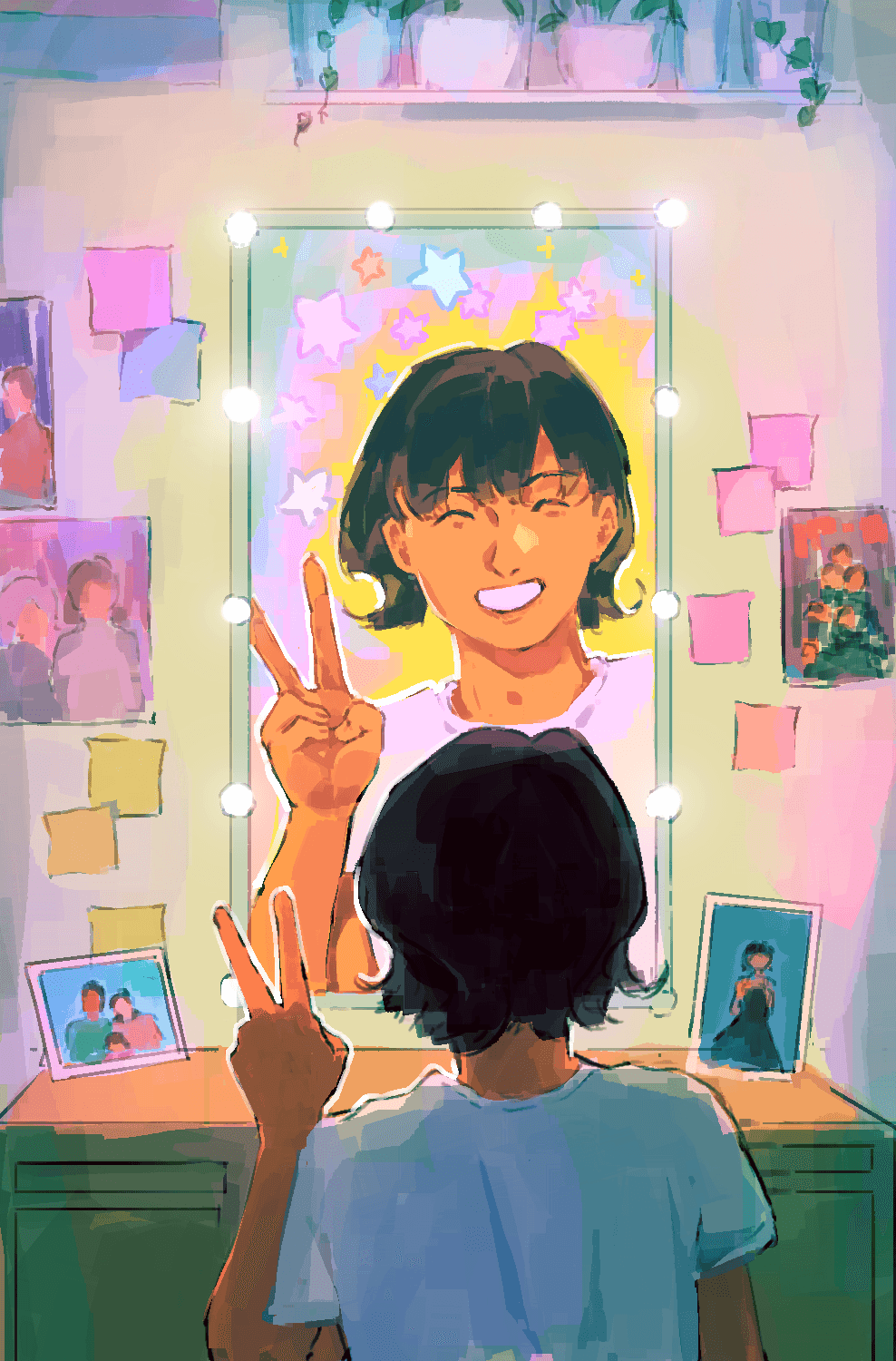
Radical self-acceptance in a time of constant surveillance
By AMBER DUHS — alduhs@ucdavis.edu
Often, when I’m walking to class, working on campus or studying in the library, a close friend will notice me from afar. Spotting me excitedly, they’ll snap a photo and send it off to our group chat — relishing in the sighting, knowing that by next week I, too, will have an analogous photo of them. Similarly, when I go dancing with my friends or head to the occasional house show, I receive a plethora of images and videos documenting our evening — a well-curated mix of posed and candid shots. While all in good taste, I can’t help but notice that between the social media posts, constant documentation and culture surrounding self-image, we currently see more of ourselves than ever before.
I’m sure we’ve all experienced seeing an embarrassing photo of ourselves uploaded to a shared album: A particularly unflattering angle, a moment where you rested your shoulders and slumped into the comfort of poor posture or, worst of all, a snapshot mid-reaction — who was going to tell me I looked like that? Under the watchful eye of cell-phone cameras and the oh-so flattering digital camera, we’ve slowly (and accidentally) stumbled into a time of overwhelming surveillance.
We were never meant to live in such constant self-perception. Every way we turn there’s a mirror or a camera — a magnifying glass for our self-image. The more we look at ourselves, the more we process the intricacies of our own likeness and criticize every little atom of our bodies we decide isn’t up to par. This constant exposure to our reflections can cause anxiety — who else notices these details? What do they think of them, and what do we need to do to change them? Between the increased self-awareness, the anxiety that follows and the self-consciousness that then develops, we’ve created a world in which our appearance has to be at the forefront of our minds.
The progression from processing that we constantly have access to millions of angles of ourselves, to becoming exceedingly preoccupied with how we look is one that's developed in real time. The rise and popularity of social media has greatly contributed to this, creating a platform devoted to curated images and videos of everyone, whether you know them or not. Whether it's professional influencers or someone you simply went to high school with, we find and exploit any avenue that allows us to constantly compare ourselves to others.
Instead of reevaluating why we place such instrumental value on physical appearance and why we continuously feed into it via social media, we create and sell “quick-fixes.” From wearing teeth-whitening strips, using gua-shas to tighten jawlines or taking Ozempic to dissolve fat, there’s constantly new messaging pushing us to believe that our bodies need to be altered, feeding into this obsession and anxiety. The simple choice to accept our body the way it is has become a radical concept.
At the end of the day, those photos aren’t accurate representations of our whole selves — they’re small snapshots of split-second moments that, in real-time, would likely never be remembered. While it may not feel like it, we all make a conscious choice the moment we see that photo: To judge ourselves and pick apart every inch of imperfection, or to acknowledge that it’s an inaccurate moment preserved of us. Not only that, but they’re preserved memories. The images aren’t meant to remind you that your jawline needs to be tighter, but that you had a picnic with your friends and smiled the entire walk home.
In an attempt to save my mental sanity from cartwheeling each time one of those unflattering photos lands in my phone, I’ve decided to adopt this radical self-love. From the growing body-positivity movement, which emphasizes self-love, to body neutrality, which removes any moral language surrounding our self-image, we’re slowly making attempts to move away from body obsession.
It isn’t our job to actively review and redetermine if our bodies are worthy of being positively perceived by others, regardless of what new angles were discovered that day. I choose to not feed into the obsession — to not subject my self-worth to the ups and downs of my self-esteem.
Choose to believe that regardless of how you look, you have innate self-worth and thus are worth feeling confident and secure in your own natural body. Choose not to ignore the photos of yourself, but instead change your mindset towards them — change the meaning and value you put behind your appearance. Choose yourself, and choose it despite what the internal whisperings of self-doubt may tell you.
Written by Amber Duhs — alduhs@ucdavis.edu
Disclaimer: The views and opinions expressed by individual columnists belong to the columnists alone and do not necessarily indicate the views and opinions held by The California Aggie.