



Author and UC Davis professor Archana Maniar discusses “The Lost Photograph” at The Avid Reader
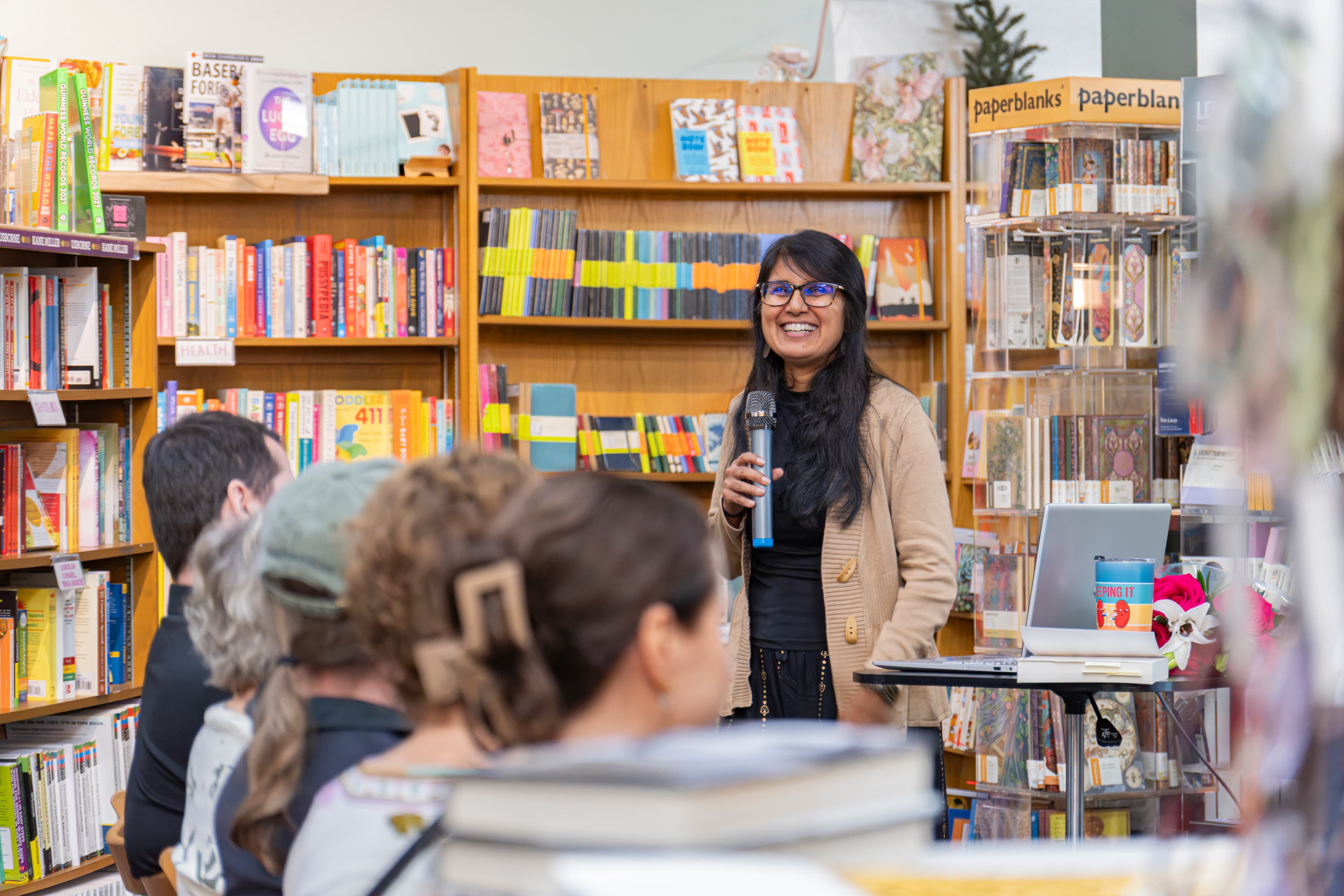
Maniar spoke about her new historical fiction novel and the remarkable women whose stories inspired it
By IQRA AHMAD — arts@theaggie.org
On Oct. 9, UC Davis professor of medicine and author Archana Maniar made an appearance at The Avid Reader to discuss her second novel, “The Lost Photograph” — a historical fiction novel that explores the roles of women in India’s independence movement during the 1920s.
Maniar, a professor of medicine and infectious disease specialist at UC Davis Health, described how her research led her to uncover the lives of pioneering women, political activists and freedom fighters who challenged British colonial rule and the social restrictions placed on women within the movement.
“What I find is that when you do the research, the history is always far more remarkable than you think it’s going to be,” Maniar said. “These women were really willing to put themselves on the line, oftentimes being separated from their kids and households while they were incarcerated.”
When asked about what she wants readers to take away from her novel, Maniar explained that historical fiction offers an opportunity to revisit past narratives and ask whose perspectives have been overlooked or uncovered.
“I would want people to think about who gets to tell history and whose story is missing from history,” Maniar said. “If there is one strength about historical fiction, it’s that we get to take what we know about human nature, human aspirations and dreams, and we get to put that into a story in a way that the history books can’t.”
“The Lost Photograph” is tethered across two timelines, linking modern-day Boston, Massachusetts with Bombay, India during the independence movement.
The novel follows Jaanvi Chowdhury, an overworked surgeon who discovers an old photograph and letters while looking through her attic. The image shows a woman who bears a striking resemblance to her, standing outside the London School of Medicine for Women in the 1920s. That woman is Kalyani Joshi, Jaanvi’s great aunt whose life takes Jaanvi on a journey into her family’s past.
Through Kalyani’s experiences, the novel explores the many challenges facing Indian women who pursued medicine, the growing resistance to the British role and the complicated relationship between integrating women into resistance efforts. A third major character, Alexander, the son of a Scottish missionary, adds another perspective between the alternating timelines.
Maniar explained that the idea for the novel originated in a South Asian history course she took at UCLA. The class challenged Maniar’s understanding of India’s independence movement, which is often associated with Mahatma Gandhi and his philosophy of nonviolent resistance.
She learned that the movement was influenced by divisions involving religion and the caste system, and that women also maintained a significant role in organizing protests and demanding political change through action.
Much of Maniar’s presentation during the event focused on the stories of the real women who inspired her characters. Among them was Dr. Rukhmabai Raut, an early Indian woman physician who challenged child marriage before travelling to Britain to study medicine. Another inspiration was Dr. Muthulakshmi Reddy, a physician and women’s rights advocate who overcame social barriers to pursue medicine and later entered politics. Reddy was the main inspiration for Kalyani Joshi.
“She was the first Indian woman to attend a male medical school in India and if that wasn’t enough, she was a very early proponent of the concept of women’s health,” Maniar said. “She opened a facility to help women who were undergoing treatment for gynecological malignancies and wound up being the first female legislator for British India.”
Maniar also highlighted the efforts of Kamaldevi Chattopadhyay, an independence activist who organized women to participate in civil disobedience campaigns against the salt tax.
“I think I underestimated some of the characters that I was researching, and it was only when I read the autobiography of Kamaladevi that I realized they were really out there on the front lines expecting to get beaten down,” Maniar said.
These discoveries and thorough research influenced the intensity of the scenes Maniar ultimately described in her book.
One of the central discussions of the event pertained to the “salt satyagraha,” or the salt march, a nonviolent civil disobedience movement that challenged British colonial restrictions on the production and sale of salt by Indians.
Maniar explained the importance of salt and its transformation into a symbol of resistance because it was an everyday necessity shared by people across India’s religious and economic divisions. She described how women gathered along the shores of Bombay, collecting seawater and boiling it in makeshift stoves to produce salt in defiance of British law.
Maniar’s research extended to the practical details of everyday life during colonial rule, including transportation routes, inheritance laws, labor movements and the roles of Scottish missionaries in colonial India. To capture details accurately, she studied historic tram maps to determine how her characters would travel throughout the city.
Alongside the discussion of compiling and analyzing various documents and historical accounts, audience members were curious about how Maniar balances her literary career and her work as a physician and family responsibilities.
“I have everything meticulously outlined because I never want to sit in front of the computer and not know what I’m going to write for the day,” Maniar said. “I always have a very detailed outline, but I’m always open to changing it because the characters do start to take on a life of their own.”
As the evening concluded with a Q&A session, a group photograph and book signing, Maniar returned to the question that had guided much of her discussion: who has the power to shape the way history is remembered?
Maniar stated that for her, the purpose of historical fiction is not simply to recreate the past, but to invite readers to reconsider the stories they have inherited and the voices that may have been left out.
“The Lost Photograph” is now available for purchase. The Avid Reader is scheduled to host author Seth Fleisher on Oct. 24 at 6:30 p.m. to discuss his novel “The Farther Shore” and author S.E. Wendel on Nov. 10 at 6:30 p.m. to discuss her novel “Heartsworn.”
Written by: Iqra Ahmad — arts@theaggie.org