




The Basement Gallery turns the lights off in new exhibition ‘About Looking’
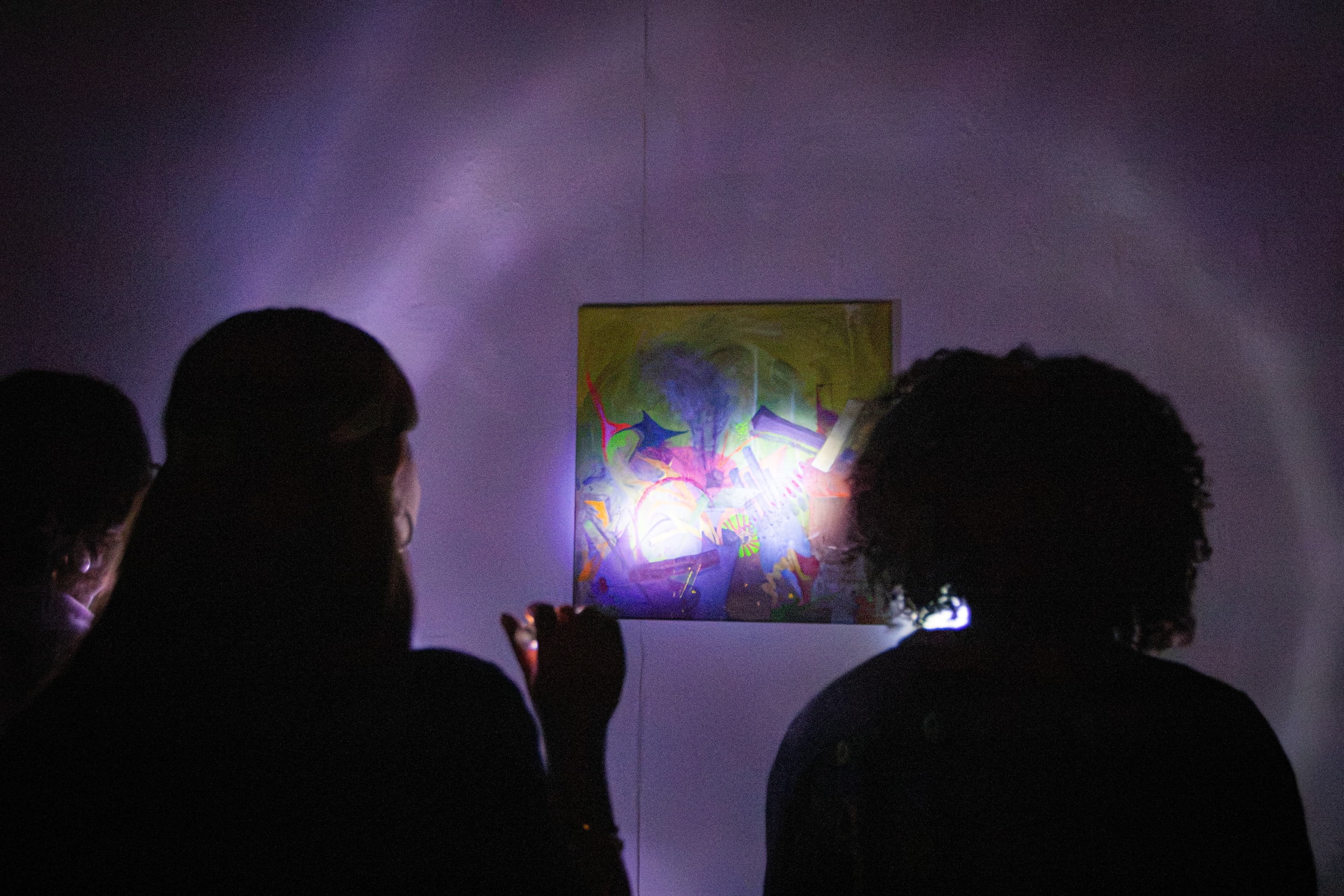
The inaugural exhibition is part of a broader effort to experiment with how art is presented and encountered
By MOLLY WILKINSON — arts@theaggie.org
On Oct. 23 from 5 p.m. to 8 p.m., The Basement Gallery — a student-run space dedicated to undergraduate art — held an opening reception for its inaugural exhibition of the academic year: “About Looking.” The show embraced an unconventional viewing experience, as visitors navigated the gallery by flashlight in near-total darkness.
Co-Director and Lead Preparator Nathan Henry explained that “About Looking” explored how perception is never neutral; identity, experience and memory shape how we see and interpret art. Acknowledging the intrinsic subjectivity of perception may help people consider alternative perspectives and ways of relating to others.
“Where I am, who I am, where I come from, all these factors, all these conditions, give rise to the way that I perceive the world,” Henry said. “I think that garners empathy because it allows you to realize that other modes of looking are possible and other ways of relating are possible.”
The exhibition took its title from John Berger’s book “About Looking,” which was also a key influence on its portrayal of the implications of observation. Its intellectual foundation also drew on philosopher Édouard Glissant’s “Poetics of Relation,” specifically the chapter “For Opacity,” which Henry encountered during a residency. Glissant challenged the assumption that understanding someone means having access to every part of who they are.
“[Glissant] was talking about this idea of opacity and the right to opacity, the right to remain unknowable,” Henry said. “And the way that we can still meaningfully relate to things — identities, histories, whatever — without having full transparency and gaining full access.”
The gallery displayed 21 pieces by 20 artists, with work spanning painting, sculpture, photography, mixed media, cyanotype, charcoal and linocut. This reflects the range of work welcomed through its open calls, which take submissions from undergraduates of all majors.
Co-Director and Lead Archivist Margaret Mariani explained that artists interpreted the exhibition’s theme in different ways.
“Some people take the theme ‘about looking’ more literally than others,” Mariani said. “Some of the art literally has eyes in it.”
Max Rocero, a third-year art studio major, took a more conceptual approach. His woven drawing combined the Golden Gate Bridge with palm trees recalled from visits to the Philippines, bringing together the two places that have shaped his identity.
“I was trying to figure out how I feel about not knowing a lot about where I came from,” Rocero said. “I grew up knowing I was Filipino and having a bit of that culture, but being in the Bay Area my whole life, I've been pretty Americanized. I was grappling with that and realizing that I don't have to change anything about the way I am.”
By concealing parts of each drawing, Rocero’s weaving technique made Glissant’s concept of opacity tangible — the composite image invited viewers to engage with the work without revealing the full story behind it.
“The process of weaving covers up roughly half of each drawing, but then makes something completely different as a composite of those two,” Rocero said. “I thought that related to the theme in that you don't really know what's underneath there, and you could either guess at it or you can just look at it as a whole and accept that you don’t know.”
The exhibition’s central curatorial feature was its use of light. While navigating the darkened gallery with a flashlight, visitors naturally chose which artworks and details to illuminate. This turned the show’s intellectual premise — that looking involves focusing on select things while overlooking others — into a tangible experience, decentering the assumption that sight provides a neutral, objective view of the world.
“The show uses darkness as a device to reveal these structures that give rise to our perception,” Henry said. “It highlights how there's a kind of authorship involved in everything that we look at. If we look at something it also means that we're omitting something else. Everybody sees a different exhibition this way.”
This approach exemplified the team’s broader curatorial attitude for the year — pushing the envelope — which Henry described as a commitment to unconventional installation, intellectual ambition and active engagement.
“I came up with the theme because I felt a need for more critical thinking in the gallery space, for more ambitious projects and unconventional modes of installing and viewing work,” Henry said. “We’re thinking about how [a display] can be choreographed in a way that's conceptually relevant to the ideas being discussed in a given show. How can an exhibition be an encounter that you're wrestling with, rather than something light that doesn't require anything from you?”
Starting this year, The Basement Gallery is hosting conversation clubs alongside its exhibitions. These discussions are an extension of the gallery’s philosophy; bringing together students, faculty and visitors to think critically about a given exhibition and engage in meaningful discussion.
The first session, in tandem with “About Looking,” took place on Oct. 29 from 6 p.m. to 8 p.m. For Mariani, it extended the exhibition’s exploration of perception into collective discussion.
“The things that we see go through our memories, our perspectives, and then come out the other end as an art piece, or as a conversation,” Mariani said.
Henry explained that the sessions use a “cold read” style, where artists contribute their perspectives without providing all the answers.
“We want space to develop our own answers,” Henry said. “[Participants build] a greater language, a greater vocabulary to put toward thinking about the work and the exhibition.”
Henry described these conversations as particularly valuable for artists, who can use others’ interpretations of their work to inform their creative processes.
“To be able to read a work and see how other people are reading it is extremely beneficial for artists,” Henry said. “Maybe they're able to articulate something about your work that you've been trying to articulate for months and you can go back in the studio and push for that. Or maybe they misread it, and you can use that and develop your work accordingly.”
The gallery also plans to host film screenings once or twice during the quarter, creating a more casual, social atmosphere in which visitors can engage with its ideas. These will feature short films that carry forward the themes explored in recent exhibitions.
“About Looking” is just one expression of The Basement Gallery’s ongoing commitment to experimentation and intellectual rigor. Follow their Instagram @ucd_basement_gallery for updates on future exhibitions, conversation clubs and film screenings.
Written by: Molly Wilkinson — arts@theaggie.org