






The UC Davis Design Museum welcomes textile artist Lynn Setterington with ‘Connecting Threads (together)’
The exhibit spans decades of socially engaged textile work exploring community, memory, identity and the everyday
By MOLLY WILKINSON — arts@theaggie.org
British textile artist Lynn Setterington’s “Connecting Threads (together)” is on view through Nov. 20 at the UC Davis Design Museum in Room 124 of Cruess Hall. Admission is free and open to the public Monday through Friday from noon to 4 p.m.
UC Davis’s showing of “Connecting Threads (together)” is the fifth and final iteration of an exhibition first presented at the Fashion and Textile Museum in London in March 2025. It traces Setterington’s decades-long career, spanning independent and collaborative work and recurring interests in community, identity, memory and domesticity.
A five-part film component, made by director Mary Stark, documents the people and processes behind Setterington’s work.
“[The films] are a way to bring the people with me,” Setterington said. “I think it’s important to show the involvement of people, because you often see a finished product, but you don't see who's actually made it.”
The exhibition also features work by UC Davis students, a decision that continuing lecturer and co-curator Susan Abplanalp said reflects the exhibition’s broader focus on community.
“‘Connecting Threads’ is a lot about students and community members, so I think it's really important to, whenever possible, include student work,” Abplanalp said.
“That was one of the things that I curated for the show.”
Setterington’s work in the 1990s with Asian women’s groups in Britain, including women from Bengal and India, showed her that embroidery could connect people across linguistic and cultural differences.
“They didn't speak much English; I didn't speak much Bengali,” Setterington said. “But we had stitch; that was our common language.”
Those early projects became the catalyst for a largely collaborative practice that has since taken her into schools, libraries, health centers and galleries around the world.
Among the pieces that emerged from such collaboration is a series inspired by signature cloths, which Setterington first encountered during a fellowship at the International Quilt Museum in Nebraska.
“[Signature cloths] started in the mid-1800s when American settlers were moving west and leaving behind their old communities,” Setterington said. “People made these quilts with their signatures as a way to remember the people they were leaving behind.”
That practice informed “Threads of Identity,” a banner created in 2016 with students at Burnage Academy for Boys that commemorates the 30th anniversary of the death of former student Ahmed Iqbal Ullah.
The banner is assembled from individual handkerchiefs, each bearing a letter from the school’s name and embroidered with signatures collected by the students from people significant to them.
The discovery of Ahmed’s old diaries, and subsequently his signature, made the act of remembrance even more remarkably tangible.
“Poignantly, as the project was coming to an end, somebody discovered Ahmed’s signature in one of the diaries they found while researching his life,” Setterington said.
“So I stitched one handkerchief in memory [of Ahmed] with his dates [of birth and death] on it and copied his signature. It made the connection to him real and concrete.”
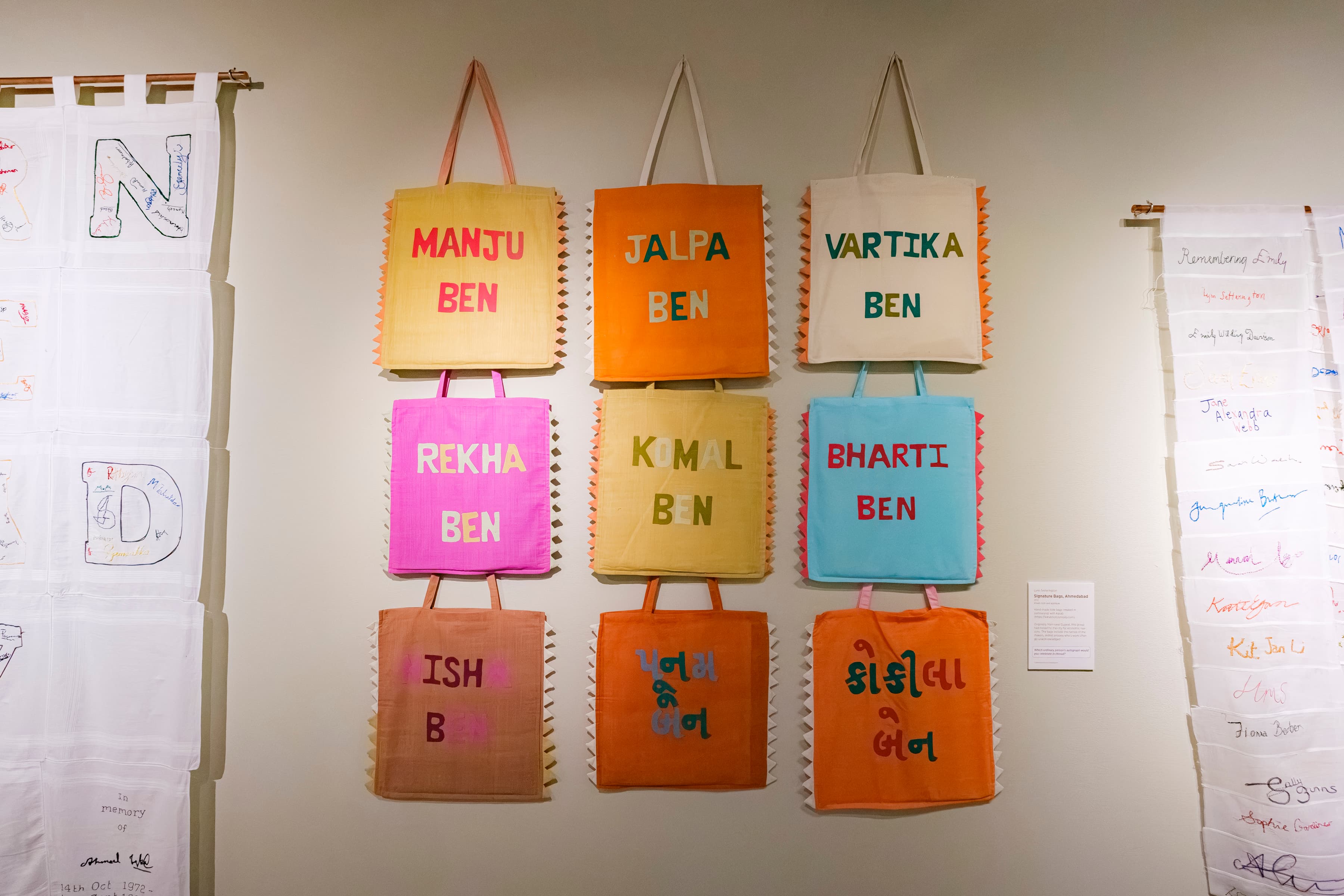
Nearby, “Signature Bags, Ahmedabad,” a selection of handmade tote bags created in partnership with female artisans in Ahmedabad, India, uses the signature as a means of recognition. Each bag is stitched with the name of the woman who made it, acknowledging the makers whose labor might otherwise go unrecognized.
“They’re really skilled women, and I got them to put their names on [the bags] because they’re so often overlooked and they don't have much visibility,” Setterington said.
Setterington also uses embroidery to draw attention to everyday objects and repurposed materials, as with her early engagement with kantha quilts, a Bengali folk art traditionally made from fabric scraps and recycled saris.
The five kantha quilts on display reflect Setterington’s broader interest in making ordinary materials and items worthy of attention. She depicts familiar objects like hairdryers and kitchen utensils, as well as traditional practices like shoe shining.
“That’s a theme throughout my work: celebration of the everyday,” Setterington said. “It’s not about fancy things; it's ordinary life, what we have around us every day, what we take for granted but is very much part of our lives.”
That attention to overlooked materials appears in her more recent work with netting used in the construction industry, which she tears into threads and incorporates into her work after learning that it’s often discarded.
“I discovered working with the construction industry that the net used to cover entire buildings is not recycled; it’s treated as waste,” Setterington said. “So I'm using it in a different way.”
A nearby wall of samples offers a glimpse into that experimentation, displaying different threads, materials and stitching techniques from Setterington’s creative process.
For Trevor Lance, the museum’s principal preparator, the sample wall highlights the tactile qualities of Setterington’s work.
“The sample wall is fantastic, all the different shapes sort of notch together to create a larger piece,” Lance said. “It’s not just two-dimensional textiles; there’s such a tactile element.”
The simplicity and accessibility of embroidery allow Setterington to focus on connecting with people rather than technique alone.
“I keep things inclusive and fairly simple because there are a lot of issues in the world at the minute, so being able to talk to people and share is really important,” Setterington said. “Stitch is quite a good way of doing that because it's inclusive, it's accessible, you don’t need fancy equipment and you can do it anywhere.”
An accompanying workshop hosted on Sept. 29 put that approach into practice, bringing together UC Davis students and community members to experiment with traditional and contemporary materials and techniques.
“I really enjoy having my students here participate in something other than classes,” Abplanalp said. “It's really nice to be able to see students being able to take more of a role.”
“Connecting Threads (together)” presents stitch as a language, a record, an acknowledgment and a celebration of the everyday, weaving together the people and stories that make up Setterington’s work.
Written by: Molly Wilkinson — arts@theaggie.org