






The furry flying friends under the Yolo Causeway
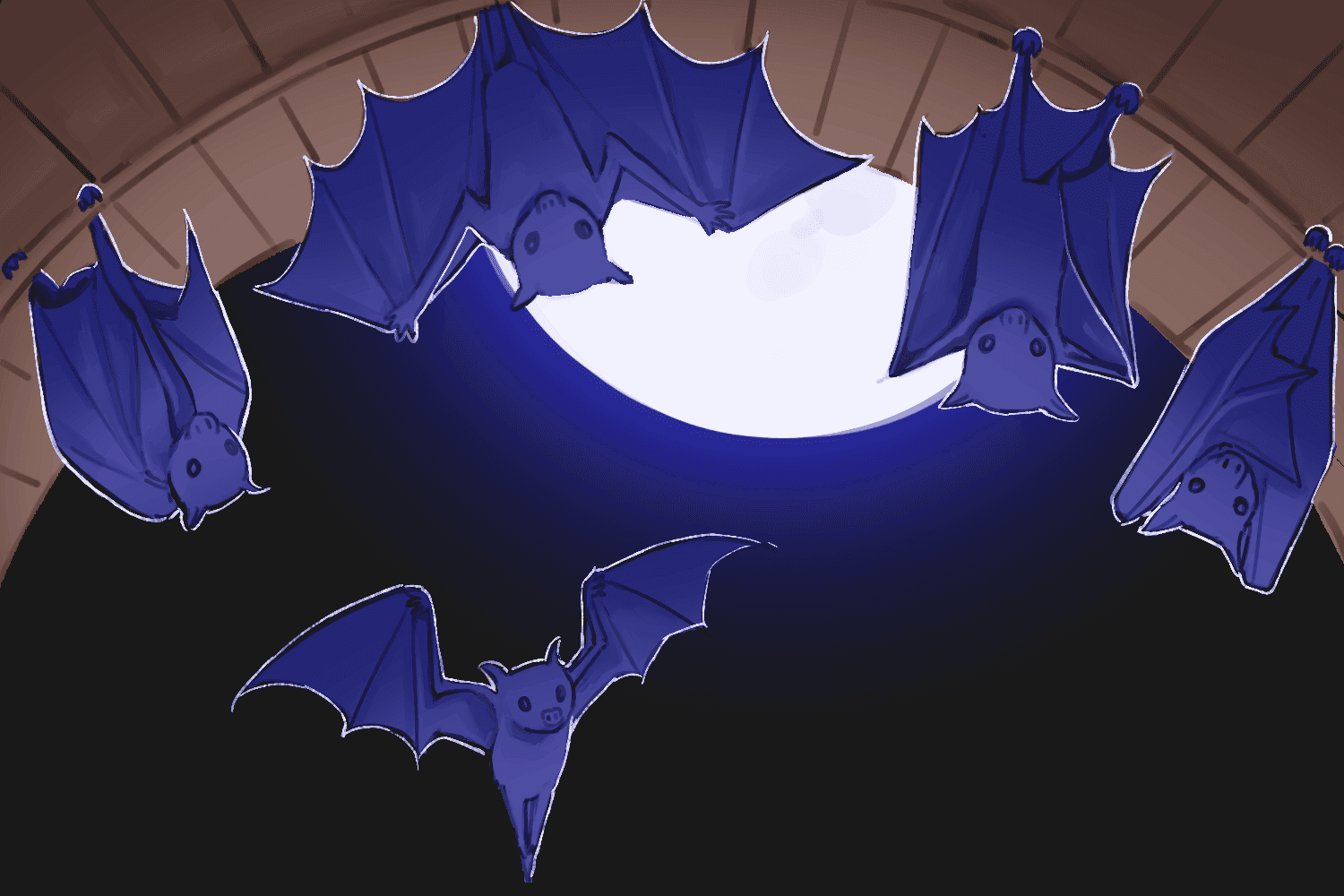
This week’s curiosity column dives into why bats hang upside down
By EMILIA ROSE— science@theaggie.org
The Yolo Causeway — commonly known as “the Causeway” among Davis and Sacramento residents — is a long stretch of highway along Interstate 80 connecting Davis and West Sacramento. While averaging nearly 150,000 commuters daily to and from Davis, the Causeway hosts an even larger population underneath it.
During the summer, roughly 250,000 Mexican free-tailed bats roost beneath the Causeway before emerging around sunset to hunt. Before they take to the sky, these bats spend most of their day hanging upside down.
Winifred Frick, a chief scientist at Bat Conservation International and a professor of ecology and evolutionary biology at the University of California, Santa Cruz, describes the simple reason bats hang upside down.
“Bats hang upside down when at rest or sleeping because it’s easier to take off into flight,” Frick said.
Bat Conservation International explains that bats can also hang without continuously using their muscles because tendons and ligaments in their feet help hold them in place.
If a human hangs upside down, blood rushes toward the head and can cause discomfort. Bats don’t have this issue; they are much smaller than humans, so there is less blood and a shorter distance between different parts of the body. Their circulation has also adapted to their upside-down lifestyle. Bat Conservation International notes that bats do not experience the same volume of blood movement as humans when inverted, though this can vary between species.
Further, “bats” are hardly one uniform group; there are a multitude of species, as Frick explained.
“Bats are incredibly diverse with over 1,500 known species and scientists are discovering new species every year,” Frick said.
The Mexican free-tailed bats beneath the Yolo Causeway are particularly comfortable around human structures. They commonly roost in bridges and other buildings, and they hunt flying insects over agricultural areas. A report by UC Berkeley and University of North Carolina at Charlotte ecologists on the same bat species at another Sacramento-area causeway shows how strongly the species return to such roosts. When construction began on the Franklin Boulevard Causeway in 2002, a colony of more than 60,000 bats was displaced. Two months after the construction was completed in 2004, more than 15,000 of the same bats returned to their roosts.
Beyond serving as our flying, furry neighbors, the bats play a larger role in the ecosystem. As they fly over farmlands, they prey on crop pests such as corn earworm and codling moth, both major threats to local crops. For Davis-area farmers, the colony beneath the Causeway may be doing some quiet pest control.
The next time you drive on the Causeway, don’t be alarmed when you see a large swarm of bats during the evening. Remember what was hanging just below the road: a colony of bats waking up and ready to take flight.
Written by: Emilia Rose — science@theaggie.org