





Students line up around UC Davis voting center to cast midterm ballots
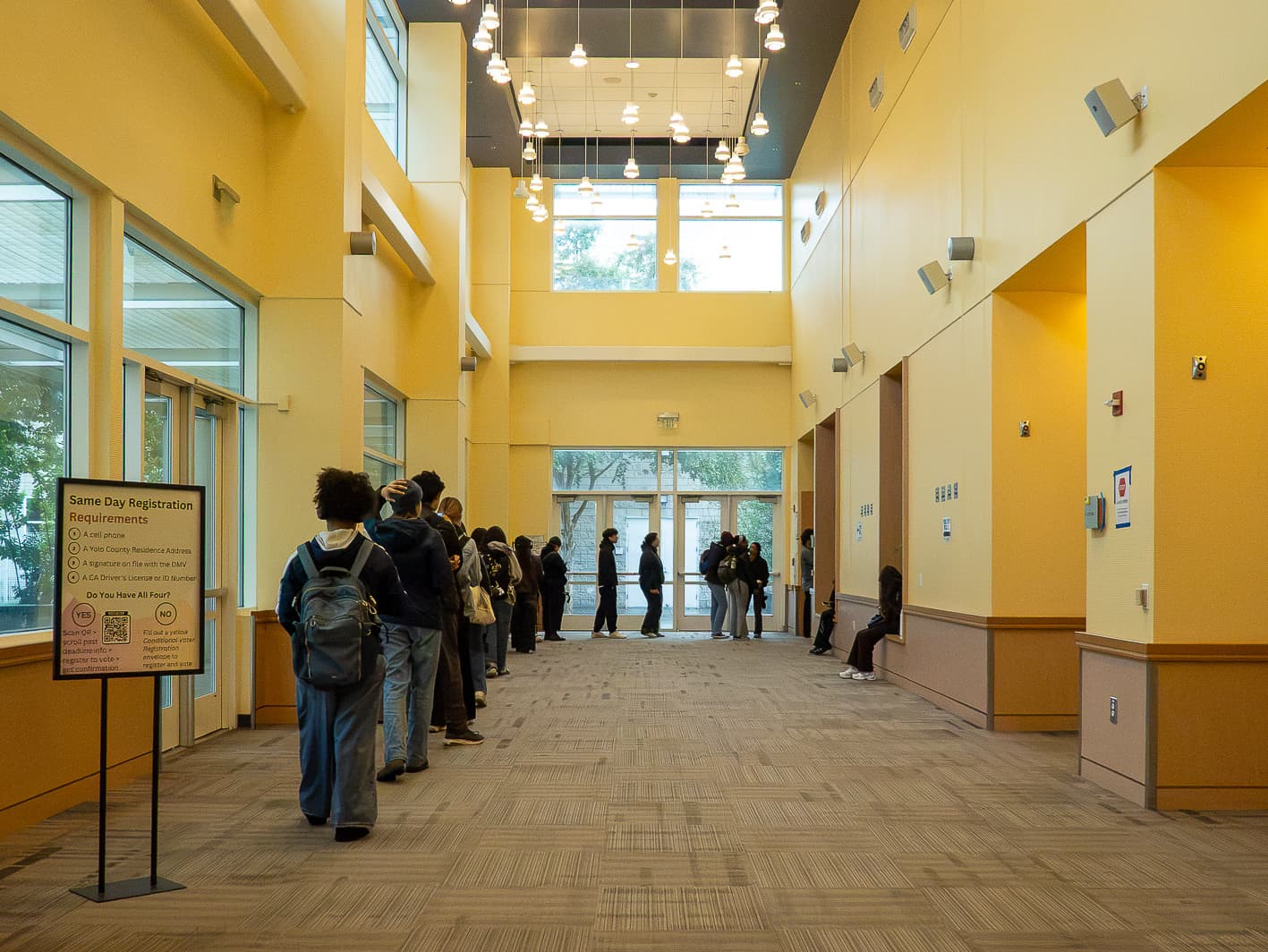
Campus polling sites saw long wait times throughout Election Day
By MEGAN WANG — campus@theaggie.org
On Nov. 3, long lines of students eagerly awaited to cast their ballots in the 2026 midterm elections, stretching well outside and around the Activities and Recreation Center (ARC). Throughout the day — from its opening at 7 a.m. to when polls closed at 8 p.m. — the voting centers saw a steady influx of returning and first-time voters.
Student turnout was high, with voters saying they were motivated by a wide variety of concerns — from local to national — and expressed a shared interest in participating in the democratic process.
“I think it’s important that we use our rights properly, and we speak up for the people,” Leila Gomez, a fourth-year sociology student, said while waiting in line to vote. “Not everyone gets the privilege to vote, and it’s really important that those of us that do use it.”
Throughout the country, young people consistently turned out to polling places — bucking the trend of lower youth participation in midterm elections compared to presidential elections. 27% of young people voted in the 2026 midterm elections, marking the second-highest midterm youth turnout in the past 30 years, according to the Center for Information and Research on Civic Learning and Engagement at Tufts University.
“I feel like people, especially our age, tend to not show up for midterms, especially in college towns just because it’s seen as less important,” Ashley Bembry, a third-year computer science major, said. “But you see everything that’s going on, especially in America right now, I think it’s very important that we show up and show out for what we want.”
At around 4 p.m., lines to vote extended outside the doors, with wait times reaching up to an hour. The ARC was one of two voting centers on-campus open on election day and during the days leading up to it, alongside the UC Davis Conference Center.
Students expressed a range of issues that motivated them to vote, from concerns over immigration enforcement to healthcare. When asked why she voted, first-time voter Seniya Tonah Simpson, a first-year biological science student, said that she was concerned over the recent surge in United States Immigration and Customs Enforcement activity across the nation.
“Honestly, it took a lot of research to know what I’m voting for,” Tonah Simpson said. “I grew up in a very predominantly Hispanic and Black neighborhood, so just being there for my people is really important.”
Others, like Emily Nguyen, a fourth-year neurobiology, physiology, and behavior major, cited an interest in influencing issues closer to home like Proposition 40.
“The new proposition came out where this is the first where we can vote on taxing billionaires,” Nguyen said. “I think that particularly compels me.”
Last Tuesday’s election was a resounding win for the Democratic Party, which took control of both houses of Congress, picking up 7 seats in the Senate and flipping more than 40 in the House of Representatives. The results have been called a “blue tsunami,” with the Republican Party losing Congressional seats across the country. Two Senate seats — in Alaska and Mississippi – remain uncalled as of late Tuesday, Nov. 10.
This election also marked a new era of Generation Z political officials, as 29-year-old Melat Kiros of Colorado became the first Gen Z woman elected to Congress. For the first time in American history, someone born in the 2000s was elected to Congress after 26-year-old Michael Alfonso won his bid for Wisconsin's 7th Congressional District.
When asked whether she felt that younger generations were adequately represented in politics, Bembry pointed to younger political figures, like New York City Mayor Zohran Mamdani, as a source of hope.
“I think we’ve all been inspired by new and younger nominees,” Bembry said. “Obviously we don’t have [Mamdani], but I think we’re definitely on our path to getting where we need to be.”
In California, Xavier Becerra was elected as the first Latino governor in the state’s history. In the race for California’s 4th Congressional District — which was redrawn after the passing of Proposition 50 last year and includes Yolo County — remains too close to call, though political newcomer Eric Jones maintained a narrow lead over incumbent Rep. Mike Thompson as of late Friday.
Back at UC Davis, Gomez emphasized the importance of every individual ballot, especially given the large voter turnout.
“I hear a lot that, ‘My vote doesn’t matter’ or like ‘So many other people vote, my one is not gonna matter,’” Gomez said. “But when you see everyone collectively together it takes everyone to be a part of that as a collective group. The majority is made up of individuals, and we are the individual, so taking part in that does matter.
Written by: Megan Wang — campus@theaggie.org