





Uncovering the true discoverer of the structure of life’s code
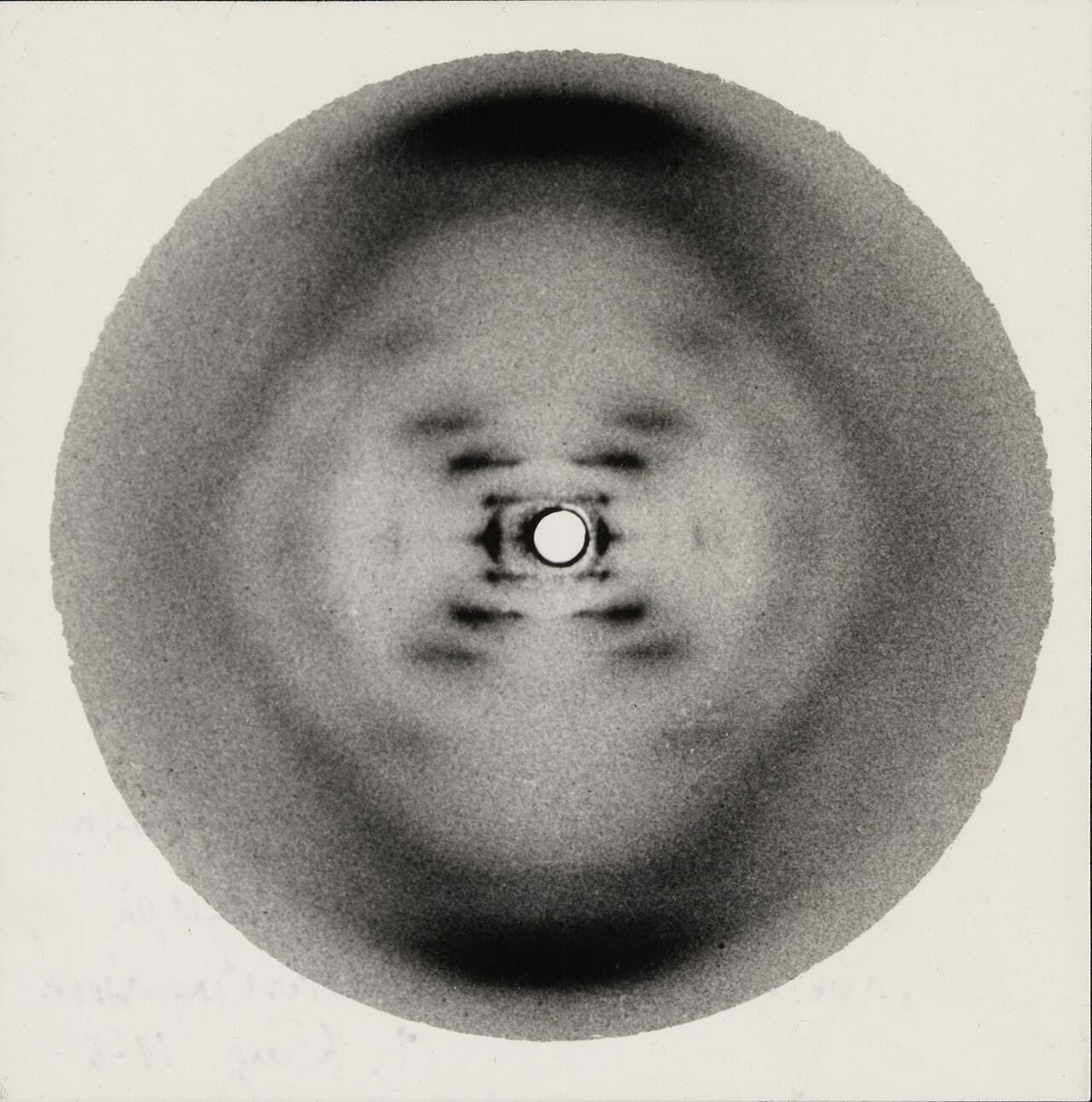
Rosalind Franklin’s unpublished Photograph 49 elucidates the first correct structure of DNA
By NETRA UMRANIKAR — science@theaggie.org
On Oct. 5, 2026, a report by Sponsel and Sutton from Rosalind Franklin’s alma mater, King’s College London, provided photographic evidence from Franklin’s notebooks that demonstrated she was aware of DNA’s helix form before James Watson and Francis Crick.
Deoxyribonucleic acid (DNA) is the genetic material in humans and other organisms. Early biologists struggled to accept DNA as genetic material due to its apparent simplicity in chemistry. In the 1950s, X-ray crystallography and diffraction were techniques used for determining the 3D atomic structure of a molecule. DNA was found to be a double-stranded helix, a crucial discovery that would support the theory that DNA could encode hereditary and genetic information.
During this period, James Watson and Francis Crick were among a group of scientists across the world rushing to identify and be the first to publish the structure of DNA. At a standstill, Watson and Crick consulted Maurice Wilkins, who revealed Rosalind Franklin’s unpublished X-ray diffraction data. Following this, Watson and Crick published their model for the structure of DNA, not acknowledging Franklin in her work.
Sponsel and Sutton’s report reads that Franklin had written notes under Photograph 49, one in her many experimental trials on DNA strands, that indicated that she interpreted the DNA pattern in the photograph to be that of a helix.
Angelica Guercio, an associate professor of teaching at the Department of Molecular and Cellular Biology, explained the significance of the report’s inclusion of Photograph 49.
“Franklin was an expert crystallographer who was continuously analysing her own work and the analysis of Franklin’s laboratory notebooks shows that she had already examined Photograph 49 […] and calculated important structural features of the hydrated B form of DNA, including measurements consistent with a helix,” Guercio said.
While Photograph 49 provided the structural details necessary to characterize the DNA double helix, Guercio explains that Photograph 51 — the image found in the landmark Nature publication — was used for a clean publication-ready figure.
“She then seems to have deliberately adjusted her experimental setup to produce Photograph 51, a clearer, less cropped and better-centered version of the same sample/diffraction pattern.”
Photograph 51, a clear picture of the DNA’s helical structure, was handed over by Maurice Wilkins, Franklin’s colleague at King’s College London, to Watson and Crick. This wasn’t just any photograph: it helped award three men the Nobel Prize years after Franklin’s early discovery and tragic death.
Devin Romines, a fifth-year integrative genetics and genomics Ph.D. candidate with a designated emphasis in reproductive biology, shared some insight into how this report challenges existing assumptions.
“The person who took the photograph [Photograph 51], Dr. Rosalind Franklin, got very little credit at the time for her contributions, even having her reputation marred by Watson for years after her early death,” Romine said. “Why she didn't rush to put together a model and publish a paper is now seen as her [pursuit] of a more complete answer of the different structures DNA can take rather than ineptitude.”
Thus, such a report challenges popular beliefs that Rosalind Franklin had taken Photograph 51 by accident or that she had failed to understand its significance. It is important to note that these myths arose from Watson’s 1968 memoir “The Double Helix,” which was published years after Franklin’s death.
Franklin was unable to defend herself and her discovery, leading to the persistence of a false belief of her alleged incompetence. The report by Sponsel and Sutton overturns these beliefs and highlights the importance of honest recognition of contributions and the significance of representation in science.
Guercio shares the significance of the report’s findings for the field.
“The discrediting or underrecognition of contributions from underrepresented groups in science is unfortunately not a new phenomenon,” Guercio said. “It is up to us to ensure that stereotypes and interpersonal relationships do not distort how scientific contributions are remembered.”
By examining the intention behind Rosalind Franklin’s work, Sponsel and Sutton’s report demonstrates that she had a much stronger idea of the DNA’s structure before Watson and Crick, thus challenging pre-existing beliefs and inviting new recognition of Franklin’s contributions.
Written by: Netra Umranikar — science@theaggie.org