





Science Café provides casual space for Davis community to learn about university research
The monthly event features speakers from UC Davis faculty
By BRIAN LI — city@theaggie.org
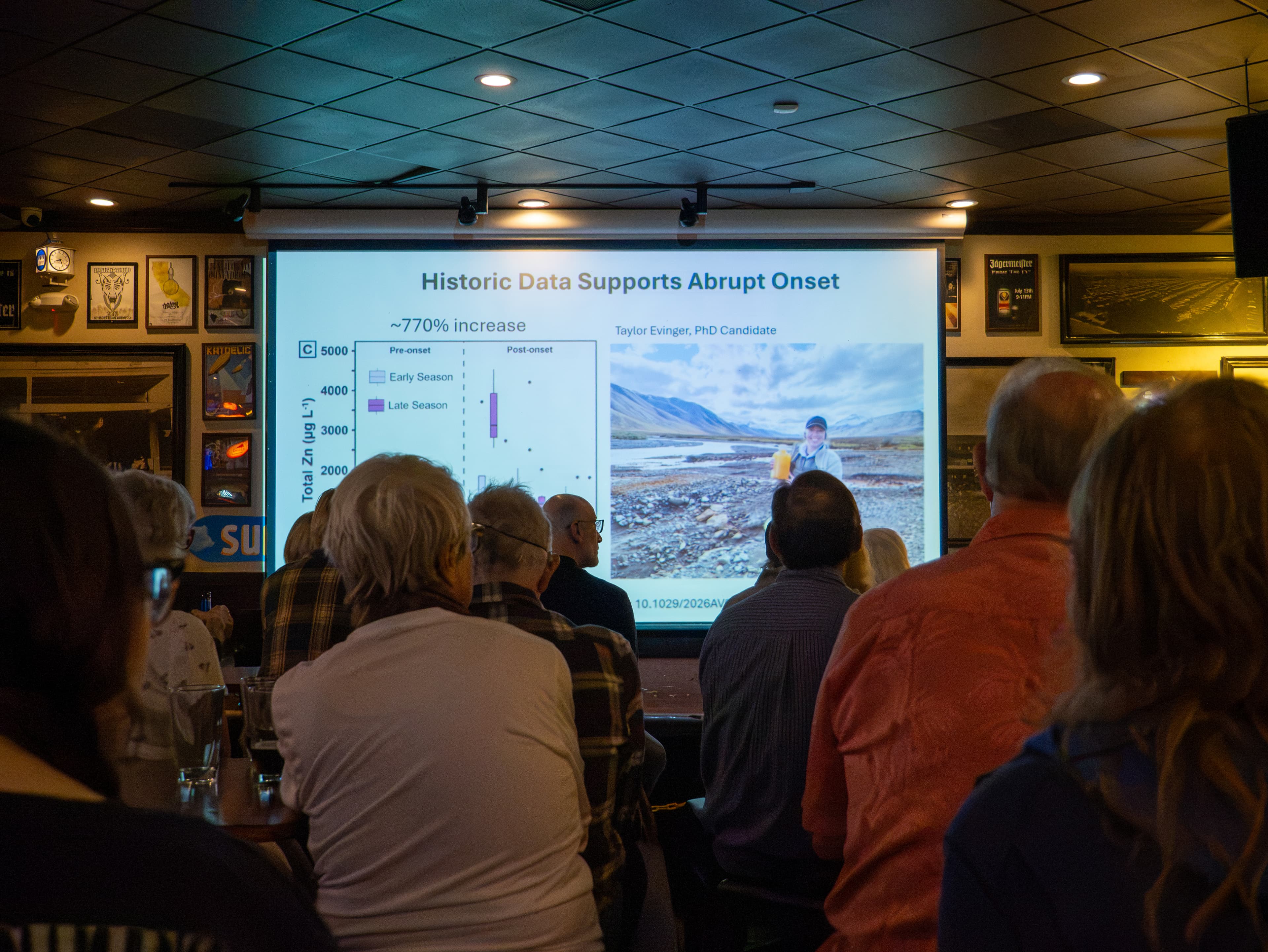
On Wednesday, Nov. 11, G Street Wunderbar was unusually packed with customers. Anyone who hadn’t managed to grab a stool at a table squeezed into whatever standing room was available along the walls. However, the crowd that evening wasn’t cheering for a sports game, but was instead listening intently to a lecture for this month’s Science Café.
Science cafés are community-organized gatherings typically held in informal spaces such as pubs or cafés, where science enthusiasts can come and hear lectures from respected scientists and researchers. Tracing their origins back to England in the late ‘90s, science cafés have since grown into a global phenomenon.
The Davis Science Café was started by Dr. Jared Shaw, a professor of chemistry, in 2009, and was the first science café created in the Capital Region. Shaw was a new professor looking to get involved with public outreach efforts when he first learned about science cafés and was inspired to start his own.
What began as an annual event held by Shaw in the Arboretum has since evolved into a massively popular monthly gathering. Shaw’s science café now receives financial support from the College of Letters and Science, which he uses to supply complimentary soft drinks. In addition, the Davis Science Café is promoted by Capital Science Communicators, an organization that connects science communication professionals in the Capital Region.
The Science Café is hosted by Shaw every second Wednesday of the month from 5:30 to 7:30 p.m. at G Street Wunderbar with free admission. The venue was deliberately chosen by Shaw to make the event feel more accessible to the general public.
“The main point is to have a location that's not a lecture hall on the UC Davis campus,” Shaw said. “We want to come out to the public.”
Each month features a different UC Davis faculty member who gives a brief presentation on the research they are currently involved with. After the presentation, the event transitions to a lively open discussion format, with Shaw passing the mic around among audience members who wish to ask questions.
Shaw preps each speaker beforehand to ensure that presentations are both engaging and easily understandable for an audience without formal science backgrounds. He advises them to avoid using overly technical language or slipping into “lecture mode.”
Beth Brock, a regular attendee of the Science Café, expressed appreciation for the event’s efforts to accommodate non-scientist attendees.
“The professors generally speak to us as laypeople,” Brock said. “They're really good […] at talking to the public who are not scientists. They dumb it down for people like me.”
This month’s speaker was Dr. Brett Poulin, a professor from the Department of Environmental Toxicology, who studies the spread of metal contaminants. His presentation showcased two of his research projects: one studying how the thawing of frozen soil due to climate change releases contaminants into Arctic rivers, and another examining how the acid ingredient in vapes corrodes their metal components and increases the risk of cancer.
Shaw highlighted how one of his primary goals with the Science Café was to create an opportunity for the Davis community to better understand the research happening at the university and to clarify basic science, or research done purely for the sake of science that doesn’t yet have a practical application.
“A lot of people don't know what basic research is, and maybe they don't understand why it's important that we have scientists engaged in scientific inquiry at a university,” Shaw said. “So [my goal] is to demystify […] what goes on in these big buildings here at UCD.”
Another one of Shaw’s goals with the event is to promote greater scientific literacy among the public. Shaw expressed the hope that the Science Café could play a small role in combating misinformation surrounding science.
“I want people to be just a little more scientifically informed and hopefully think about it maybe when they vote,” Shaw said. “Whatever your politics are, you can make better decisions if you have a little more science knowledge.”
Elaine Whalen, a fourth-year anthropology major, came with fellow students Isabelle Boudey and Leo Konefat after hearing about the Science Café through Instagram, and agreed that events like this play an important part in keeping the public informed about science.
“I think direct communication from scientists keeps the public informed on issues that otherwise they might be misinformed [about] by pundits,” Whalen said. “An informed and curious public is more resistant to being tricked.”
Having observed recent threats to scientific funding, informing the public about the importance of scientific research was also Poulin’s main motivation for getting involved with the Science Café.
“We as a research enterprise are under scrutiny and [threatened by] a movement to defund science,” Poulin said. “The more we can do to build a base of knowledgeable individuals that understand why fundamental funding is needed for research at universities, the better off we'll all be.”
Shaw said that his ultimate goal with the Science Café is simply to provide a fun and engaging space for the Davis community to learn more about science.
“If you're interested in music […] you can go to a live show. But for science, there's not a lot outside of taking a class,” Shaw said. “So we like to say we're the live show for science.”
Whalen praised the atmosphere of the event, characterizing it as a much more enjoyable environment for learning in comparison to a standard college lecture.
“There [isn’t] the stress of lecture and assignments and all that weighing down on you at events like this,” Whalen said. “It’s just a chance to learn for learning's sake.”
More information about the Science Café, including the topics and speakers planned for each month, can be found on their Instagram page @davisscicafe.
Written by: Brian Li — city@theaggie.org