





You are spoon-fed controversy
Voter ID isn't crazy — you’ve been trained to think it is
By NEVEN BISINOVSKI— ndbisinovski@ucdavis.edu
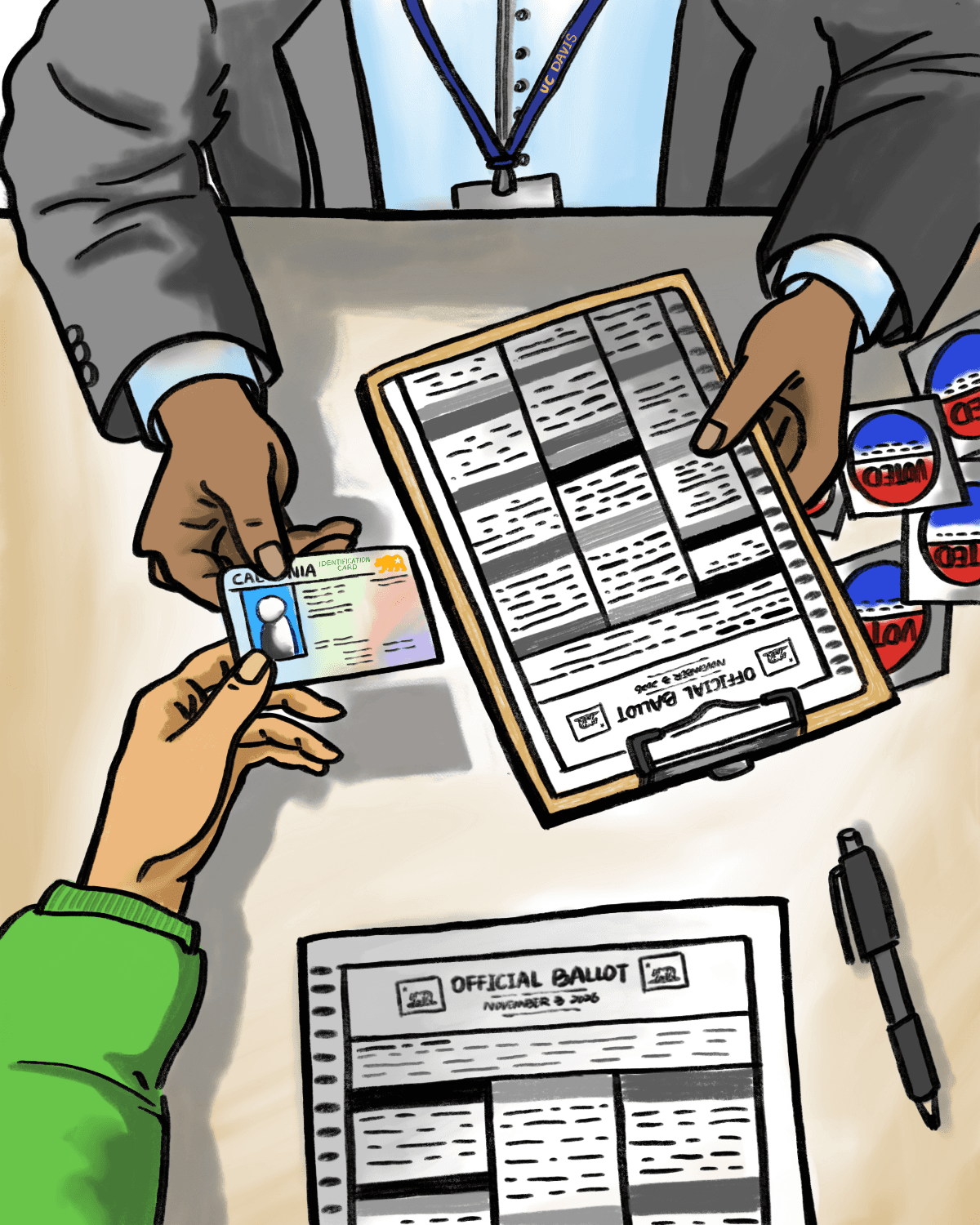
In the recent midterm elections, Californians flocked to the polls to decide more than who would represent them; specific statewide policy proposals were also on the ballot. Among them, Proposition 39 — which sought to require that voters present identification (ID) to cast their ballot — sparked a particularly heated political showdown. Partisan babblings turned a routine administrative procedure into a toxic ideological battle, resulting in Californians rejecting the proposal. Despite its controversy in the United States, voter ID is neither radical nor unfamiliar in democracies around the world. Yet, Americans have uniquely turned the concept into a toxic, partisan spectacle.
Consider the Netherlands, where voters simply present a government-issued ID and a voting pass that is automatically mailed to eligible citizens ahead of Election Day. Dutch authorities even accept expired ID, appreciating that a document’s expiration does not invalidate one’s identity. This framework is remarkably straightforward and comprehensible; it upholds electoral integrity while avoiding unnecessary burdens on voting accessibility, demonstrating that the two can coexist with ease.
Canada follows a similarly pragmatic approach. Canadians must present photo ID to vote, but flexible policies are in place to accommodate those without it. Voters can, alternatively, present two documents that reasonably establish their identity, or simply have another eligible voter vouch for them. These countries do not treat identification and accessibility as mutually exclusive concepts, both having established electoral infrastructures that secure elections while minimizing voting barriers. Citizens of these countries thus do not view voter ID as a policy necessitating debate; they accept it as good governance and a necessary procedure for electoral functionality.
Americans’ view of voter ID is dramatically different — we tend to take things to the extreme. The campaigns surrounding California’s Proposition 39 reflected a tendency in American politics to extrapolate simple policies into fierce partisan battles. The campaign opposing Proposition 39 characterized the measure as an extension of President Donald Trump’s voter suppression agenda and directed voters to reject it by invoking its backing by “Make America Great Again” (MAGA) figures, shifting attention from the policy itself to the partisan affiliations of its supporters. Conversely, Republican Assemblymember Carl DeMaio (R- San Diego) celebrated the proposal as an opportunity to turn the tide against what he called “far-left insanity” — another shallow partisan jab rather than a genuine examination of the policy’s merits. Overall, both sides took a simple policy and attached broad partisan narratives to it, intensifying America’s already polarized political climate and distracting from critical policy analysis.
The partisan mess that was made of this simple proposal reflects a broader issue in the U.S. Ordinary matters of governance that should be as universally comprehensible as they are abroad — such as requiring ID for election integrity — are challenged not for their inherent merit, but through partisan alignment. The resulting discourse becomes a perverse version of policy debate, devolving into a competition to vilify one’s opponents rather than articulate workable solutions. Administrative reforms are thus made existential and compromises are seen as betrayals and defeats.
This cultural tendency is problematic because it presents a threat to sound governance. When the most mundane administrative reforms become attached to ideological controversies, genuine improvements are unnecessarily difficult to implement. For example, San Francisco Mayor Daniel Lurie’s recent effort to streamline the city’s notoriously convoluted government charter through Propositions D, E and F was denounced by the Democratic Socialists of America (DSA) as a power grab that threatened democracy. His proposals — including simplifying contracting procedures and restructuring city departments — certainly contained aspects that deserved examination, most notably because the mayor’s office sought authority over appointment and dismissal of department heads. But, this policy of a strong mayor is common in other U.S. cities, and the overall rhetoric of DSA dramatized the reforms to make voters believe democracy’s fate was on the line. As a result, ordinary responsibility of government beyond voter ID was yet again turned into a polarizing issue to divide Americans.
This polarization also undermines intellectual independence. When every policy becomes associated with a political faction, citizens are pressured into evaluating proposals according to partisan loyalty rather than individual judgement. This undermines voters’ nuance, as stepping outside of one’s typical political narrative becomes viewed as an ultimate betrayal. Consequently, voters’ beliefs are no longer formed independently, but are instead spoon-fed to them by partisan oligarchs.
The international comparison makes this phenomenon all the more apparent. The Netherlands and Canada demonstrate that pragmatic measures for good governance — such as voter ID requirements — can exist independently of partisan battles. Hence, voter ID does not possess an inherent political ideology abroad — politicians and voters accept the policy as bureaucratic and extra-ideological. Their goals are to perfect their democracy, while the goal of American politics is to score cheap wins against the opposition.
California’s rejection of Proposition 39 should therefore provoke a larger conversation than whether voter ID belongs in our elections, but about the approach to policies itself. Americans should reconsider their unnecessarily intense political culture that so readily transforms administrative disagreements into broad, moral confrontations. Democracy provides the freedom to disagree, but it’s only valuable when ideas are examined for their merits, not for their ability to vilify opponents.
Written by: Neven Bisinovski — ndbisinovski@ucdavis.edu
Disclaimer: The views and opinions expressed by individual columnists belong to the columnists alone and do not necessarily indicate the views and opinions held by The California Aggie.