





Gorman Museum exhibition showcases works of the acclaimed artist and community leader Brian D. Tripp
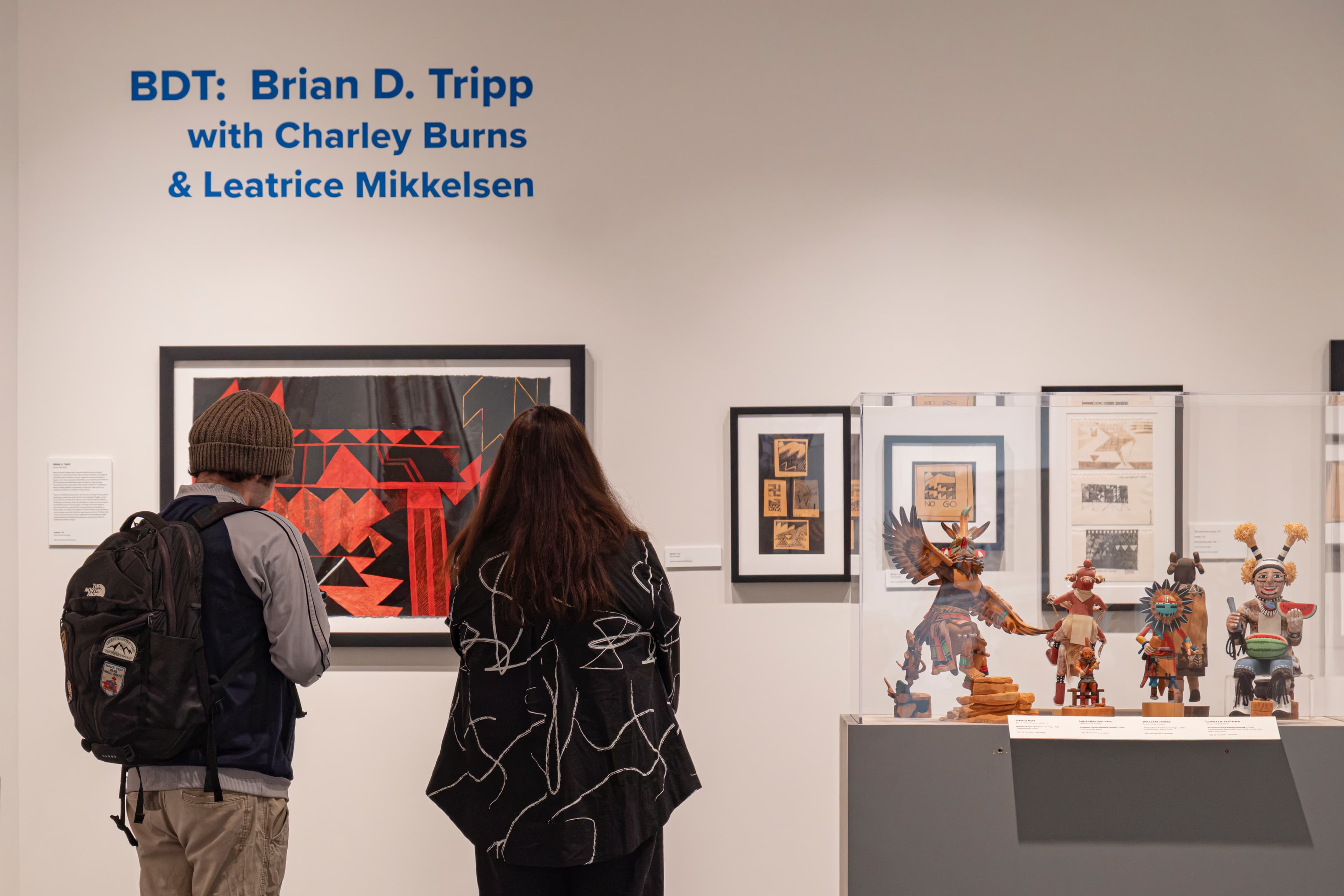
The exhibition also features two other connected Indigenous artists
By JONAH BERMAN — arts@theaggie.org
Until March 30, 2027, the Gorman Museum of Native American Art will be showing the exhibition “BDT: Brian D. Tripp with Charley Burns and Leatrice Mikkelsen.”
The exhibition features many newly acquired works by the Indigenous artist and community leader Brian D. Tripp, who was a member of the Karuk Tribe. Throughout his life, Tripp created art and poetry while actively working to preserve Karuk culture and tradition. In addition, he served as an educator, teaching at California Polytechnic State University, Humboldt. Over his career, he built a close connection with the Gorman Museum, according to Executive Director Veronica Passalacqua.
“He has a long history with the museum,” Passalacqua said. “If you look at our exhibition history, he's been featured a lot over the last 50 years. He's done a lot of work with us. But the other thing as well is that he was really valued by the community and he was quite a participant and an activist.”
Elio Cathcart Randall, a fourth-year theater and dance major and museum assistant, noted how Tripp’s variety of artistic approaches influenced their own growth as an artist.
“As a queer artist myself, I’ve always been inspired by his use of mixed media,” Cathcart Randall said. “He has this real ability to take corporeal images from other pieces of media and infuse it with his own meaning.”
Many of the new pieces were donated to the museum last year by Dorothea Theodoratus, a professor emerita at California State University, Sacramento.
“It's kind of wild because since we moved into this building, we've had so much more visibility,” Passalacqua said. “I don't know where it's all coming from, but we have donors kind of coming out of the woodwork asking us to take in their collections. That [was how] Dorothea found out about us.”
Although he employed a variety of media throughout his career, including installation work, most of Tripp's pieces in this exhibition employ ink and other tools on paper. Geometric motifs rooted in Karuk culture, such as repeated triangles, are consistently present throughout the exhibition.
Among the new acquisitions are a variety of pieces from the 1980s “NO-GO” campaign, which Tripp contributed to with his art and activism. The campaign targeted a planned road through the Siskiyou Wilderness, which was heavily protested by Indigenous groups. The road was eventually blocked, becoming a symbol of successful Indigenous resistance and organizing.
Furthermore, Tripp’s drawing “The Sun Set Twice on Our People that Day,” which shares a name with a mural of Tripp’s, will also be on display. The drawing and the mural also share their title with a line from one of Tripp’s poems, which emphasizes the memory of the 1860 Wiyot massacre, where at least 80 people were murdered by white settlers in present-day Humboldt County.
In addition to Tripp's artwork, two other Indigenous artists are highlighted in the exhibition: Charley Burns and Leatrice Mikkelsen. Burns is a member of the Yurok tribe, and his work also examines geometry and uses motifs that originate in Indigenous basketry. Like Tripp, he was born in Eureka, Calif., and shares connections to the same region.
Furthermore, Mikkelsen is a Navajo, Cherokee and Wyandot artist whose work uses watercolor, acrylic paint, chalk and ink. Her pieces often focus on spiral motifs, as well as the Navajo story of the White Shell Woman.
The Mikkelsen family donated the majority of the works by Burns and Mikkelsen. While curating the exhibition, Passalacqua chose to present these artists together due to their friendship and the shared connections in their work.
“I hope the next generation will learn about this part of California native art history,” Passalacqua said. “All of these pieces are from around the same time frame, and you can see the relationships that are in there artistically.”
Mariah Alire, a second-year communication and political science double major, Museum Assistant and member of the Ione Band of Miwok Indians, also noted the importance of highlighting local artists and their contributions to Native American art.
“As a California Native American, I think it's important to highlight these pieces and the artists that are local,” Alire said. “I think all of this is very crucial to showcase to the public and people at Davis so that they're aware that we're still here and this kind of history matters.”
The exhibition will remain on display until March 30, 2027, at the Gorman Museum, which offers free admission.
Written by: Jonah Berman — arts@theaggie.org