





ASUCD Fall 2026 Elections Guide
Meet the senate candidates and ballot measures in this week’s student government election
By LILY KENROW, VINCE BASADA, KIMBERLY AYSON, ZAYNAB MOHIUDDEEN, DANIEL HII, LOUISE NICHOLLS, J.J. RENNER & MEGAN WANG — campus@theaggie.org
Though the Nov. 3 midterms may have passed, if you are an undergraduate student, you may still have another ballot to fill out.
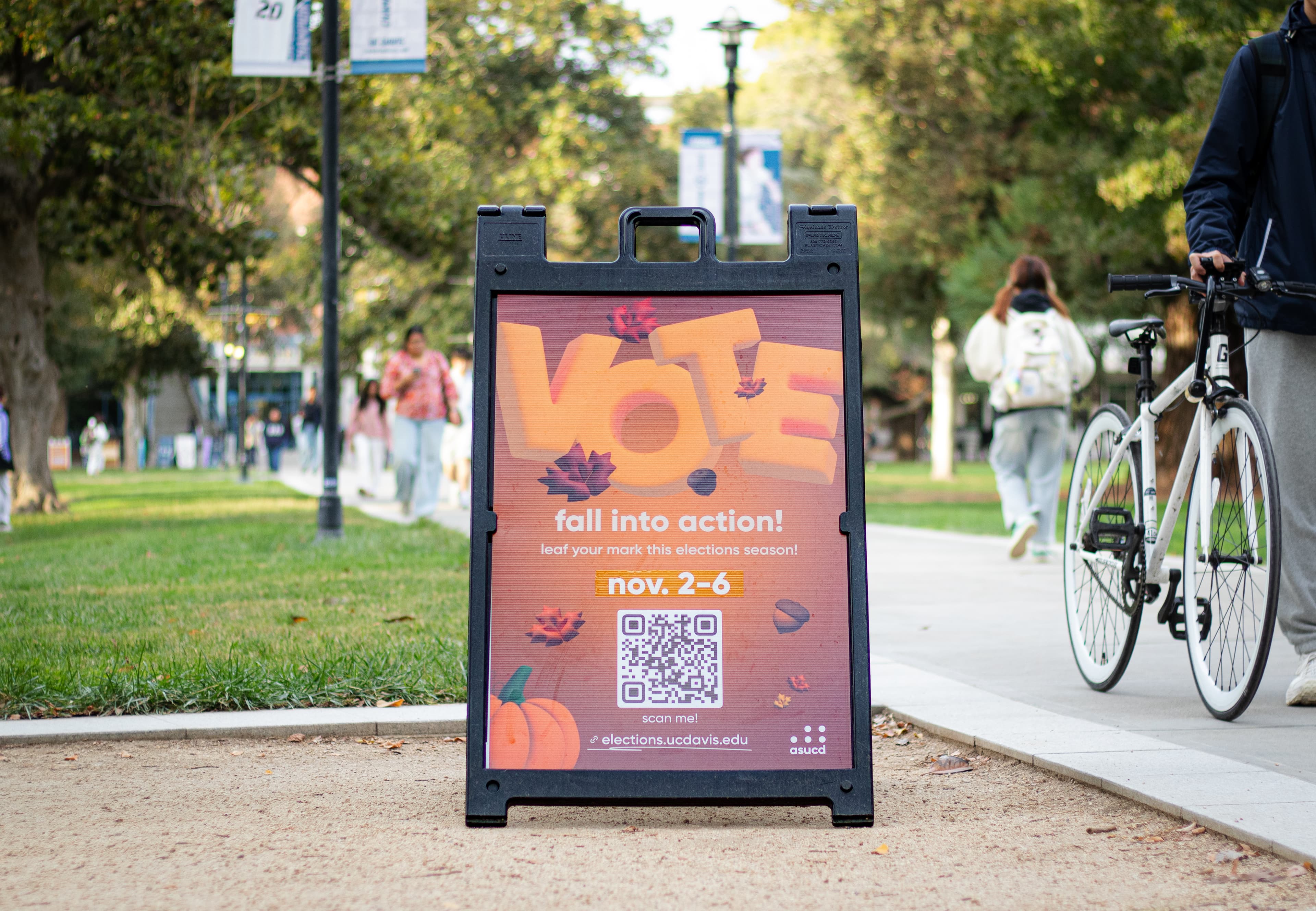
The fall 2026 ASUCD elections, which run from Nov. 2 to 6, offer students an opportunity to decide on the next leaders of their student government. This cycle includes 15 Senate candidates and two Constitutional Amendments for approval by the student body.
This election, there are four slates, or groups of candidates running on a shared platform. They are: Avanza, Empowered, The GOAT (Greater Opportunities, Affordability and Transparency) and STFU (or Stop Taking From Us). Additionally, four candidates are running independently without slates.
ASUCD elections use a ranked-choice voting system, where voters can rank as many or as few of the candidates based on preference. Voting began Monday, Nov. 2 and ballots are open through Friday, Nov. 6. Students can vote online now at elections.ucdavis.edu.
Written by: Lily Kenrow, Vince Basada, Kimberly Ayson, Zaynab Mohiuddeen, Daniel Hii, Louise Nicholls, J.J. Renner & Megan Wang — campus@theaggie.org
Senators
ASUCD senators are tasked with voting on legislation and bills, deciding on the allocation of the Association’s budget, advocating and representing the undergraduate student body to administrators and overseeing ASUCD’s units. The 12 senators each serve one-year terms; six are elected in fall and another six are elected in spring.
Candidates are listed alphabetically by slate, then by last name.
Avanza: Promotes student safety and affordability initiatives, calls for diverse and equitable representation

Harshpartap Dhillon
Third-year biological sciences major
A former ASUCD Senator, Dhillon termed out in spring but returned to the table earlier this fall to serve as an interim, filling a spot left vacant by Senator Ezra Rubin’s resignation. He says that his time in the Association has shown him the importance of collaboration, and he brings a deep understanding of the Association’s inner working and bureaucracy. He also mentioned that his last term showed him how easy it is for ASUCD officers to become insulated in legislation and within ASUCD, and he’s called for Senators to be more accessible to the student body.
Dhillon’s second campaign focuses on making transportation more affordable and creating professional development opportunities, especially for pre-health and STEM students. He also supports ASUCD hosting more cultural programming; as a Senator he helped spearhead funding for Jaggo Night, a celebration of Punjabi culture. Outside of ASUCD, he serves in several medical clinics and in leadership roles in Sikh Registered Student Organizations (RSO).
“I bring a combination of experience, commitment and genuine understanding of the responsibilities of this position,” Dhillon said.
“I’ve already had the opportunity to serve in the Senate, and that experience has taught me about what student government can accomplish and where it needs to improve.”
Tianneh Garcia Bonardi
Fourth-year political science — public service and sociology double major
Garcia Bonardi, a former ASUCD interim senator, is seeking to leverage her knowledge of the table for a full term to the table. She is running with an emphasis on student safety, access to services and professional development opportunities.
Pointing to the recent Cornell Seven case and other instances of sexual assaults at fraternities, Garcia Bonardi hopes to advance safety initiatives at Greek life houses. She’s indicated a willingness to work with university officials to achieve this goal and hopes to increase student government oversight of fraternities and sororities. Her other campaign goals include advancing equitable representation within ASUCD, and she’s proposed using surveys to better gauge ways the Association can better serve the student body.
Garcia Bonardi previously ran in the spring 2025, before being disqualified after voting closed due to a delay in submitting her campaign expense reports.
“I really do want to bring back the values and the programs I wanted to bring the first time around — bringing more career-based programs and things like that for UC Davis students, just because I feel like there's not that connection yet,” Garcia Bonardi said.

Dali Y. Guerrero Fernández
Third-year political science and Chicana/o/x studies double major
Guerrero Fernández recently transferred from De Anza College where she served as the Equity and Diversity Senator at the community college’s student government. Her past experience includes advancing youth representation at the local and state level, and she was recently confirmed as a member of ASUCD’s Undocuscholars Advocacy and Aid Committee.
With her experience with budgets, logistics and outreach, Guerrero Fernández hopes to uplift student voices and concerns, as well as increase work with Registered Student Organizations and student halls for student questions. She hopes to use her experience as a transfer student to uplift marginalized student voices and bridge the gap between ASUCD and students.
For Guerrero Fernández, the senate position brings opportunity for civic engagement and actionable change.
“Knowing that I left that impact [at De Anza], I think it pushed me to run for this position because I feel like having that experience is really helpful,” Guerrero Fernández said. “I know firsthand what students like myself, who are either first-generation or immigrants, are going through and what is needed to support students [who] are also from those backgrounds.”
Empowered: Campaigning on protecting basic needs services and advancing ASUCD outreach efforts

Bibi Sara Naibi
Third-year mechanical and aerospace engineering double major
Naibi is running on a platform of bridging the gap between students and access to basic needs services and resources. Through her experience of being a Student Health and Wellness Liaison within UC Davis Student Affairs, she hopes to especially advocate for greater accessibility to health and wellness resources and student safety measures.
Having observed firsthand that many engineering students face mental health crises, Naibi hopes to work on increasing efficiency for students’ access to student health resources and feels that longer wait times deter students from accessing the resources they need. She also wants to work on lowering Safe Ride times as part of her goals to prioritize student safety.
Naibi hopes to work on furthering the reach of academic and financial support systems. As a Student Cabinet Leader representing the MENASA Student Resource Center and a Women in STEM Project Leader at the UC Davis Global Hub, she knows that many scholarships and academic assistance programs go unnoticed by many students. She hopes to work on raising the visibility of these resources as part of her initiative to bridge the student-to-resources gap.
“I don't promise something that is out of my control,” Naibi said. “I have missions that are in my control, and I [can] promise students that I will take action and speak up for them. And I will make sure that [it is applicable] in their real world.”

Lia Washington
Fourth-year political science major
Washington is running for ASUCD Senate with the Empowered slate, hoping to help students advocate for themselves and their communities. She previously ran in spring, and again is seeking a seat on the Senate with a platform centered on equity and inclusion, safety, and sexual violence prevention.
Washington previously served as a voting member of the student government at De Anza College before transferring to UC Davis last fall. She also served on ASUCD’s Ethnic and Cultural Affairs Commission, working on social media and outreach, and on the staff of former ASUCD Senator Jaliah Payne.
Her priorities include expanding survivor-centered resources for students affected by sexual violence or hate crimes and advancing diversity and equity within the Association. Washington hopes her candidacy encourages more transfer students to pursue Senate positions, emphasizing the value of their experiences across institutions.
“I really want to be an active voice for change and upholding campus values,” Washington said. “Especially now, within an administration that's incentivizing our admin to not take action to not fund identity-based and cultural programs.”
The GOAT (Greater Opportunities, Affordability and Transparency): Supports campus events and school spirit, parking and basic needs support, budget transparency

Grace Azanedo-Leon
Second-year political science — public service major
Azanedo-Leon is running for senate on a platform rooted in community engagement and basic needs resource access. She is also hopeful to look into potential programs that relieve students of high parking costs, including shared parking permits between students with morning and evening classes.
Running with the GOAT slate, she feels that her fellow slate members bring passion and sincerity to their campaign. Through her past work volunteering in her local community, campaigning for her local assembly member and working as a youth ambassador in Los Angeles, Azanedo-Leon brings experience of leadership and community work. She says her involvement with various clubs around campus has also given her the opportunity to interact with a diverse group of students, who she hopes will come to her with any and all questions.
“The main reason I’m [running] is because I love our school, and I really want to be that person for students to come up to me and ask questions,” Azaendo-Leon said. “And I just really want to be involved.”

Lukas Logvin
Third-year political science major
Logvin, running as a part of the GOAT slate, is hoping to advocate and prioritize affordability. As a transfer and commuter student, he knows firsthand the financial burden of paying for on-campus parking multiple times a week. If elected to the senate, he plans on working toward creating parking passes for students, whether on a monthly or annual system.
Another change he hopes to see within ASUCD is further transparency and communication with the student body. Part of his and GOAT’s goals would be to publish quarterly reports on ASUCD budget spending, explaining to students what the Association did for them.
Logvin has past experience working in student governments; he served as director for legislative affairs at Folsom Lake College’s student government, as a member of the Constitution and Bylaws Committee and as the student representative on the community college’s Student Equity and Success Committee.
“Having such a big impact and big role on student government [at Folsom Lake College], really gave me faith in what ASUCD could do if we collaborate, work together and bring our ideas to the table and create change,” Logvin said.

Saba Rahimi
Second-year economics major
As a part of the GOAT slate, Rahimi is running on a platform of greater opportunities, affordability and transparency. As a former committee member of the ASUCD Student Sustainability Career Fair, Rahimi hopes to continue to expand student opportunities through more professional events. She also hopes to advance ASUCD’s sustainability efforts and transportation safety.
Rahimi believes ASUCD could benefit from increased transparency on its budget, which is one of her central campaign priorities. She has advocated for ASUCD to publish quarterly budget reports for students, informing them on how the Association’s funds have been allocated.
With an immigrant background and experience with youth advocacy in local government, Rahimi brings passion and goals for tangible improvement within ASUCD. She also believes her prior experience within ASUCD is a stepping stone toward doing greater work within the Senate, if elected.
“Coming from a background where I had immigrant parents who came from a country where democratic rights were not a reality for them, I think that it's super important to be able to understand that every voice does matter,” Rahimi said.
Independent:

Jacob Dougherty
Second-year mechanical engineering major
Dougherty is running independently because he finds his goals to be very personally aligned. As a STEM student, he hopes to bring more representation to the table of diverse student interests and wants to introduce financial scholarships to help cover student lab equipment and materials.
Dougherty also works as a conductor for Unitrans, and hopes to use his experience to support safer transportation infrastructure for bikers, pedestrians and bus riders alike. Specifically, Dougherty hopes to implement solar bus stop lighting to offer safer waiting environments for students at night as well as increase visibility of riders waiting for bus drivers.
Building on his STEM background, Dougherty believes that helping fund student research is important and wants to create grants for materials in student projects at the Engineering Student Design Center, which provides students with equipment but not materials.
“I think the primary goal [of the ASUCD Senate] is to represent all students on campus,” Dougherty said. “You are not just a leader; you’re an advocate.”

Melissa Estrada
Third-year economics and political science — public service double major
Estrada is running for senate to help students find resources, alleviate their stress and create change. As the director of professional development for the Chicanix/Lantinx Collegiate Association, she feels qualified to represent the student body and believes she can comprehensively support them.
Estrada hopes to increase resources, representation and accessibility within the Association. By getting directly involved with student groups, she wants to reduce struggles that may otherwise be overlooked. In particular, Estrada’s work at community food banks has motivated her to focus on food insecurity by advocating for extended ASUCD Pantry hours.
“I want students to vote for me because I'm here to represent them and to echo their voices,” Estrada said. “I want them to embrace every single aspect of themselves, whether it's their culture, their religion, their academics. I want students to be well rounded, and I'm here to support them.”

Tatiana Eden Ochoa
Second-year political science, cognitive science and philosophy triple major
Ochoa is running independently with a clear vision for her goals and platforms.
With extensive experience with different campus groups, from All4Yolo, BridgeUSA to the Davis Journal of Legal Studies and more, Ochoa consistently works and meets with different students. She listens to their perspectives, something she believes is important when advocating for them.
The main points of Ochoa’s platform and goals if elected are transportation, equity and opportunity.
She hopes to work with Unitrans to address different delays as well as look at ways to improve bike safety. She also plans to increase awareness of different programs on campus that address basic needs and create a welcoming environment for cross-cultural engagement.
As a peer mentor for the STaR (Student Transition and Retention) program, representing students and understanding their struggles is a large part of her platform.
“I have had moments where I felt like maybe UC Davis wasn't for students like me,” Ochoa said. “But I also care and know that it isn’t just about passion, and it isn’t just about dedication — it's about heart. And I have the heart in order to bridge those gaps between people and go above and beyond.”

Haining Peng
Fourth-year political science and economics double major
Peng is running on a platform of affordability, transparency and campus safety. With high costs of living felt by many students, Peng recognizes a need for lower barriers in accessibility to basic needs, including in services like The Pantry and Aggie Eats.
With her experience in budgets and finance, including as an intern at the State Treasurer’s office, Peng also has a deep knowledge of budget allocation and funds. Her work on the ASUCD Election Committee as a coordinator has given her an understanding of background logistics, and Peng hopes to bring that experience of the elections process to the Senate table.
Peng is also concerned over student safety and hopes to address some dark areas within the city of Davis and seek efforts that help better fund and support SafeRides.
“My goals and my priorities and the things that I [will] try to achieve are really practical things,” Peng said. “And that can change not just a small selective group, but every single student on campus will benefit from them.”
STFU (Stop Taking From Us) Slate: Focused on addressing affordability, protecting basic needs services

Grant Cole
Second-year international relations major
Cole’s platform — which focuses on affordability, accessibility for human rights and basic student needs — is, in many ways, a mature relaunch of his last campaign. He previously ran for Senate in this year’s Spring election and has launched his second campaign with more experience and understanding of ASUCD.
Over the past summer, Cole worked as an administrative assistant with a local charity that serves the immigrant community and runs a food pantry. He says that experience ties directly into his promise to ensure equitable access to the ASUCD Pantry.
Further, Cole says his experience as Chief of Staff for his running mate, Nate Little, has given him insight into the behind-the-scenes operations of ASUCD and has allowed him to identify internal issues he’d address if elected. Cole’s focus is on rebuilding a sense of connection between the student population and Davis residents by establishing partnerships with various city departments to benefit the student body. Through these programs and prior experience with outreach, Cole hopes to implement tangible change for the benefit of all students at UC Davis.
“I want people to come and talk to me and hold me directly accountable, along with the rest of the Senate,” Cole said.

Nate Little
Second-year history and political science double major
Incumbent Senator Little’s platform honors the ASUCD mission statement, “to [serve] and [empower] students through essential services, exceptional programs, and growth opportunities that enrich our campus community." Little recognizes that collaboration is necessary to achieve his goals, and he is running for reelection with the STFU slate, focusing on affordability, basic needs and advocacy for human rights.
Little believes affordability allows students to improve their college experiences and that ASUCD has the power to support this enrichment. Since last fall, Little has succeeded in eliminating the Senate’s $4,000 food budget — a major campaign focus his first time around — and increased the Club Financial Council budget by $20,000.
Seeking a second term, Little intends to promote ethical spending within ASUCD and prevent funding cuts to the three basic needs units of ASUCD: Housing Advising for Undergraduate Students (HAUS), Aggie Reuse and The Pantry. Additionally, he intends to increase student awareness about the expanded CalFresh eligibility rules.
“If you are actually going to really prosper on campus as an individual [...] none of that matters if you don’t know where your next meal is gonna come from, or if you’re unhoused or you can’t find proper clothing,” Little said.

Yara Sanchez
Second-year philosophy and religious studies double major
Sanchez has extensive experience with protests, from standing alongside teachers and other students to fight a proposed mass teacher layoff in her local Anaheim Union High School District, to speaking at the protest against sexual violence on campus in early October. However, they believe that institutional change is necessary to substantiate the efforts from protests.
Sanchez’ high school JROTC experience taught them to be an approachable leader, and they aim to serve as a bridge between the student community and ASUCD. They hope to work closely with their slate members to achieve their collective goals of basic needs advocacy, as well as their personal goal of improving accessibility.
Sanchez is an active member of the California Alliance of Students United for a Reformed Future, a progressive club which is affiliated with the Eric Jones campaign, and is working with the club to create a coalition to support local immigration organizations with funding and manpower.
“I implore people to come to me with their stories, their perspectives and their experiences because there is nothing more I love to do than hear people’s stories and to know who they are,” Sanchez said.
Ballot Measures
Voters may choose to “approve,” “reject” or “abstain” from any given ballot measure; “abstain” votes do not affect the voting result or count toward the total votes cast. Constitutional amendments require a simple majority approval of eligible votes cast to be passed.
Constitutional Amendment #99
CA#99 would make the position of student advocate — head of the Student Advocate’s Office (SAO) — appointed by a committee rather than elected by the student body in spring. The SAO helps advise students who have been referred to the Student Conduct and Integrity, formerly the Office of Student Support and Judicial Affairs.
The amendment’s author — former student advocate Inbar Schwartz — has argued that appointing the job via committee would ensure a level of institutional knowledge is retained and kept at the SAO. Amendment supporters also say it would curtail the risk of an unqualified and untrained candidate being placed in the role.
A similar amendment, CA#96, was voted on in the spring elections but failed to pass after falling short of the majority required.
Constitutional Amendment #100
CA#100 would restructure the ASUCD Elections cycle to consolidate the two ASUCD elections into one larger annual election at the end of the school year. Currently, ASUCD elections are held in both fall and spring; six of the 12 senators are elected in the fall and the other six, as well as all other elected positions, are elected in spring.
Proponents of the amendment argue that reforming the elections cycle would help increase voter turnout in ASUCD elections, which have historically had some of the lowest turnout rates among any student government in the UC system. They say that consolidating the election cycle would allow for the ASUCD Elections budget to be used in its entirety to promote one single election, rather than two, and make races more competitive by forcing all candidates to run at once.
Opponents of the amendment argue that it will stifle student government participation for incoming students in fall quarter, potentially alienating first-year and transfer students.
The status of CA#100 is currently in question following an injunction placed on it by the ASUCD Judicial Council, over concerns that the way in which it was introduced to the Senate for consideration violated the ASUCD Constitution and Bylaws. The amendment was introduced by ASUCD President Luis L. Garcia, who also authored the bill, seemingly against rules in ASUCD’s governing documents prohibiting the president from introducing normal pieces of legislation.
The Judicial Council has ordered that the amendment not be certified or take effect until after it renders a decision on its constitutionality, regardless of the outcome of the vote. A hearing on the matter is scheduled for Tuesday, Nov. 17.
CA#100 remains on the ballot, though any votes for it will be invalidated if the Judicial Council strikes it down after voting closes, according to the ASUCD Elections Committee.