






2026 Templeton Colloquium in Art History focuses on the intersection between the arts and climate change
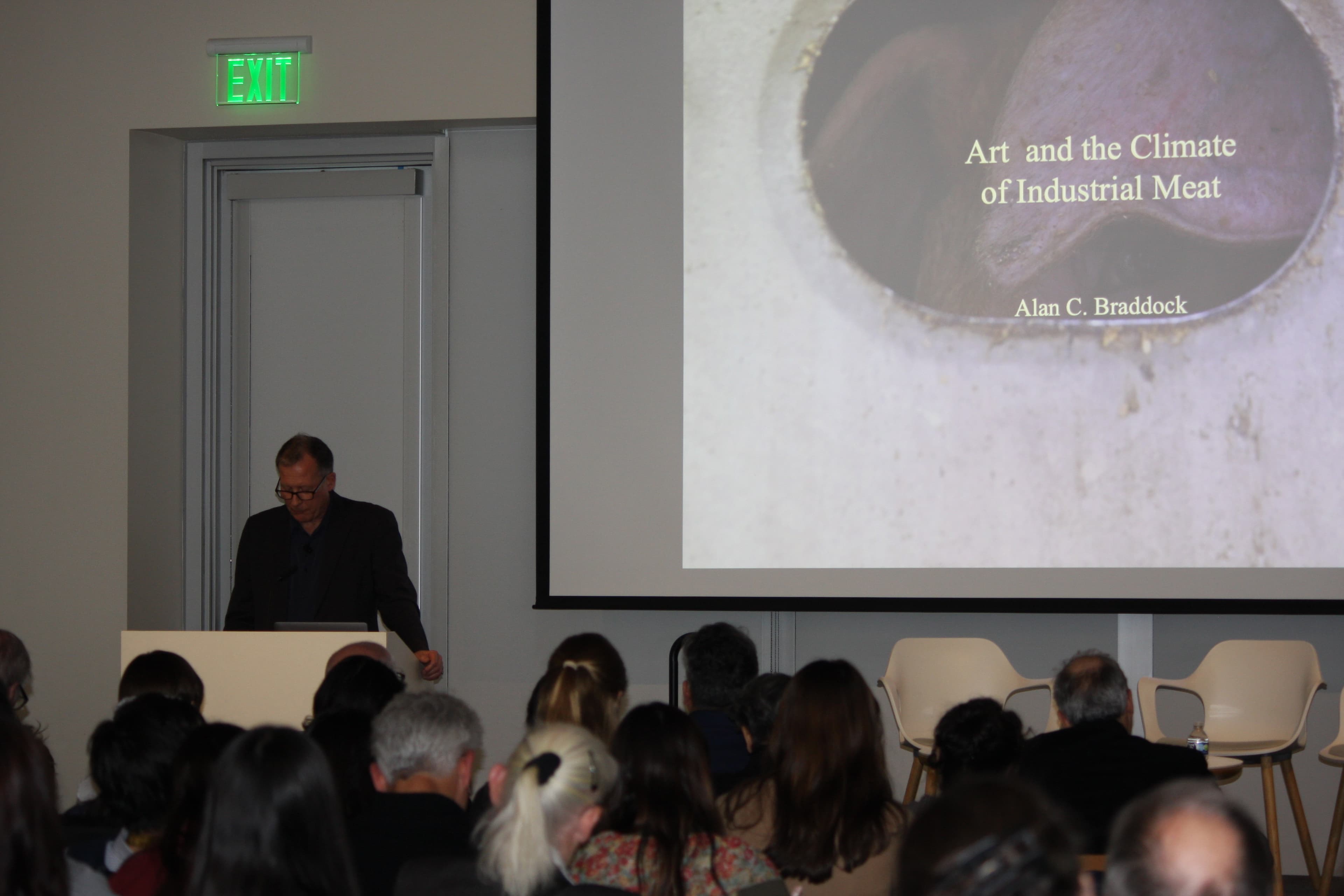
Speakers Alan C. Braddock and Andrew Patrizio discussed how different artists have confronted the climate crisis
By JONAH BERMAN — arts@theaggie.org
On March 7, the Jan Shrem and Maria Manetti Shrem Museum of Art hosted the annual Alan Templeton Colloquium in Art History. The event, which has been held for over a decade, invites speakers with unique expertise in their field to share new perspectives with the UC Davis arts community. The Colloquium’s namesake, philanthropist Alan Templeton, is a UC Davis alumnus and 2021 UC Davis Medal recipient whose contributions allowed for the development of the Colloquium.
Each installment centers on a different theme within the discipline of art history; for example, past editions have focused on Pacific art and how race intersects with American art institutions. This year’s Colloquium, entitled “Art History and Climate Change,” investigated environmental education and justice, a topic the Manetti Shrem Museum has previously addressed through its “Breath(e)” exhibition last fall.
Executive Associate Dean in the College of Letters and Science Elizabeth Miller was in attendance and noted her appreciation for the discussion of climate subjects at UC Davis.
“I am especially thrilled to be here for this event,” Miller said. “This is very much the intellectual waters I swim in, and I couldn’t be more delighted about the topic of this year’s Colloquium."
The two featured speakers were Alan C. Braddock, a professor of Art History, Environmental Humanities and American Studies at the College of William & Mary, and Andrew Patrizio, a professor of Scottish Visual Culture at the Edinburgh College of Art. Both professors are experts in the quickly growing field of ecocritical art history, which examines the relationship of art with ecology and the anthropogenic climate crisis.
Braddock, who spoke first, gave a talk entitled “Art and the Climate of Industrial Meat.” He began by discussing his main reasons for covering the topic, partly inspired by the recently altered United States Department of Agriculture (USDA) food pyramid, which centers the consumption of meat despite scientific consensus surrounding its environmental impact. However, he chiefly cited the relative lack of literature on the subject.
“My main reason for addressing this topic today has to do with the growing body of related artistic activity and the discipline of art history’s general avoidance of it, including a tendency even within ecocritical art history to shy away from the ugly realities of industrial meat,” Braddock said.
In order to introduce art that deviates from this societal norm and challenges a culture that highly values meat consumption, Braddock broadly divided meat-related art into five categories, each of which he covered in depth. These spanned from “counter-mapping,” which utilizes aerial photography to investigate visual impacts on the environment, to “institutional critique,” which analyzes anthropocentric perspectives within art institutions.
One featured piece, which drew a notable reaction from the audience, was Theresa Schubert’s “mEat me” (2022). In the performance piece, Schubert ate meat grown from her own cells in order to demonstrate a perceived hypocrisy in the support of lab-grown beef, which necessitates the slaughter of pregnant cows.
“If we imagine such violence to be ethical and unproblematic, the artist asks, why not just eat ourselves?” Braddock said.
Next, Patrizio gave his lecture, “Looking for Love in Chaos Terrains,” during which he focused on three artists interacting with the climate from his home country of Scotland.
He began with artist Hanna Tuulikki, whose multimedia work “Love (Warbler Remix)” (2025) uses the marsh warbler bird as a gateway to open discussions about environmental effects on animals from around the world. The piece combines live and recorded audio to trace the migratory path of the species from southeastern England to the Horn of Africa, showing how the warbler’s path has been significantly altered by changing temperatures.
Patrizio then discussed “Out of Ice” (2014), an installation piece by artist Elizabeth Ogilvie which combines film footage with sensory experience to convey the urgency of melting glaciers in areas like Greenland, where Ogilvie worked with a film crew and the local population to complete the work.
Patrizio noted the unique metaphorical significance of icebergs and glaciers.
“They have always been extreme, at least to humans,” Patrizio said. “But today, they become both simultaneously less extreme — as they warm up and melt — and more existentially extreme, in the sense that as they collapse, all animal life above and below the water line has to adjust if it can.”
Lastly, Patrizio elucidated his talk’s namesake, Ilana Halperin’s “Chaos Terrain” (2022). Halperin, inspired by the concepts of geologic deep time, blurred the line between science and sculpture with the piece, which consists of laser engraved coral and local marble. Patrizio found the work and its accompanying title to be uniquely poignant in describing contemporary attitudes about the climate.
“It serves as a visual metaphor for terrains that are muddled and do not tell their story of formation,” Patrizio said. “A puzzle and a confusion gives a powerful analogy to the times we find ourselves in.”
During the talk, Patrizio continuously emphasized the importance of using art history as a tool for equity, especially as a response to past injustice within the discipline. Earlier, Patrizio discussed his specific ecocritical niche within his field of study with art seminar students.
One such art seminar student, Braedyn Hutchison, a third-year applied mathematics major, enjoyed Patrizio’s in-depth coverage of the three Scottish artists during his talk.
“I thought it was really cool to see different mediums of art as well as the sciences combined in such a unique way,” Hutchison said.
The seminar that Patrizio visited is taught by Professor John F. López, who moderated a discussion after each historian spoke. Throughout, López emphasized the importance of art history as a critical method of analysis for our culture.
“Art history and climate change: on the surface these topics seem paradoxical,” López said. “However, I would argue that climate change is not a recent vagary of nature. It instead results from the cultural mentalities and historical processes that have deep roots in the past.”
Written by: Jonah Berman — arts@theaggie.org