






The evolution of women in gaming as both protagonists and players
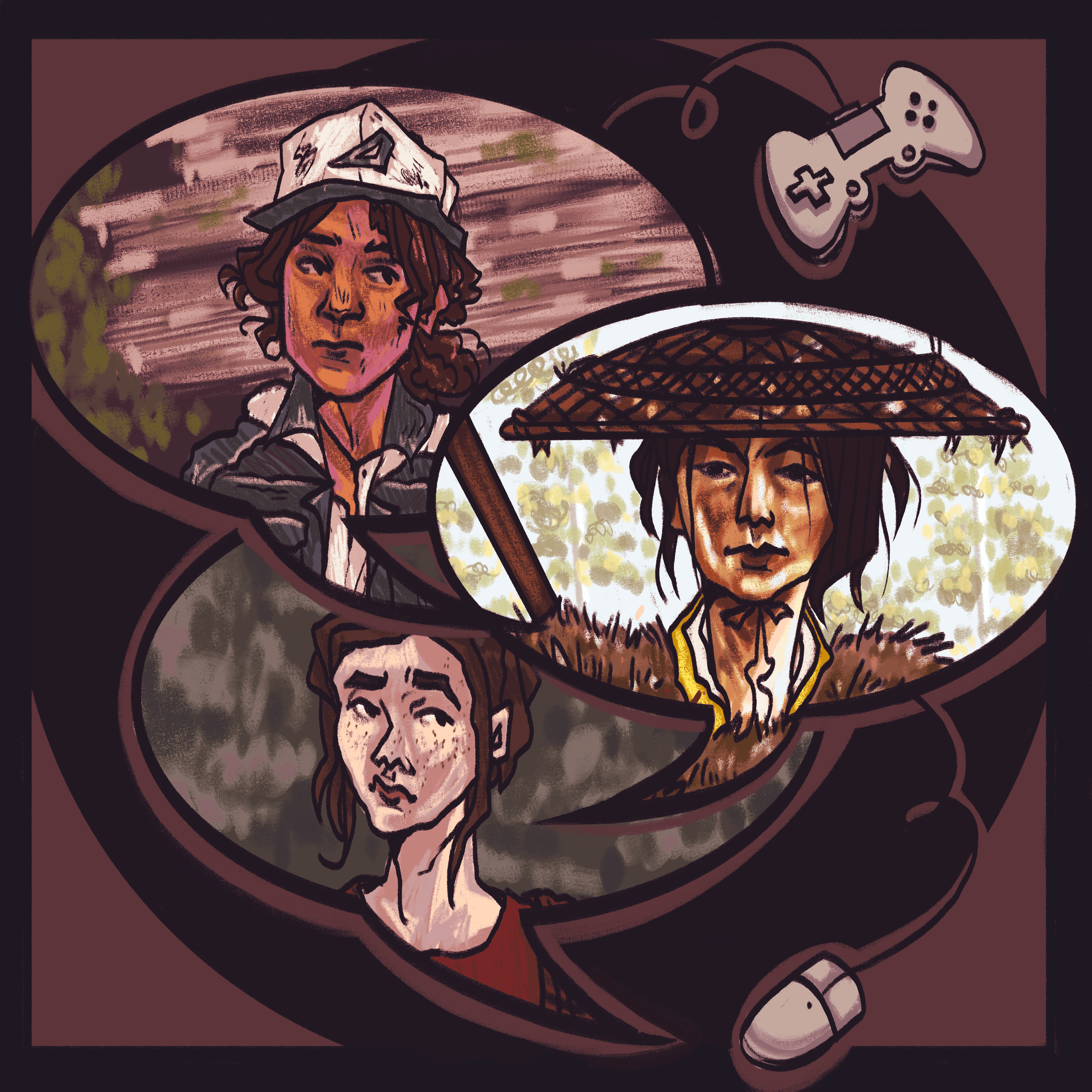
Do female characters and players face rejection in today’s gaming community?
By BELLA PETERSON — arts@theaggie.org
While approximately 47% of avid video game players in 2025 are women, gaming hasn’t always been perceived as a gender-neutral activity.
“A lot of my friends in high school were guys and they were gamers — if you mentioned you liked a game, they’d be surprised,” Teagan Durbin, a second year art history major, said. “They wouldn’t include me and my friends in conversations about video games because they just assumed we didn’t know anything about it. I remember being so annoyed by that.”
Similar to Durbin’s high school experience, female protagonists, players and streamers alike continue to face criticism and sometimes harassment within the gaming community. This behavior is not just a product of old gaming culture standards, but an underrepresentation of leading female protagonists with intersectional identities, according to Dames 4 Games Founder Destinee Cleveland. Dames 4 Games, an events-based organization, aims to create more inclusive spaces where female-identifying gamers can play and create together.
“Unfortunately, the video game industry continues to neglect women and non-binary people when developing storylines,” Dayna Pilger’s article for Folklife Magazine reads. “Consistently, protagonists are male.”
Video games provide players a chance to not only immerse themselves in a story, but also in the lives of its characters. When it comes to stepping into the role of protagonist, Quantic Foundry used survey data to examine how different players perceived their gender being represented in gaming.
The data showed that 56.8% of surveyed female gamers feel the availability of female protagonists is “extremely important,” a data point three times higher than that of male gamer counterparts. 32% of surveyed, self-labelled “hardcore” male gamers feel that having a female protagonist option is “not important at all.”
Durbin explains that for her, playing as a female protagonist can be just as fulfilling as playing a male role.
“I love that in 'Portal,' gender is not a huge part of the game,” Durbin said. “There isn’t really a difference — I just think she [Chell] is really cool.”
Many recent female protagonists — Ellie Williams of “The Last of Us,” Clementine in “The Walking Dead” and Atsu of “Ghost of Yōtei” — share one similarity: that their series begin with male protagonists first. It wasn’t until the sequel installment that Ellie became the main playable character in “The Last of Us,” joined by the newly introduced Abby Anderson as the secondary playable character. Similarly, in “The Walking Dead,” Clementine becomes the series’ main playable character after the first installment. This can also be seen in “Ghost of Yōtei,” though it’s more a standalone than direct sequel; in “Ghost of Yōtei,” the player controls Atsu, a female warrior in search of revenge over the murder of her family.
Being added into a storyline originally featuring a male protagonist may be a factor in why many male video game players reject them: Ellie, both in the 2020 video game sequel and as portrayed by Bella Ramsey in “The Last of US” TV adaptation, has faced fan backlash as a result of her lesbian identity. Atsu, who is voiced by gender-fluid Voice Actor Erika Ishii, has also been the subject of criticism and insults.
While games like “Horizon Zero Dawn” and “Tomb Raider” have always been led by a woman, male gamers have historically tended to find issues with these titles too — commonly the result of how they assess the visual appearances of these female protagonists.
Despite internet criticism, women in gaming continue to vocalize their appreciation for female protagonists.
Asna Wagley, a second-year neurobiology, physiology and behavior major, shared some of her thoughts on the discussion.
“I would say one of my favorite [video games] is ‘Assassin’s Creed Odyssey.’” Wagley said. “You have the option to choose between the male character Alexios or the female character Cassandra, but in the game there’s no difference, no matter what gender you pick. All the different things you can do are the same. It really is just a preference of whether you’d want to be a female or a male character, which is cool.”
While some video games, like “Assassin’s Creed Odyssey,” maintain the same level of gameplay for gamers of any gender, Durbin shared that others may still have a ways to go in terms of equality.
“I think there’s a long history of gendered marketing for video games and studios trying to make video games for girls,” Durbin said. “I think of ‘Cooking Mama’ and ‘Nintendo Dogs,’ which are fun, but they’re not seen as challenging or hard. Assumptions are made, like ‘Oh, you play girl’s games’ or ‘That’s not really playing video games.’”
Written by: Bella Peterson — arts@theaggie.org