






The Death Star to be replaced by bouncy house
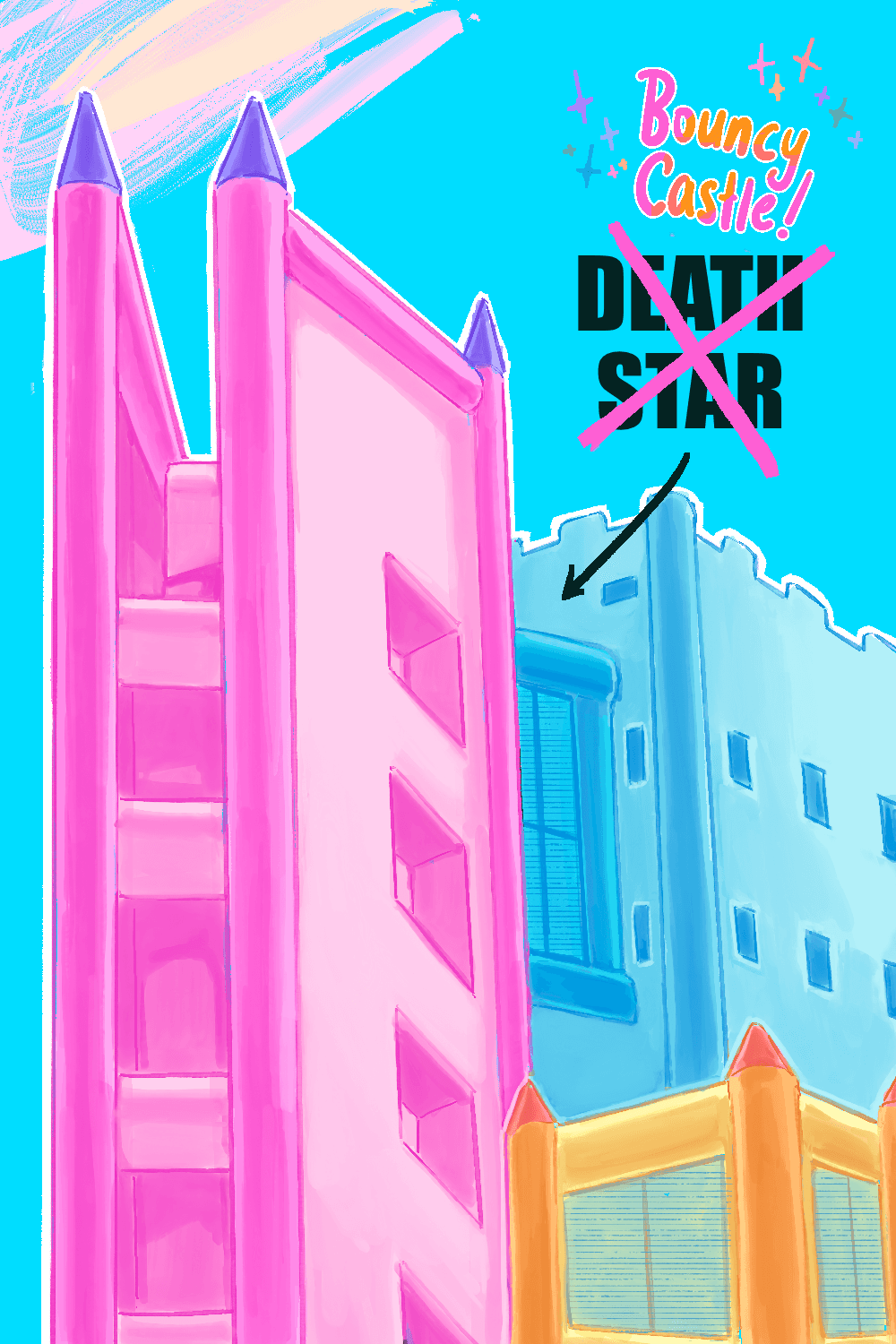
Professors worry students may actually be able to find and show up to office hours
By LILY KENROW — campus@theaggie.org
Amidst ongoing construction and seismic improvements across campus, UC Davis has announced that the Social Sciences and Humanities Building, colloquially referred to as the “Death Star,” will be torn down and replaced with a bouncy house.
The announcement did not come without concerns from students and professors alike. Sociology Professor Joshua Knapp shared that he is worried that students might actually be able to attend office hours, instead of getting lost while trying to find his office.
“What if students show up and I actually have to answer their questions?” Knapp said. “I don’t know the answers! They really should know to ask ChatGPT instead of coming to me.”
The change will also affect students looking to switch majors within the College of Letters and Sciences. The Letters and Sciences’ advising office, originally located in the north part of the Social Sciences and Humanities building, will now be a part of the bouncy house.
Joyce Mercado, a second-year history student who has changed her major 17 times, celebrated the change, saying it will make it easier to switch majors.
“Now I don’t need to fill out a form on OASIS every time I switch majors,” Mercado said. “I can just jump around 10 times, and I’ll be a Spanish major, and then jump another 10 times and I’ll be an economics major.”
With advisors freed from the oversight of major switching forms, students shared their newfound hope that they may actually be able to schedule an appointment within 10-12 weeks.
However, the original seismic safety concerns around the Death Star will not go away with its bouncy house replacement. To abate the seismic issues, planners discussed filling the inflatable structure with helium. The filling of the structure with helium would also be covered under the AB94 Seismic Improvement Project, which currently funds all other seismic improvements across campus.
The Death Star’s replacement may also serve as a trial run for other buildings on campus. Administrators are already discussing switching out the Memorial Union for one big skating rink and the Activities and Recreation Center (ARC) for a trailer park.
The bouncy house replacement also offers the university a chance to increase its number of Leadership in Energy and Environmental Design (LEED) certified buildings — the ratings and certification are given to buildings that meet a “green” standard. The school hopes that the replaced Social Sciences and Humanities Building will be considered for LEED if the building runs on energy that is self-generated by students and faculty jumping around.
“LEED certification is really about the sustainability of the building, and I think we really embrace environmental design by having a building made of PVC vinyl,” a university spokesperson said via email. “Instead of a long-lasting concrete structure like the current Social Sciences and Humanities Building, an inflatable building that will need constant refilling of helium, especially when there have been concerns of a helium shortage, will be the best choice.”
The energy generation will have to be constant, however, so the spokesperson also noted that the university is working with Transportation Services to allow students to pay their parking tickets and violations by jumping and generating energy for the building.
If the decision to fill the house with helium goes through, students may continue to find issues with getting to class, as there is no set solution yet on how to reach a floating bouncy house.
Hanna Patton, a third-year physics major, is worried that the replacement of the building with a bouncy house will change the building’s nickname as the Death Star. She’s hopeful that if the bouncy house is filled with helium, the name will stick.
“A floating bouncy house seems really cool,” Patton said. “If it’s floating, maybe we can still call it the ‘Death Star.’ But the school’s going to need to paint it grey or something.”
Perhaps a helium-inflated bouncy house was George Lucas’ true vision when he first created the Death Star in the Star Wars franchise — a floating bouncy house is way more intimidating and scary than a floating sphere in space, anyway.
Disclaimer: This article is humor and/or satire, and its content is purely fictional. The story and the names of "sources" are fictionalized.
Written by: Lily Kenrow — campus@theaggie.org