






Review: True to its name, everyone in ‘The Drama’ is part of a performance
Framing storytelling as a human compulsion, the film questions the things we share about ourselves and believe about others
BY JULIE HUANG — arts@theaggie.org
Disclaimer: This review contains spoilers for “The Drama”
In one sense, “The Drama” is about a wedding, which feels appropriate. Even the smallest slip-up in these high-stakes events might yield hours of stress for its participants, but that is nothing new. The intrinsic drama of a wedding, with all its symbolic spectacle and potential catastrophe, has been hammered home by centuries of media. What kind of twist, then, does “The Drama” put on one of the clearest breeding-grounds for human neuroses?
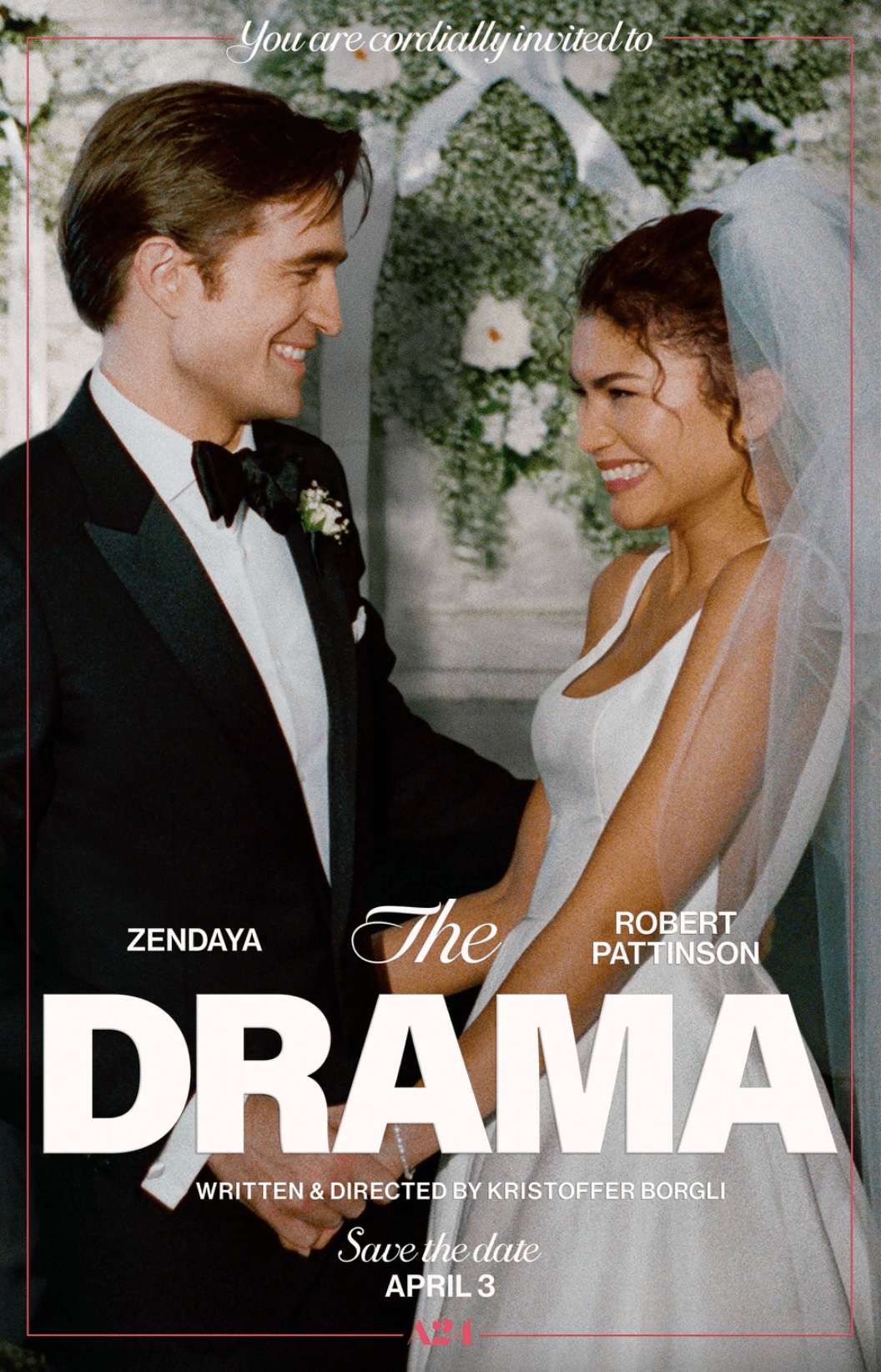
Written and directed by Kristoffer Borgli and produced and released by A24 Films on April 3, the film provides an answer that runs for 1 hour and 46 minutes across numerous genres, living up to its marketing as a “dark rom-com” or “dramedy.”
“The Drama” maintains an atmosphere of underlying anxiety in its characters and viewers, amplified by a score filled with shrill flute notes. This buzzing tension inspires the characters to act in neurotic ways, triggering a rush of second-hand embarrassment for audience members and hopefully earning the film the right to call itself a psychological horror.
Robert Pattinson and Zendaya’s performances as romantic leads Charlie and Emma are practically flawless. While onscreen, the viewer feels as though they are truly watching two comfortably middle-class Bostonians (though Charlie is actually British) navigate their way through wedding planning.
When the film starts, there’s a week left before the big day. Audiences are introduced to their relationship through the lens of the loving wedding speech that Charlie plans on giving to Emma. He runs through all the key scenes of their love — from their awkward meet-cute in a coffee shop, which he originally botched and then restarted at Emma’s prompting — to their first date, where he reveals that he completely lied about reading the book he introduced himself with. Evidently, they’ve moved past his white lie, because it’s been a couple of years since then.
The film takes ample time to establish Charlie and Emma’s personalities — an essential component of a good drama. Where Charlie fixates and ruminates, Emma is spontaneous and carefree; he loves how she can take his worries and turn them into something to laugh at. During their wedding dance rehearsal, Emma complains that the whole sequence is too polished and performative, to which the instructor replies, “That’s what getting married is about.”
It’s her honesty that becomes Emma’s downfall. During a tasting session for wedding refreshments, Charlie and Emma get drunk with their best man, Mike, and maid of honor, Rachel, who goads everyone into sharing “the worst thing they’ve ever done.”
Their answers cover a lot of ground. Mike used an ex-girlfriend as a human shield against an angry dog, Rachel locked a neighbor in the closet of an abandoned building as a child and Charlie cyberbullied a high school classmate to the point where they had to move away.
It’s really Emma’s answer that shatters the pre-nuptial optimism and harmony. In high school, she planned and nearly executed a shooting using her dad’s rifle, but never carried it out.
So begins the film’s enduring conflict. Rachel, having a cousin who was paralyzed in a school shooting, immediately becomes hostile to Emma, while Mike remains placid. Charlie is thrust into a downward spiral of anxiety that inches closer to insanity with each passing day — is he set to marry a psychopath? What should he do now?
That same night, lying next to Emma in bed, Charlie brings up the Freudian notion of repression, suggesting that things left unsaid have ways of surfacing. Perhaps it’s an attempt to get her to share more about why she planned such a thing, but it ends up becoming Charlie’s self-fulfilling prophecy.
Outwardly, he tells Emma that he still loves her. He says that this revelation changes nothing. All he asks is that she explain herself and her history, because all he wants is to understand more about her.
Inwardly, Charlie panics, paralyzed by indecision. After the revelation, Emma’s spontaneity, supposed empathy and free-spirited attitude all begin to look different. Without really committing to a choice, Charlie struggles onwards toward the wedding, verbally diminishing his rapidly increasing anxiety, while his actual behavior grows visibly erratic and frenzied to others.
He deletes his wedding speech, but all he can think of as a replacement is “Emma, I know worse people than you.” With one confession, what once was the love of Charlie’s life is now a danger, a mystery, an unknown variable, and he begins to treat her as such. The film thus presents the reality that humans experience as intensely fragile, vulnerable to complete destruction from the effects of mere words.
At the heart of “The Drama” is the question of what it means to be a person burdened with the responsibility of acting on limited information while always subjected to the perceptions of others. Why is Emma’s plan, chilling though it is, more deserving of scrutiny and condemnation than the tangible consequences of Mike and Rachel’s worst actions?
The latter two minimize and downplay the effects of their choices, and the strength of their moral characters is never truly called into question by those around them. Perhaps it is this lack of scrutiny and pressure that allows them to continue to live in a reality where they are essentially good people.
Conversely, the film suggests that it is Charlie’s indecisive reaction to Emma’s secret that truly creates the rift in their relationship. He no longer trusts his previous convictions about her, but neither is he willing to fully believe she is an evil person. He no longer has a script to guide him, unprepared both to give his wedding speech and to confront his damaged ideas about who she is and who he is in relation to her.
In the absence of convincing frameworks of belief, people struggle to fill in the gaps on their own, drawing from what’s familiar and expected. “The Drama” comments on the ways that individuals might be influenced, expanded upon and reduced by wider narratives.
Charlie, as a Brit, suggests to Rachel and Mike that Emma’s brief stint with guns as a teenager was fueled by the United States’ longstanding cultural fixation on firearms. Rachel questions, scathingly, if Emma’s apparent affinity for violence is “America’s” fault. This mocking question might actually hold some weight, though the film refuses to dictate which stories are worth believing in.
Characters tell stories over the course of the main narrative, which are often accompanied by visual sequences implied to come from the characters’ imaginations. Each sequence is shot in an equally realistic fashion, even though the audience knows that some are truthful and some are not.
One of the most memorable sequences occurs the night when Emma’s secret is revealed. Charlie and Emma go to bed blanketed in silence. What follows is a shot of their wedding venue, filled with upended tables shrouded in white tablecloths, which are quickly staining red from the bloodied bodies atop them.
This shot is implied to be a nightmare that Charlie or Emma had throughout the night, and is not once verbally acknowledged by the characters. Yet its existence within “The Drama” becomes a haunting presence, as if the film intends to impart to viewers the same anxiety that torments Charlie. Might it actually happen?
Borgli thus weaponizes the very nature of film as an artifice where every second is part of an intentional performance. After witnessing the bloody scene early on, the audience is left to stew in the possibility for the remaining runtime. Is it foreshadowing, or a fake-out? Is anyone ever in any real danger, or is it all imagined? In a mirror of Charlie’s experience, the viewer won’t get a clear answer until the performance ends.
Written by: Julie Huang — arts@theaggie.org