






UC Davis artist Nathan Henry selected for prestigious Yale Norfolk Summer Program
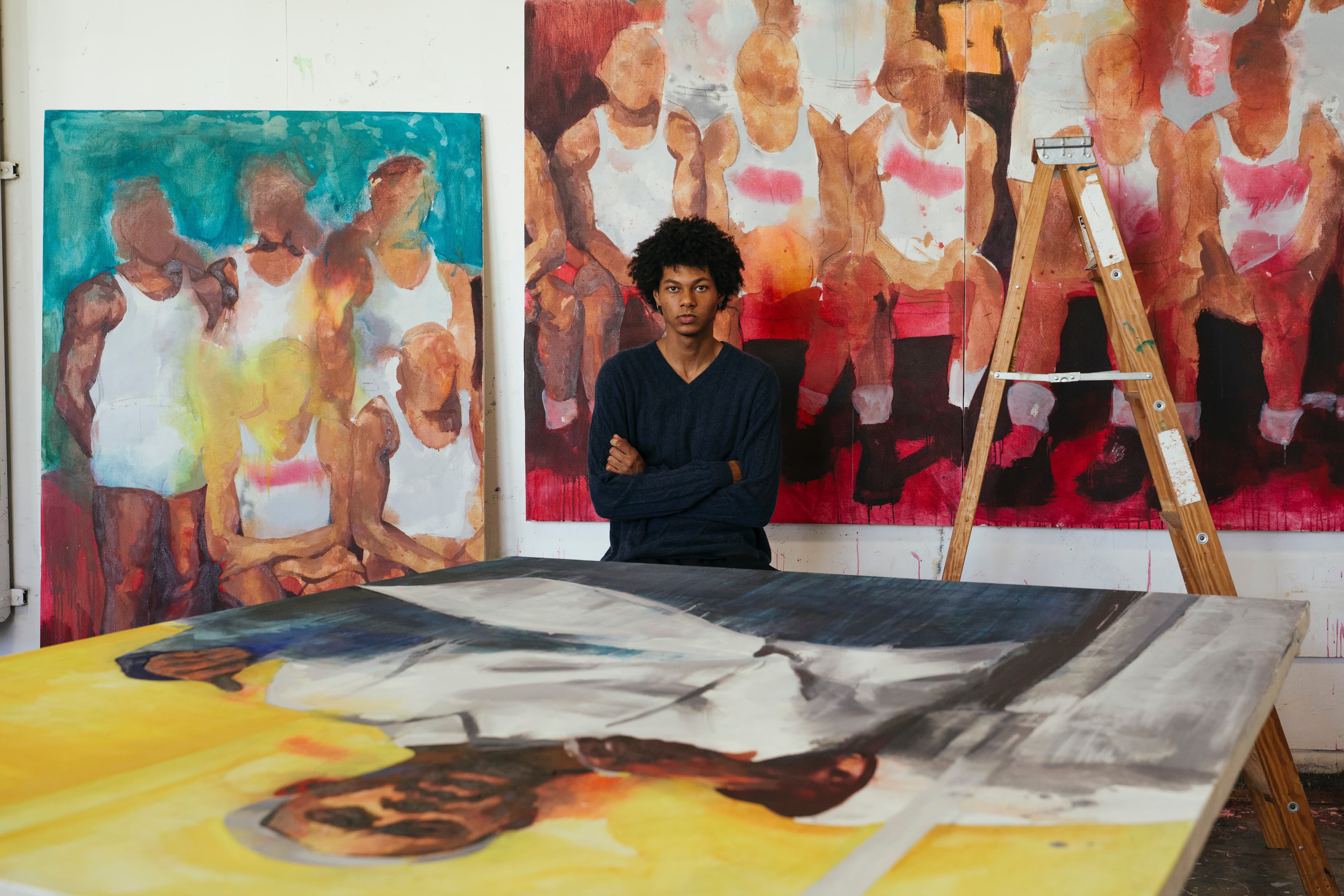
The undergraduate art studio student discussed his inspirations and artistic development
By JONAH BERMAN – arts@theaggie.org
Nathan Henry, a third-year art studio major, has been enamored with painting for as long as he could remember.
“Even before I could walk, I had paintbrushes in my hands,” Henry said. “Art was always something that I did. It was just part of my life, part of the house.”
Raised in a family of artists, Henry decided that he wanted to pursue art professionally in high school, leading him to UC Davis to continue his studies. Within the town, he has an upcoming solo exhibition at the John Natsoulas Gallery in January 2027.
Both the town of Davis and the university’s unique atmosphere complement Henry’s creative process.
“It’s a quieter environment, [...] which helps me create my work,” Henry said. “I’m from Los Angeles, which, in comparison, is a really busy and bustling environment. So here, I can really quiet down and concentrate.”
Recently, Henry was invited to attend the Yale Norfolk Summer Program, a prestigious initiative that selects 26 rising senior art students from around the world to work in individual studio spaces and participate in Yale College art courses. After receiving a nomination from the UC Davis Art Studio Department faculty, Henry submitted a portfolio and a 90-second video. While he remains undecided on exactly what he’ll create, he is greatly anticipating the program.
“The Yale School of Art is this kind of beacon in the art world,” Henry said. “It’s this place for critical engagement and experimentation, and I think it’s going to be an amazing opportunity to strengthen my work and develop my practice."
However, this isn’t the first art residency program that Henry has participated in during his time at the university; he also studied at the Royal Drawing School in London through a program funded by philanthropist Maria Manetti Shrem.
Henry noted his appreciation for the Royal Drawing School’s open-minded artistic philosophy.
“Being there was indescribable,” Henry said. “It was this place with a great culture of play, and it allowed me to feel comfortable taking risks."
In the United Kingdom, Henry also spent time at the Dumfries House in Scotland — a 1700s historic estate made available to artists through the Royal Drawing School — where he developed drawings of nature that were critical in fostering his artistic development.
“I was trying to give up the control that I have over my medium,” Henry said. “Water was important for me to use because the quality of water is that it just flows, it goes where it wants. And now I’m pouring buckets of acrylic paint on my canvases, making these color fields. So while my work in Scotland looks nothing like what I’m doing now, there were seeds that I was planting during my time in the U.K.”
Henry mainly works with acrylic and oil paints, often on large canvases that usually take him from multiple weeks to months to complete. To complement the paint, he has pursued experimentation with other media, such as in the recent piece “Corn is Maize” (2025), which utilizes pom poms to represent corn kernels.
When planning his pieces, Henry seeks to achieve great attention to detail without sacrificing spontaneity, an aspect of art which he views as foundational.
“I want to say I’m not a planner, but I am,” Henry said. “But my plans are very loose. I feel like there’s so much power in spontaneity. If you’re wedded to how things are, then you’re eliminating the possibility of how things could be.”
Henry holds admiration for a wide assortment of painters, ranging from French classical artists, which Henry revered in his youth, to contemporary figures such as Michael Armitage and Marlene Dumas.
“I love art, I love looking at art and I look at a lot of art,” Henry said. “As an artist, you kind of have to know everything.”
He also frequently draws inspiration from artists in different mediums, such as theater or literature; for example, one painting’s title, “Sugarman,” is sourced from the novel “Song of Solomon” (1977) by Toni Morrison.
Looking through his body of work, Henry highlighted certain subjects he frequently returns to.
“The figure is a subject that is recurring in my work,” Henry said. “The figure, the Black figure. All the figures in my work or the characters I create in my work, they’re all kind of self-portraits, in a way. They’re a way for me to think through the place that I have in the world.”
Furthermore, notions of performance and societal roles are seen often throughout Henry’s oeuvre; he invoked theatricality when describing the design of his pieces, likening his compositions to a stage. Henry has also explored the theme in multiple paintings that depict soldiers.
“Soldiers were something that I was fascinated by because of my lack of understanding and who I am in relation to the reality of a soldier," Henry said. “My work was kind of about examining the tension between the roles that we play in our lives and our true nature. And the tension between the two is exciting to me.”
After graduation, Henry plans to pursue a Master of Fine Arts (MFA) degree and continue painting; looking forward, he remains steadfastly passionate about the infinite possibilities of art.
“Drawing is seeing,” Henry said. “Painting is seeing. Even writing is seeing, as Ocean Vuong says. Every mark does something, you know? And when you put that next to that, and change this, it changes everything. That’s the beautiful thing about art.”
Written by: Jonah Berman — arts@theaggie.org