






America must start playing chess, not checkers
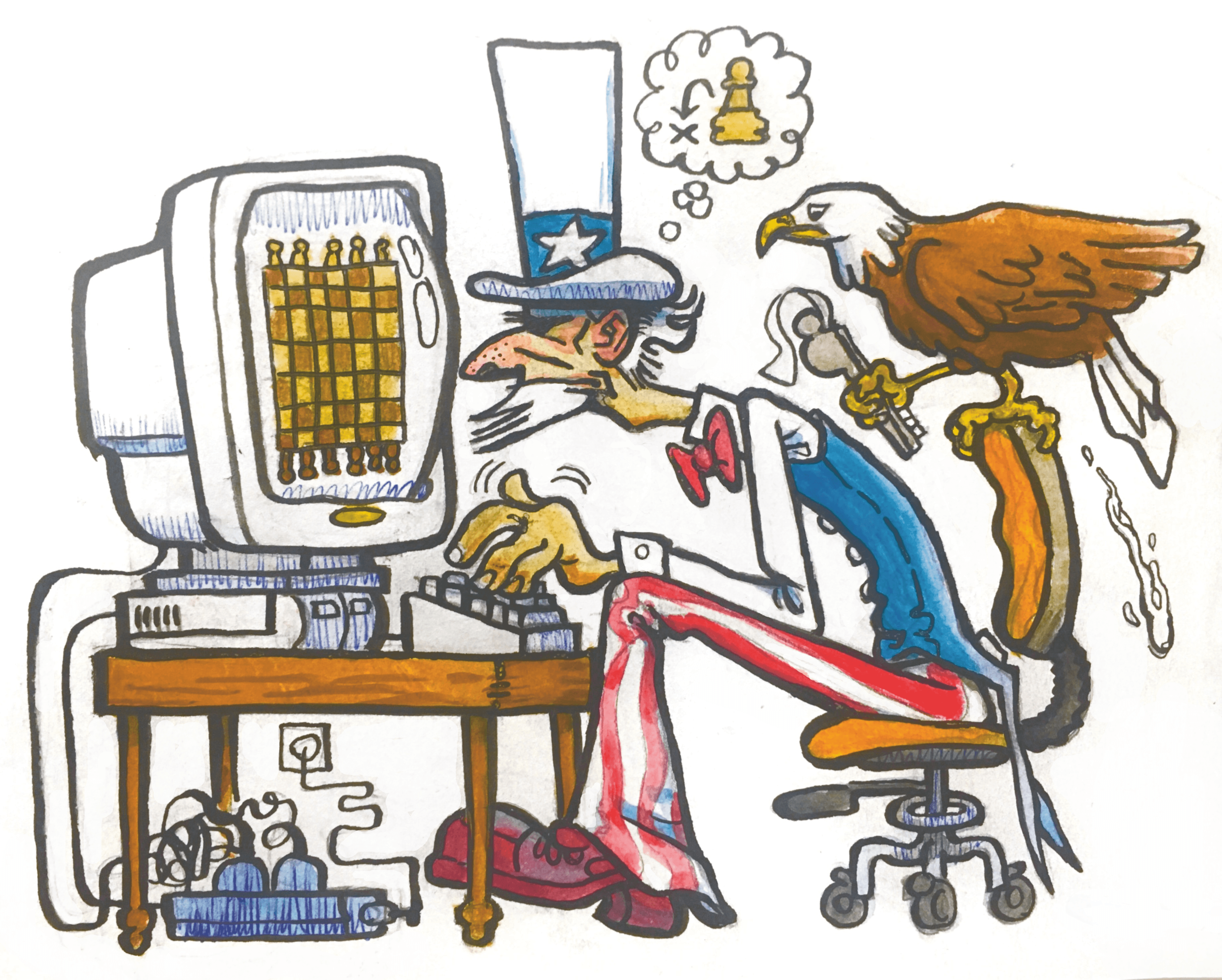
How a famous game theory experiment can improve American foreign policy
By YUENJO FAN — opinion@theaggie.org
Following the April 7 ceasefire in the United States-Israeli war on Iran, traffic in the Strait of Hormuz has dropped up to 95%, and there have been over 10,000 military and civilian deaths — including 13 U.S. service members. In just over a month, an indelible mark has been left on the international community.
Though American officials continue to justify the war by citing an imminent nuclear threat, evidence has suggested otherwise. Tulsi Gabbard, U.S. director of National Intelligence, reported in a sworn statement to Congress that Iran has not been building nuclear weapons — directly contradicting the American casus belli, a situation that provokes or justifies a declaration of war.
The 2025 bombing of Iranian nuclear facilities in “Operation Midnight Hammer” was claimed by the White House to have destroyed Iranian nuclear capabilities. However, preceding the 2026 escalation, President Donald Trump’s special envoy contradicted this by proposing an unrealistic deal requiring an immediate halt to all of Iran’s nuclear program. Unsurprisingly, it was rejected by the Iranian regime.
Both the contradictory war justifications and desultory peace negotiations exemplify how recent American foreign policy has echoed aggressive imperialist and Cold War mentalities, even into the 21st century. Whether it be erroneous reports in the Gulf of Tonkin leading to the Vietnam War or falsified accusations of weapons of mass destruction to justify intervention in Iraq — and now Iran — the same aggressive foreign policy playbook has been used time and time again.
If the U.S. still seeks to maintain itself as a reliable leader of the international system, it must significantly alter its foreign policy strategy to prevent further conflicts.
Introduce the famous Axelrod’s tournament, a game-theoretic experiment conducted in 1980 by political scientist Robert Axelrod, which could hold the blueprint for America’s best course of action moving forward. Officially titled the Iterated Prisoner's Dilemma tournament, the experiment sought to observe whether cooperation or defection — a positive-sum or zero-sum approach — would constitute a more successful long-term strategy.
The experiment pitted computer programs of different tactics against one another in a tournament-style competition. Axelrod levied different strategies against one another, with some programs always seeking defection, while others always cooperated and the rest remained somewhere in between. When one program defected while the other cooperated, five points were awarded to the former while the latter received zero. When both programs cooperated, each received three points. When both programs defected, they were awarded only one point each.
What Axelrod found was that, regardless of circumstance — the experiments were run multiple times under different conditions to ensure accuracy — the program that favored cooperation via a tit-for-tat strategy always came out on top. This program never defected first, retaliated only when defected against and prioritized cooperation and forgiveness. With this, Axelrod demonstrated that a measured approach that neither sought conflict nor allowed itself to be exploited proved to be the most effective strategy.
Borrowing concepts from this model would require a categorical reassessment of the current administration’s “peace through strength” and “America first” policies, alongside other similar concepts employed in the past. This is not to say that America should neglect positioning its own interests at the forefront, but rather that implementing Axelrod’s philosophy means emphasizing the importance of employing cooperative means — such as alliances, economic goodwill and soft power — to America’s advantage. In other words, we must welcome genuine partnership on the world stage instead of defection, yet at the same time rejecting appeasement or submission. Since international relations are not one-off interactions; securing long-term trust and relationships is key to rebuilding confidence in America's global authority.
The rationale behind the Iran war shows a clear imbalance, where the impetus of hegemony and the desire to retain American primacy have taken precedence over promoting peace or liberal democracy. In Iran’s case, its ideological differences, refusal to abide by the petrodollar system and subversion of an American-Israeli-dominated Middle East have drawn the ire of American foreign policy — leading to the aggression seen today — cloaked in the excuse of a nuclear threat.
Furthermore, America’s constant aggressive and selfish demeanor has proved both inappropriate and inefficient for a global superpower. America cannot expect to humiliate traditional allies by threatening withdrawal from the North Atlantic Treaty Organization (NATO) or annexation of allies, then solicit their support during international crises. It is equally unreasonable to expect the international community to hold America in good faith after it has raised the average effective tariff level to 11% (a record high since 1943). Furthermore, the closure of the U.S. Agency for International Development and the slashing of foreign aid only detracts from American soft power, leaving a vacuum ripe for the taking. All of these have become central to current American foreign policy failures, and also demonstrate how we’ve chosen defection over cooperation.
If America still seeks to be respected as a global leader and guide the world through tumultuous times, it cannot be the driving force behind the chaos. In this rapidly transforming world, the most stable, influential and accommodating power will be increasingly favored by the international community.
To employ more cooperative measures is to lead by example and reestablish global faith in America while it still can. To continue with defection is to plunge the world into further uncertainty and upheaval, which, at worst, will collapse the international structure. U.S. foreign policy must choose wisely or risk repeating history’s violent cycle once more — only this time, without a guarantee of a second chance.
Written by: Yuenjo Fan — opinion@theaggie.org