






Hot, new AI slop enters the villa
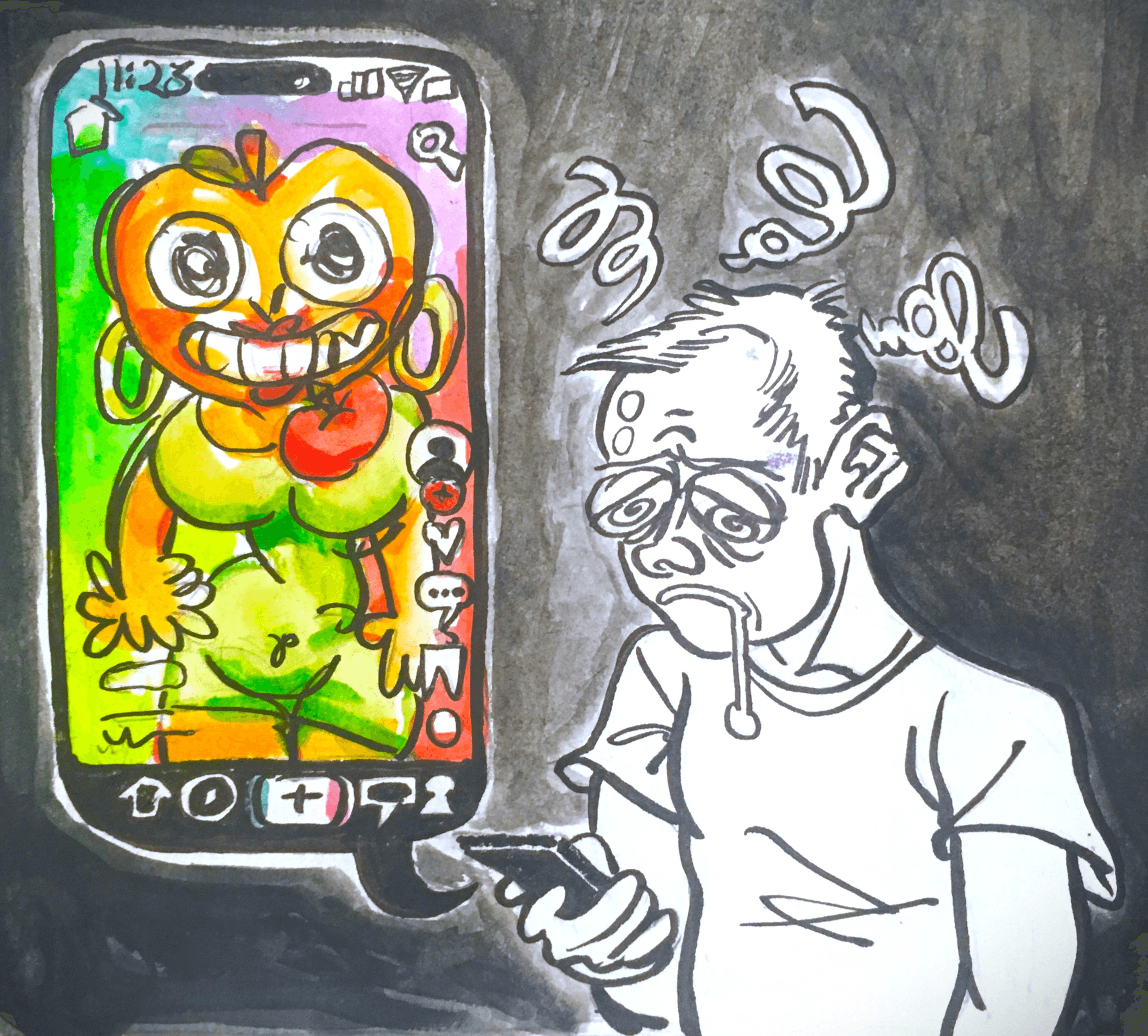
As ‘Fruit Love Island’ takes the Internet by storm, it’s time we have an honest conversation about AI art
By SABRINA FIGUEROA — sfigueroaavila@ucdavis.edu
The other night, I was talking to my sister about shows and movies we wanted to watch when she asked me, “Do you watch ‘Fruit Love Island?’”
“No,” I said. “What is that?”
She proceeded to show me a generative artificial intelligence (AI) TikTok mini-series of fruit characters with human features modelled after real “Love Island” bombshells. They’d yell at each other, echo iconic funny moments from the original series and flirt with each other.
I couldn’t help but feel uneasy when my sister showed me the TikTok page — @ai.cinema012 — full of videos that had a human-like kiwi with a bowl haircut as the thumbnail. What was worse was that every video had millions of views, with people — even celebrities — genuinely enjoying it.
Once AI-generated content started taking off on the Internet, people began to discuss the possibility of AI in film and TV. I used to think that humans would never stand to watch content that was AI-generated because of the uncanniness of the ultra-smooth and illogical details in the AI art style. Clearly, I was wrong.
Humans are so accustomed to using media for specific needs — especially for entertainment. That can mean a plethora of things, from hate-watching to watching for pleasure, but, no matter what, attention is attention: and attention is money. If we continue to let AI art take over the content we watch, it won’t be long before we see it in theaters, TV shows, advertisements and exhibitions; they’ve manufactured our consent. The more that we see AI in our daily lives, the more normalized it becomes in everything. If we dislike that it encroaches on every aspect of our lives, we eventually learn to simply live with that dislike until it becomes obsolete.
Another discussion to be had is whether or not AI-generated art — including TV shows and films — will ever be up to par with human art. AI art (if you can even call it that) receives backlash, and deservingly so. Human art reflects the creativity of the mind and the woes and wonders of the human condition. The fact that it is done by a human is the beauty of it, and we can look at the history of art movements to prove it.
While AI itself is manmade, it was created as an automaton — a robot who doesn’t experience the human condition, but merely memorizes it from data and other art we have created and spews it back out to us. Whether that is ethical is a whole other concern, but the point is that it lacks the soul, emotion and challenge that comes with being human; its art may be pretty or “perfect,” but it will never compare to the craft of real artists.
Of course, AI is meant to be a tool just like a pencil is a tool, but the difference is that the AI does most of the thinking and creation while the pencil is still controlled by you — the work that comes from that pencil is yours and no one else’s. If you let AI do a majority of the work, you have achieved nothing except engineering a prompt. Though that’s a skill in this new technological era, it doesn’t make you an artist.
It’s important to think about the media we consume: from what it is to who created it to how it will impact us. While your individual view may seem inconsequential, millions of “inconsequential” views aggregate to something substantial. At that point, your intention of watching — whether to make-fun or to enjoy — doesn’t matter: It all translates into demand.
“Fruit Love Island” will not be the last time we see a ridiculous AI show, given that people pay attention to it regardless of its soulless art style. It has the demand, giving other content creators the green light to create similar series. The success of these “hot” fruits demonstrates that our actions have consequences even if we think they won’t. While we can’t control the chaos of the world, we can control — and be more mindful of — our consumption and behavior.
Written by: Sabrina Figueroa — sfigueroaavila@ucdavis.edu
Disclaimer: The views and opinions expressed by individual columnists belong to the columnists alone and do not necessarily indicate the views and opinions held by The California Aggie.