






Extravagant or ostentatious?
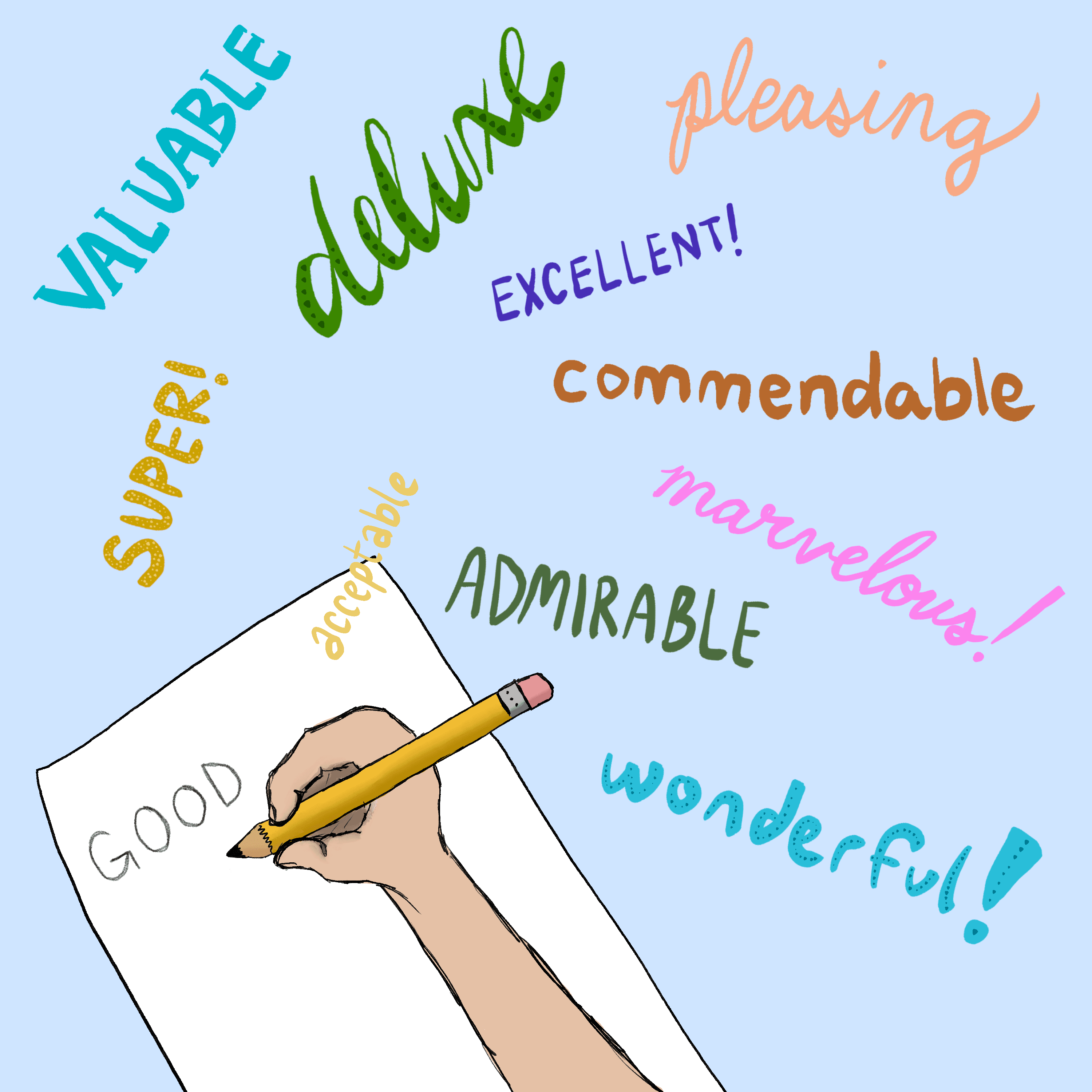
The art of a masterfully niche word
By AMBER DUHS — alduhs@ucdavis.edu
I’ve spent the last four years of my high school and college career in the student journalism space. From writing human interest stories to highlighting basic resources to presenting my stark opinions on the social situations we all encounter, one thing has remained constant: my eternal mission to find a perfectly crafted, annoyingly pretentious and slightly obscure piece of vocabulary to sneak in.
I live for the thrill of my editor highlighting my meticulously constructed sentence, proclaiming their adoration for my linguistic knowledge. I giggle to myself as I click away at my keyboard, thinking, “They’ll love this,” whilst anticipating the moment I get to dramatically read it aloud and hear my tactful syntax jump off the page.
Language has a sort-of artful obscurity to it. With nearly 1 million estimated words in the English language, there’s no telling what type of artful lexicon those around us possess. As you’re thrown into various academic spaces, you’re bound to hear a new or unfamiliar word, a unique grammatical structure that sounds interesting (and is surprisingly correct) or even a cadence which (unbeknownst to you) has the smoothest quality to it.
Yet, despite the supposed ubiquity of these encounters in a university setting, I feel we’re losing the art of a good word — a word that stops a conversation and allows us to gather, learn and listen.
Maybe I'm just an incredibly pretentious person in a college freshman's body, or have too grand of expectations for the vocabularies of those around me, but what happened to being okay with not knowing?
As a humanities student, I encounter — almost weekly — a word that is either unknown to me or has a definition and use that I haven’t fully grasped. Each time, I follow the same routine: read the word, read the definition and jot it down in my notes.
It’s an extra effort — one that will almost certainly go unnoticed — but the pros far outweigh the cons. We must prioritize our knowledge and our ability to articulate complex viewpoints above the simplicity of embarrassment, or even worse, ego.
I’m aware this seems a tad self-effacing, but my point remains: When did we stop pursuing knowledge? And more importantly, when did we start making fun of people for using words others don’t know?
In social settings, one may feel the urge to throw in a word they’ve recently read or heard — it’s on the tip of their tongue, and the moment seems just right. They practiced the desired sentence in their head, confirmed the words meaning and tone, and they prepared to slide it into the conversation carefully — or so they thought.
In high school, I had a close friend of mine who, whilst addressing a group of our peers, described a writing assignment as not particularly “arduous.” The minute the consonants slipped off her tongue, my ears perked up. Arduous? In context, I had a general understanding of the definition, but as I contemplated the situation in which this word somehow fell out of a Victorian-era novel and into her internal dictionary, an uproar occurred.
We laughed and giggled at the obscurity of her statement — at the archaism she brought to our informal chat. And yet, I added the word to my lexicon. I’ll admit that the humour of the situation helped commit it to memory, but I digress; I use it to this day.
The ability to put one's ego aside for the sake of the American people's literacy is an interesting conviction, but it’s one I feel strongly towards. The art of a crafted word-choice is personal; it tells a story about what novels one has read, or which spaces and stories they’ve interacted with. Their proclivity towards recondite over obscure, or whether they prefer sweet versus savory, are one in the same.
I implore you to lean into the uncomfortable space of admitting that, with one million words in the English language, you too will have your moment where you encounter the word “arduous” for the first time.
Language fundamentally informs who we are: it's our expression and our creativity, and it's in a constantly changing state. We, then, must allow ourselves to grow with and around it, not away from it.
Written by Amber Duhs — alduhs@ucdavis.edu
Disclaimer: The views and opinions expressed by individual columnists belong to the columnists alone and do not necessarily indicate the views and opinions held by The California Aggie.