






FADS Picnic Day Fashion Show ‘Laced in Reverie’ debuts student designs
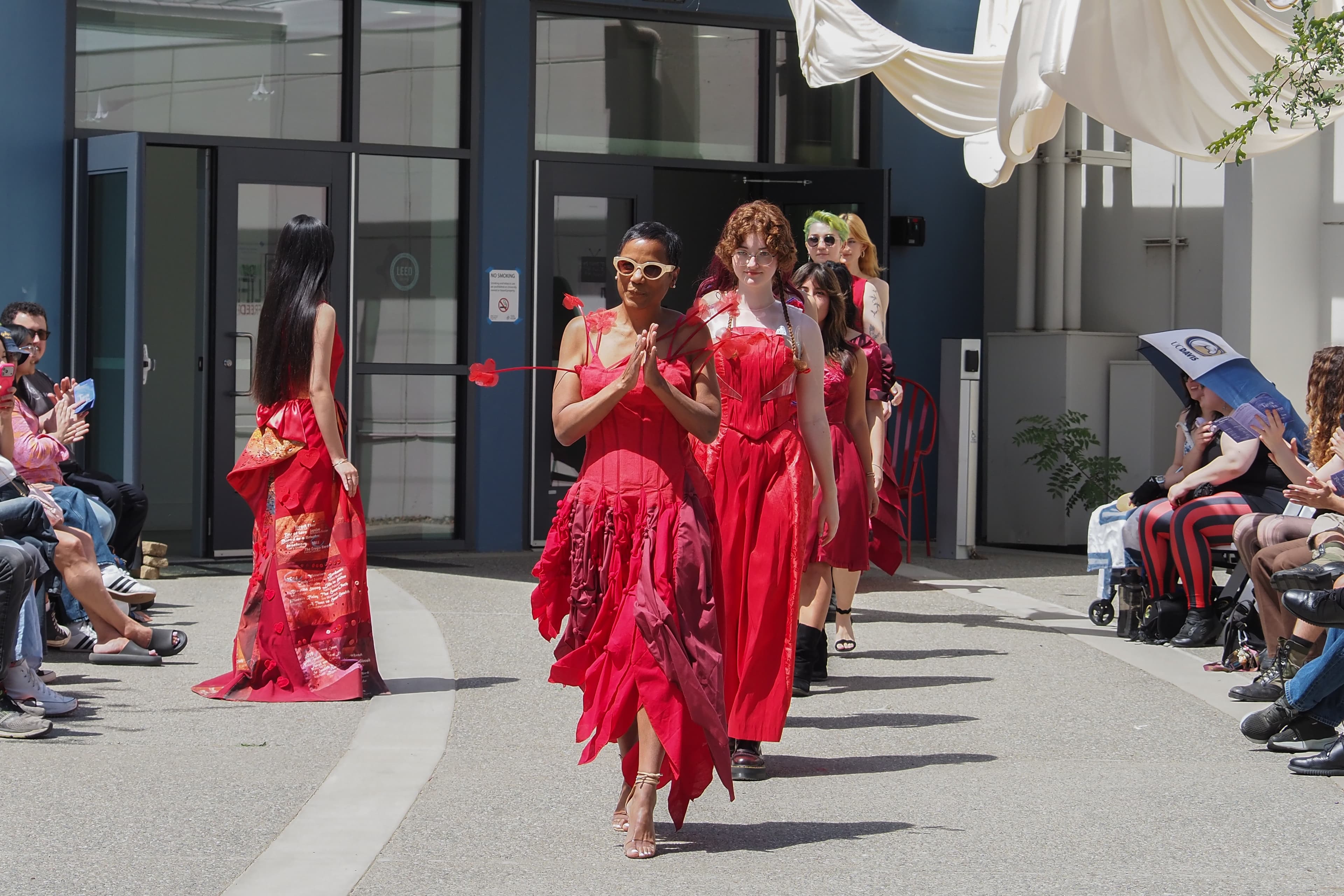
Student collections reflected each designer’s individuality and hard work across several quarters
By TALAR KESHISHIAN — arts@theaggie.org
On Picnic Day, Cruess Hall Courtyard was brought to life by a collection of handcrafted garments made by student fashion designers. The annual fashion show, organized by the UC Davis Fashion and Design Society (FADS), has been a beloved staple of Picnic Day for over 30 years, celebrating students’ creative ingenuity and dedication to fashion design.
As the music died down and the crowd found their seats, the show was introduced by FADS Co-Presidents Vivian Le, a fourth-year cinema and digital media and communication double major, and Amy Lee, a fourth-year design major. The pair explained the meaning of the show’s theme “Laced in Reverie” and how it represents the work of students in the design program.
“This year’s theme ‘Laced in Reverie’ invokes nostalgia and honors the role of memory and self-discovery,” Le said. “Each designer whose work is being showcased today has poured themselves into these pieces and, as a result, they’ve created reflections of who they are spanning across time and memory. ‘Laced in Reverie’ is a reminder to introspect and dream.”
The show was set into motion with 15 designs from the FADS Single Garment cohort. The cohort provides the opportunity for designers at any level to try their hand at fashion design. Julia Snell, a fourth-year environmental science and management major, discussed the rewarding artistic process in bringing her design, entitled “The Swan,” to life.
“This has been such a fulfilling process,” Snell said. “Seeing your creative ideas become something physical is a feeling that you can’t replicate. Going into the sewing lab and working on this project has been the favorite part of my day for months.”
Snell highlighted how the welcoming environment of FADS contributes to a productive space for inspiration and collaboration.
“Everyone in the show is so incredibly talented and wonderful to each other,” Snell said. “Everyone just lifts each other up and helps each other out by talking about our designs. My groupmates and other people I’ve met in FADS are great people. I’ve enjoyed the process a lot and I’m proud of everyone in the show.”
“The Swan,” an elegant dress constructed with pink satin and white chiffon, opened the fashion show with an ethereal track as accompaniment. Cohort model Eliza Hudson, a second-year neurobiology, physiology and behavior major, described the riveting experience of walking down the runway in the dress.
“I felt beautiful and that made me feel confident about walking out,” Hudson said. “I was so proud to wear what was hours upon hours of work and all my group’s skills culminating into this absolutely stunning final piece. Seeing everyone’s eyes widen and hearing audience responses made it feel good to be the person that could show everyone our group’s design.”
The Single Garment segment was followed by the Red Dress Collection, mentored by Professor of Design Adele Zhang. The characteristic red color of the 11-dress collection aimed to make a powerful statement on the importance of women’s heart health awareness.
“These red dresses make a visible commitment to standing together, raising awareness and taking charge of our own heart health,” Zhang said.
Isabella Mo, a second-year electrical engineering major, praised the fashion show’s emphasis on cultural and community advocacy.
“It brought into my perspective what a fashion show could be,” Mo said. “It doesn’t just have to be showing clothes that someone put together. It can champion a cause and incorporate less traditional fashion show aspects, bending the boundaries of what a fashion show should be while also making it cohesive.”
The final segment of the show featured eight designers from DES 179: Signature Collection, a capstone course that invites students to design their own collection of three to four handcrafted garments. The segment commenced with a collection from Kathryn Choy, a fourth-year design major and FADS cohort officer, entitled “Right Where I Belong.” Choy’s collection featured four denim garments adorned with red Chinese tassels and embellishments to symbolize the union of her cultural identities.
“My collection blends Eastern motifs with Western fabrics,” Choy said. “I felt that this was a good way to celebrate both my identities as a Chinese American. The denim is from the American part and the Eastern motifs are from the Chinese part.”
Choy detailed how creating this collection encouraged her to push herself to new limits.
“Creating this collection has helped me bring out my best traits when it comes to designing and challenges my worst ones,” Choy said. “I’ve really been able to push myself, which has led me to becoming a better designer overall.”
A crowd favorite was “Debut” by Giang Ta, a fourth-year design major. The collection embodied his mission to dismantle stereotypes and empower Asian American communities through fashion. The cultural significance was brought to life with a spirited lion dance, which transformed into two garments that incorporated traditional Asian textiles with a modern take.
“What we’re going for is contemporary explorations of traditional Asian American garments,” Ta said. “This is my version of a lion dance outfit turned into an áo dài. It’s made from a very utilitarian, practical standpoint for the lion dancer. When the lion dancer is out of the lion, they can still wear this beautiful garment that signifies their importance as a lion dancer, but also their respect for Asian American culture.”
For Ta, the collection exemplifies not only the culmination of his work in DES 179, but the beginning of a creative revolution with his fashion brand titled “Gin and Giang.”
“We really wanted this to be a big moment,” Ta said. “I want my garments to signify the revolution of Asian American culture. When you wear one of my pieces, you’re saying that you believe in our mission to form a cultural movement that redefines the connotations of our current culture. We, as the implicit model, need to do better in supporting our peers and in supporting each other.”
Ta also remarked upon his interpretation of fashion design, broadening the scope to the purpose of the fashion show as a whole. Together, student designers were able to create new spaces for audience members to view their creations.
“Fashion design is about your ability to turn nothing into something,” Ta said. “It’s about your ability to build not only garments, but a world out of it.”
Written by: Talar Keshishian — arts@theaggie.org