






Breaking News: Your Canvas discussion post has been awarded the Pulitzer Prize for Fiction
What constitutes as fiction these days?
By ABHINAYA KASAGANI — akasagani@ucdavis.edu
It was around 12:01 a.m. when I got notified of my selection as one of the finalists for the 2026 Pulitzer Prize for Fiction. Occurring mere moments after I had scrambled to submit a discussion post by 11:59 p.m., I was almost positive I was hallucinating, or maybe even already dreaming (I was running on three hours of sleep, at best). I rubbed my eyes and furrowed my brow: there was no way. I mean, I was good — hell, great even — but I’m A+ good, not Pulitzer good.
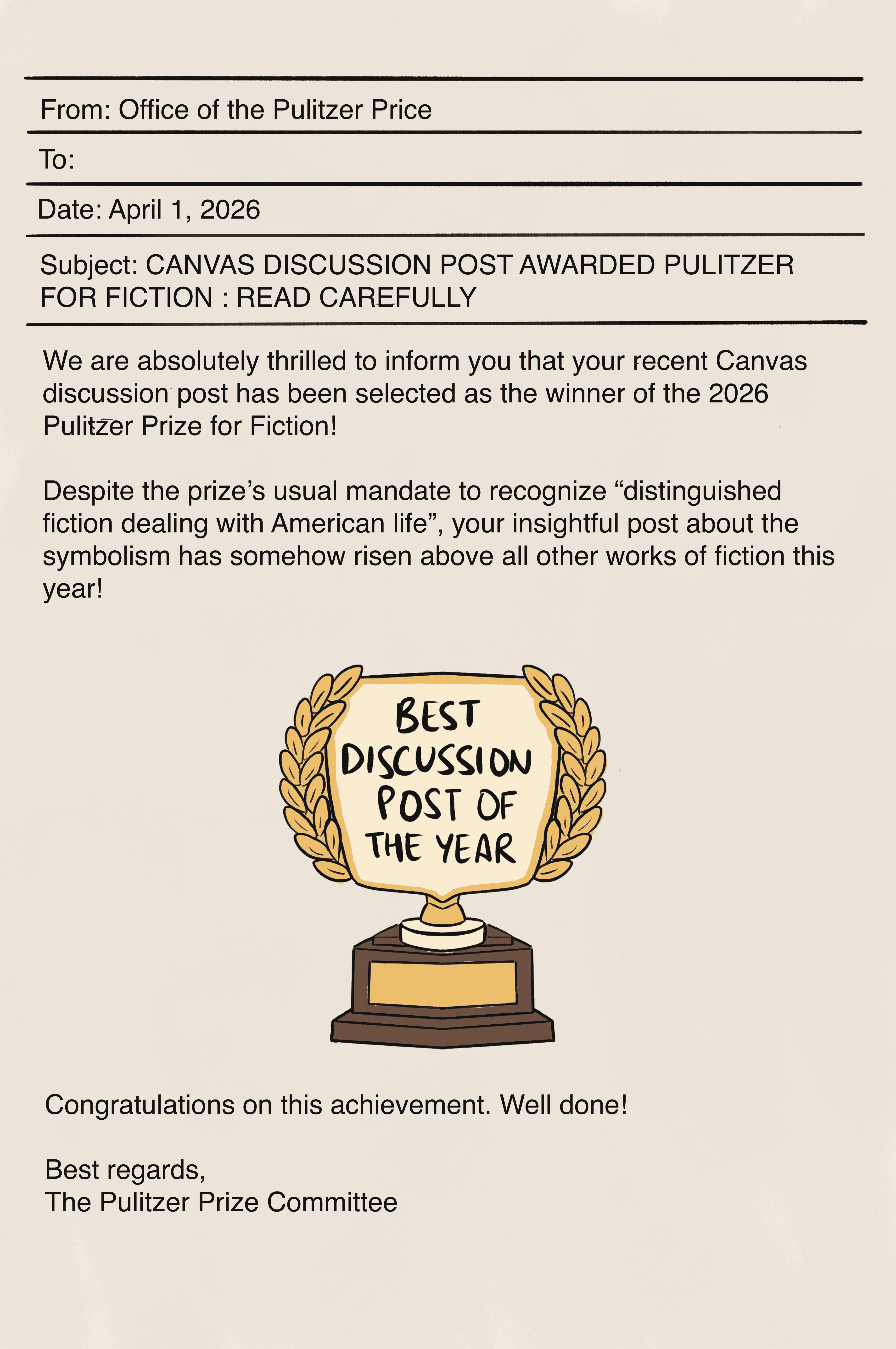
That’s when I received the email. There it was, in bold, red letters: CANVAS DISCUSSION POST AWARDED PULITZER FOR FICTION: READ CAREFULLY. To the best of my knowledge, the Pulitzer Prize Board always announced its winners in April, only informing applicants whether they were finalists beforehand. Maybe it was a prank? I mean, they had said the new submission method did not require the writer to submit since the prize committee had decided they were more interested in finding fresh talent. Was it possible to win despite not meeting the criteria at all?
I skimmed the email again, catching glimpses of phrases like “new submission method for 2026,” “distinguished fiction dealing with American life,” “notified announcement,” “$15,000” … hold up, fiction?
While I can admit that my discussion post was partially unoriginal (in order to meet the word count, I had spent a large part of the response quibbling about contradictions that didn’t exist), it was definitely not made up. I was almost offended (but I really couldn’t get myself to care all that much); I had aimed for a certain spunk and freshness in this discussion post, having felt bogged down by the lackluster quality of prose that most assignments during my college career had necessitated.
Still, I was excited not only by the glory that came with winning the Pulitzer, but also by the prospect of worn volumes being reprinted and distributed all around the world. Everywhere you went, someone was bound to have a copy in hand, whether or not they particularly cared about how commendable your attempt was.
I knew better than to blindly subscribe to the promise of iconography, recognizing that one prize wasn’t necessarily emblematic of my prowess as a writer. Still, it has always felt like the Pulitzer is the writer’s Swiss knife. Now, I was fully protected from ever having to prove myself as a writer. I would never again have to remember that one should use “bemused” to mean “confused,” not “amused,” or that “fulsome” means “profuse” and not “full.”
Around 1:25 a.m., I received a second email, asking if I wanted my response on the Canvas discussion page to be considered alongside the post, despite there being no correspondence between the two. I reread my response; I had done nothing but blindly validate the other student, providing them with no actionable feedback whatsoever. I felt awful, unable to remember the last time I had meaningfully responded to a classmate. I brushed the thought away.
I had just won the Pulitzer. With my prize money, I could now pull the plug on the whole college thing (there’s a reason the "Pulitzer" is pronounced, "Pull it, sir"). I could drop out and travel the world, buy a house (maybe not that, since it’s only $15,000), or do something simpler, like never answer another discussion post again. Anything but worry about whether I rightly engaged with someone’s response for class. Hmm, what did people do when they won the Pulitzer? Maybe I’ll write about it.
Disclaimer: The views and opinions expressed by individual columnists belong to the columnists alone and do not necessarily indicate the views and opinions held by The California Aggie.
Written by: Abhinaya Kasagani— akasagani@ucdavis.edu