






'Come be weird over here with us': furries in Davis
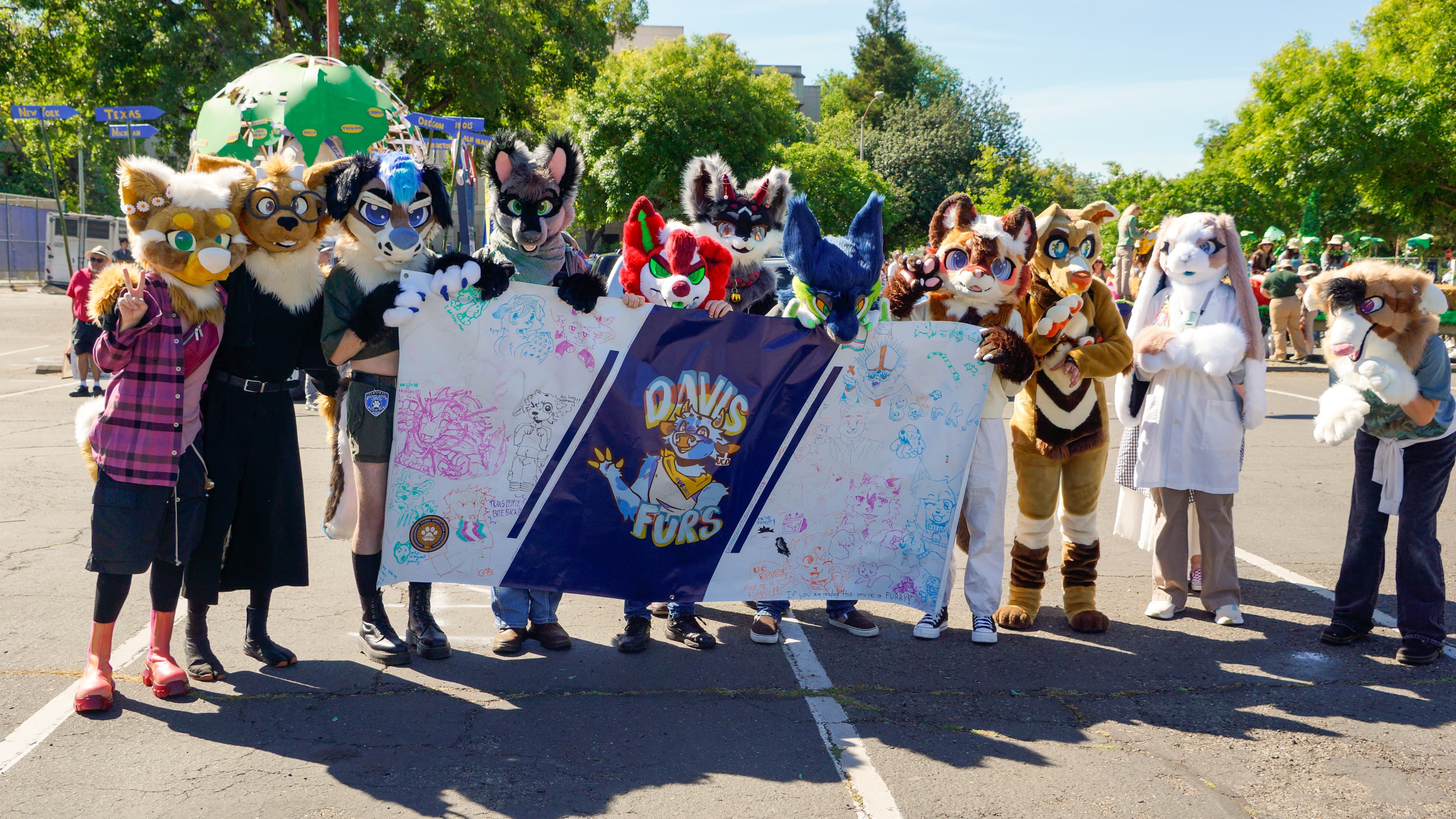
The Davis Furs Club shares what it means to be a furry — but more importantly, what it doesn’t mean
By DOMENICA PELOSO — features@theaggie.org
Founded in 2024, the Davis Furs Club is akin to most other student organizations; they host weekly social events, select leadership personnel each year and participate in on-campus events such as Picnic Day and the Involvement Fair. The key difference, however, is that they also share a profound appreciation for the often-misunderstood furry community.
The furry fandom is a popular subculture centered around anthropomorphic animals, which are fictional creatures imbued with human attributes, thoughts or behaviors. Notable examples of anthropomorphic animals include the characters from Disney’s “Zootopia,” Warner Bros.’ “Looney Tunes” and even UC Davis’ noble Gunrock.
Dating back to the 1980s, the furry community is well known for its unconditionally accepting and unabashedly weird character.
"You could tell anybody in the fandom that your name is Pancake, and their first response will be, ‘Lovely. What are your pronouns?’” Pancake, a first-year transfer environmental science and management major and the upcoming Davis Furs Club president, said. “It doesn't matter. We do not care if you're purple or whatever, you’re totally welcome. Come be weird over here with us.”
The Davis Furs club currently has over 300 members in their Discord server — several of whom are not Davis students, but Davis residents.
“There's anywhere from teenagers to 45-year-olds, and it really is a ‘dream it, be it’ fandom where anyone is welcome no matter their age,” Oz, a fourth-year entomology major and the current Davis Furs Club vice president (VP), said.
Centered around the principles of love and inclusivity, the furry fandom is widely regarded as a safe space for traditionally misunderstood and marginalized groups — especially the LGBTQ+ community.
“The furry fandom has deeply close ties to the queer community,” Oz said. “In fact, I believe that two of the first big fursuiters back in the ‘90s were a gay couple. I also know a lot of people who relate their transness or gender identity to being a furry.”
However, the furry community is also significantly stigmatized. One of the largest contributors to their taboo reputation is the misconception that all furries are interested in not-safe-for-work (NSFW) content.
“Every community has an NSFW aspect, whether you like it or not,” Pancake said. “Now, is that the face of it? No. However, back in the 1980s, when the furry community first came about, it was advertised as a kink-safe space in order to draw people in — and that has carried through the test of time. I will never shy away from this topic or deny it; instead, I just try to understand it.”
Because controversy tends to overshadow nuance, the positive aspects of the furry community often go underrepresented.
“I think the world does a good job of stripping more and more of your childhood whimsy away as you grow older,” Voski, a first-year at the veterinary graduate school with an undergraduate degree in animal science and one of two 2026-2027 vice presidents, said. ”So, I feel like getting into this community allows you to gain some of that back.”
Upon joining the furry community, one of the first questions you might hear is: “What is your fursona?” A fursona can mean many different things depending on who you ask: it can be a personal mascot, an extension of oneself, an idealized alter ego or simply a fun outlet for creativity.
“My fursona’s name is Kana, and she’s a pine marten,” Jax, a first-year biochemistry and molecular biology major and the second 2026-27 Davis Furs Club VP, said. “She’s not me, but I feel like she is representative of me. A lot of people will choose their species because it connects to them spiritually or personally — but I honestly just thought they were cute.”
Another common misconception is that all furries believe themselves to be therians, which are individuals who identify as non-human animals spiritually, according to Oz.
“I am not a dog, and I have never claimed to actually be a greyhound,” Oz said. “Is it my favorite dog? Do I love them? Do I love dog-themed things? Yeah, absolutely. However, I don’t go around my daily life thinking I’m a dog and barking at people. But even if I did, who cares?”
The controversy surrounding furries and therians necessitates an even broader discussion surrounding societal worldviews, according to Pancake.
“There is a term called anthropocentrism, which is a worldview in which humans are the center of the universe,” Pancake said. “But, there’s also zoocentrism, which focuses on animals being the center of the universe. I think it's sort of similar to religion, in that sense. I wouldn’t say that I am a mudpuppy, but in my opinion, perhaps we are just more evolved or devolved forms of our fursonas.”
While the term “furry” likely generates vivid images of animal-like characters walking around with oversized paws, cartoonish heads and flamboyant accessories, fursuiting is but a fraction of the furry community at large.
“I just got my first fursuit, and it’s something I’ve wanted for a very long time,” Jax said. “I’ve only had positive interactions with people so far — and I just like bringing that extra bit of joy into people’s days around campus.”
For the Davis Furs Club, artistry and drawing are some of the most popular forms of expression, according to Oz and Pancake.
“Throughout high school, I think I filled up like 12 sketch books,” Oz said. “That was a big section of my life. It was when I saw Disney's ‘Robin Hood’ and ‘Aristocats’ movies that I was like, ‘I love this art. I love this style. I want to do this.’”
Bringing an original character (OC) to life has intrinsic value in and of itself, but many furry artists have received monetary gains and social media followings for their creations as well, according to Lenix, a first-year biology major and the Davis Furs Club social media manager.
“I would consider myself a content creator in the fandom, because I've been posting art and gaining an audience since I was around 12 years old,” Lenix said. “When I first started, I had no idea what the meaning of money was, so I was selling stuff for like a dollar.”
After four years of online posting and six years within the furry community, Lenix has received over 2,000 digital art commissions and amassed over 30,000 followers across both X and YouTube, at the time of publication. She charges anywhere from $40 to $80 per piece.
That being said, another common misconception closely related to fursuits and art commissions is the belief that all furries are excessively wealthy.
“I worked through high school cleaning houses to get my first fursuit, and it cost about $1,200,” Pancake said. “Much of the working class [are] furries, because it’s a way for them to take a break from the harsh realities of their lives. It's really unfortunate that there is this misconception, because it kind of pushes away people who have actually worked towards what they have.”
Because artistry sits at the heart of the furry fandom, one unspoken consequence is the normalization of overconsumption and materialism, according to Jax.
“There is that social pressure to have a fursuit or to have art, so I’ve heard about many bad financial decisions that have happened within the fandom,” Jax said. “A lot of people think that commissioning art is the only way to really bring your character to life, and that’s just not true.”
In addition to fursuiting and art commissioning, the furry fandom is also known for its global conventions, meet-ups and raves. In fact, Oz went to his first furry convention at 13 years old.
“I have been doing fursuit dance competitions for a long time,” Oz said. “They're a big part of convention culture. The moment you get off that stage from dancing, the first thing someone asks is, ‘Do you need water?’ It’s so nice to feel listened to and cared for when there’s close to 8,000 people who go to those conventions.”
Because fur-suiters are known for their less-than-subtle self-expression, there exists a narrative that all furries are “fatherless” and that “their families must hate them.” However, this is another oversimplification, according to all five club members.
“I love my mom — she’s a big reason why I was actually able to get into the fandom,” Oz said. “My mom went to every single convention with me from the age of 14 up until the age of 18. My parents love the fandom, and they've seen what it's done for me; they just want me to be happy.”
In terms of the future of Davis Furs Club, the incoming leadership board plans to create more affordable and inclusive social events, as well as coordinate a summit for all California college furries each year.
Members of the Davis Furs Club encourage embracing weirdness and authenticity as modes of self-expression and creativity.
“Do every weird thing you've ever wanted to try, because that's the only way we get all these beautiful scientists and new inventions in the world — from people staying up too late and being a little too weird and doing something a little crazy that they didn't think they could do,” Pancake said.
As the school year draws to an end, outgoing members reflected on what it means to be in the furry fandom.
“It’s not a great time to be yourself for a lot of people,” Oz said. “If you can do one thing, whether it's wearing a fursuit or making a fursona or going to your local FurBowl, do it — because times are hard enough as is right now. If you create that community, then you can create that feeling of safety in a time when we are not safe and we are not understood. That’s what it means to be in the furry community.”
Written by: Domenica Peloso — features@theaggie.org