






The UC Davis Student Startup Center hosts Demo Day 2026
Those involved share their experiences working as student entrepreneurs
By AMRA ABID — features@theaggie.org
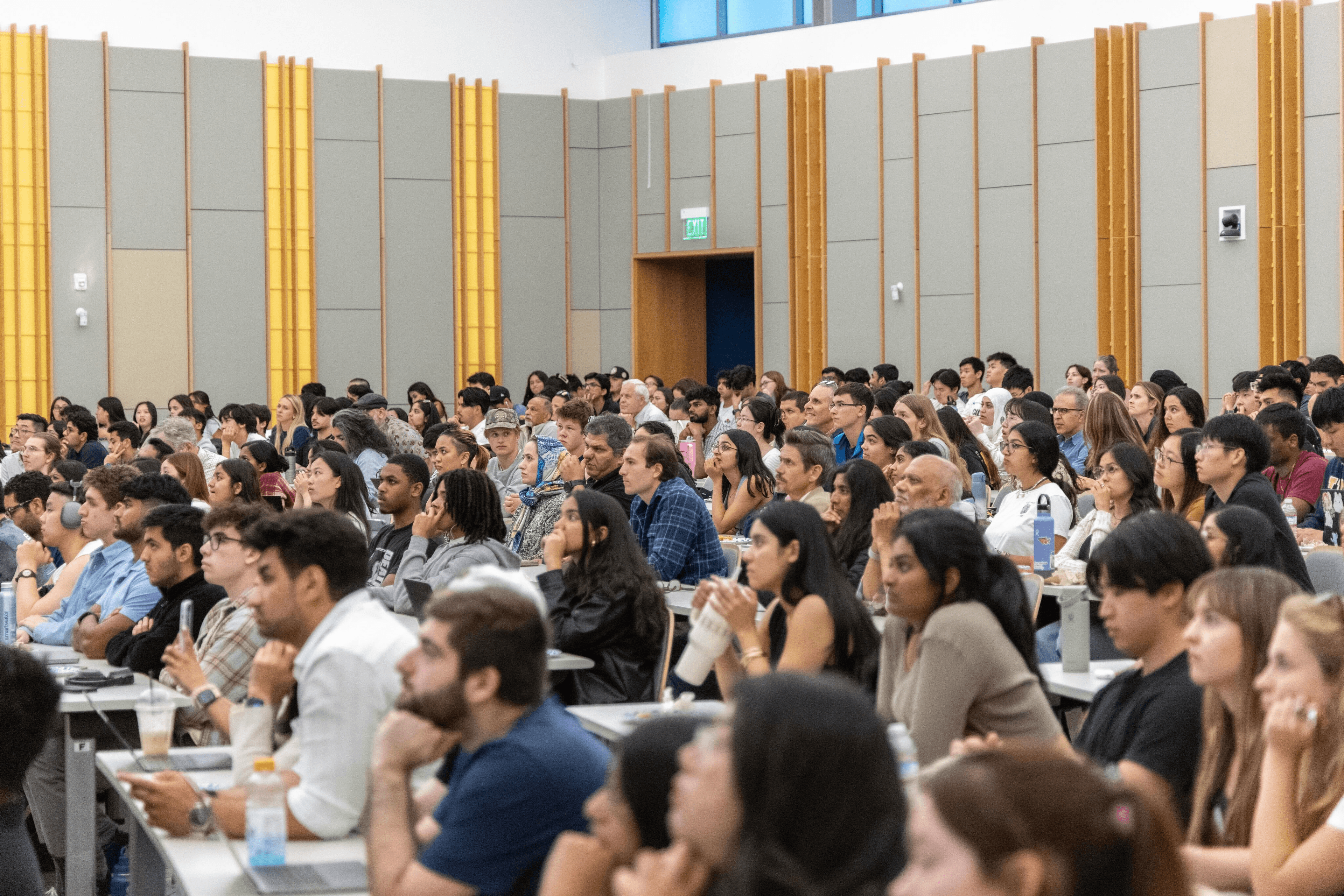
On the evening of May 7, 18 groups of undergraduates take two minutes each to pitch what they have spent the last 12 weeks building in California Hall on the UC Davis campus. This is Demo Day: the culmination of PLASMA, the Student Startup Center's 12-week program for student entrepreneurs and founders.
For the past 12 weeks, student groups onstage spent countless hours on work that earns them no academic credit, while also balancing demanding course loads, research positions and jobs.
Although the conventional image of a startup founder often elicits a stereotype of young, male computer science (CS) major or business student, in reality, this image described very few of the people in the room, according to Aaron Anderson, director of the Student Startup Center.
"A lot of students at UC Davis assume that entrepreneurship is only for the hardcore super capitalist business types," Anderson said. "Almost all of our students are not hardcore business types. They're engineering [or] some kind of science."
Ridhima Bellam, a third-year cognitive science major who manages PLASMA, noted that she carried a version of the same idea when she first arrived at the Startup Center.
"I thought a lot of entrepreneurs would exclusively be CS majors that knew a lot about how to build from scratch," Bellam said. "I think the most successful founders I've seen are people that come from unconventional backgrounds — people that are majors in the humanities — because you have a more diverse set of information that can help inform the way that you choose to build."
Simran Lallian, a fourth-year neurobiology, physiology and behavior major, won Demo Day herself two years ago as a co-founder of EpiSense, a seizure prediction system. Now, she works as a venture development manager at the Startup Center mentoring PLASMA teams. Lallian shared some of the qualities necessary to be successful as a student startup founder.
“Startups range across industries, across problems,” Lallian said. “You need representation from everyone to make things happen. You need a few good writers to be able to write grants, to apply for competitions. You need to be a strong speaker. Being a good founder and being a good startup team means that you're very versatile. I think with that comes having diverse skillsets and team members.”
An example of this strong team dynamic is Alana Paje, a second-year biological sciences major on the pre-med track, and Keira Patel, a second-year electrical engineering major. Together, Paje and Patel co-founded the startup MammoTen, an at-home breast health monitoring device aimed at the gap between mammograms. MammoTen’s goal is to assist in the months in which women at high risk for breast cancer are not screened and during which cancer can develop undetected.
"Because I'm pre-med, I never really thought of that as an option," Paje said. "For pre-med, you always do clinics or volunteer stuff. I would have never thought that I would be working on a startup, because that's not one of the conventional extracurriculars."
Paje and Patel’s main long-term endeavors, however, are not solely to run a successful business; the decision to invest an intense amount of time and effort into a company was based on the desire to make a tangible impact in their community.
“I would make projects — and then it would just be a class project, [and] we wouldn't do anything with it — and then it was like, so redundant and already done,” Patel said. “Then I was like [...] ‘If I'm already going to be here learning how to make stuff and actually do engineering, [I] might as well make something that actually has an impact.’”
The case for being involved with entrepreneurism extends beyond just wanting to launch a successful product, as Anderson shared. A large part of why he seeks to engage students in entrepreneurism as much as possible is to set them up with intangible skills.
"When you're young, you're more creative,” Anderson said. “Older entrepreneurs have a few big advantages — they have the professional network. They have the resources. But they have some big disadvantages. They have way more to lose. They’ve got a mortgage or a family or a high-paying job. You [have] nothing to lose."
Both Anderson and Lallian also pushed back on the assumption that failing has a heavy cost. Students who try and fail tend to be hired into better positions than peers who never tried, because employers in a competitive market value the real-world experience, according to Lallian.
"Most startups fail,” Lallian said. “That's just inevitable. But working on a startup, even if it doesn't end up going the full distance, you can still learn so much. It's a rare opportunity for students to get real, practical hands-on experience as an undergraduate."
Anderson extended this sentiment, emphasizing that taking hands-on risks during their undergraduate years can teach students resilience and problem-solving skills — experiences that have the potential to teach what a classroom can’t.
"Students are learning things like problem discovery and grit and tenacity and iteration and how to screw up 100 times, but to stand up 101 times," Anderson said. "In a world where [artificial intelligence] is plugging into everything, the reality is that students [who] are exceptional in the workforce are the ones [who] can identify problems and can creatively solve them."
Although Anderson doesn’t believe entrepreneurism is right for every student, he is adamant about making the opportunity and knowledge surrounding it as accessible as possible.
"I would not argue that every student needs to be an entrepreneur," Anderson said. "However, I would argue that every student should gain entrepreneurial skills. Even if you go to the most bureaucratic of government organizations, it's a skill set that will serve you well.”
Anderson also encouraged students to take risks in their creativity, urging them to take strides toward building the type of world they hope to see.
"This is a great big world that you're going to inherit," Anderson said. "You're the ones that need to shape it and build it the way you want it to be built. Don't trust anybody to build a better world for you. Go build it better yourselves."
Written by: Amra Abid — features@theaggie.org