






Student voices take center stage in Theatre for Social Change’s ‘Festival of Short Works’
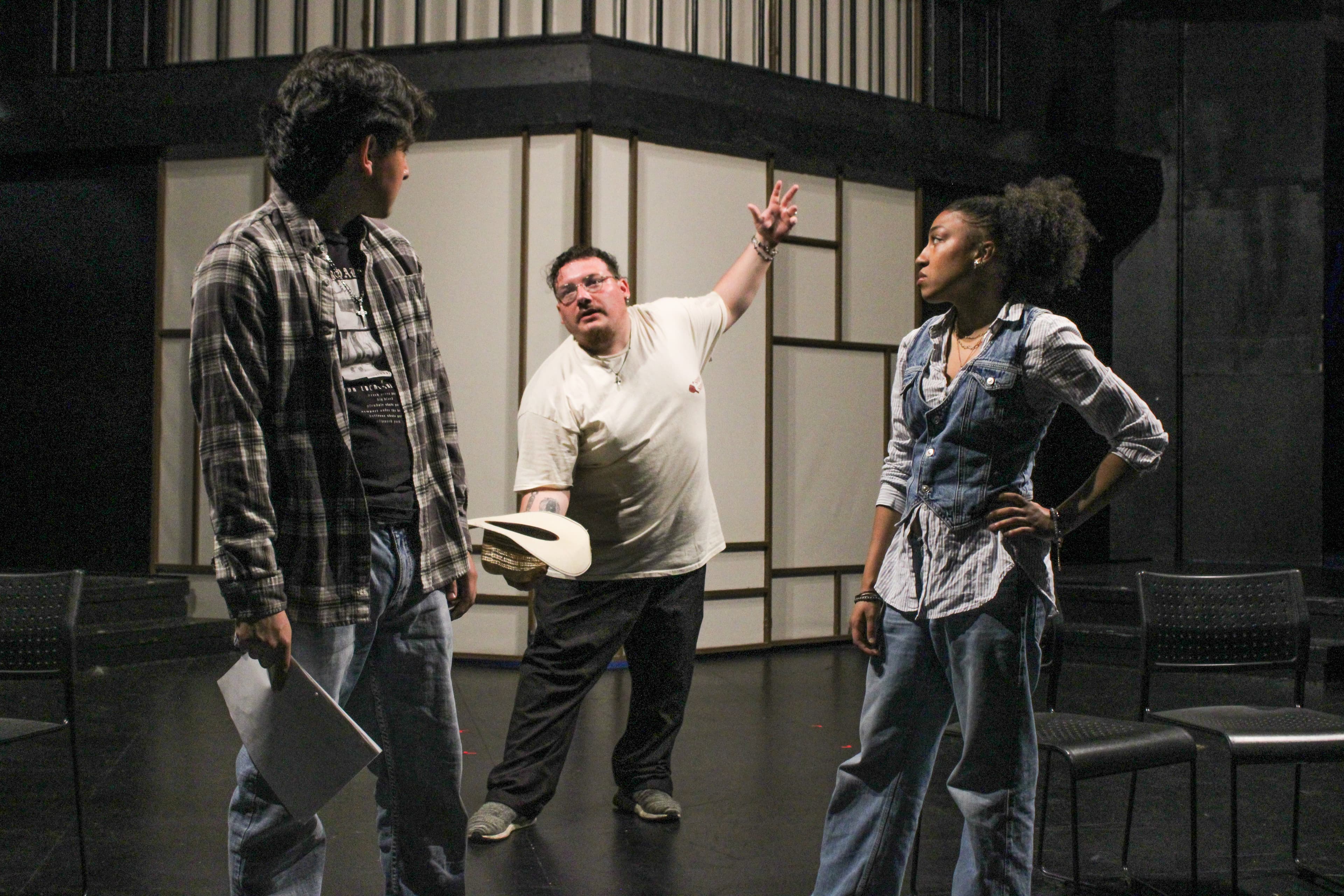
The student-run organization is set to premiere its spring production at Wyatt Pavilion Theatre on May 16 and 17
By IQRA AHMAD — arts@theaggie.org
Theatre for Social Change’s (TFSC) “Festival of Short Works” is running on May 16 at 2 p.m. and May 17 at 7 p.m., bringing together a series of original, student-led productions exploring themes ranging from gender identity and queer intimacy to truth, love and community.
Founded in 2020 under the direction of Professor Margaret L. Kemp, TFSC was created to give students a platform to address social issues through performance while building community through theater.
E.E. Buttler, a third-year evolution, ecology and biodiversity major, a student playwright for this year’s production and a TFSC designer and social media coordinator, explained that the organization emphasizes accessibility, collaboration, inclusivity and welcoming students regardless of their theatrical background. TFSC aims to showcase different forms of theater and present student projects in a unique way.
“We try to emphasize a lot of student vision works: It’s incredible,” Buttler said. “We’ve done a cabaret with student choreographers and experimented with alternative forms of theater that you might not see regularly, [and] we've done ‘Theater of the Oppressed’ which is a collaborative form of theater where the audience becomes a participant. We really seek to enhance the diversity of theater art at Davis.”
For many students involved in this year’s production, the festival is more than just a showcase of performances; it is an opportunity to process personal experiences publicly and collaboratively.
Buttler is the playwright and director of “I Heard the Wolf Sing,” a play centered on a young shepherd whose life is disrupted by the arrival of wolves in her isolated community. Its allegorical structure carries a deeply personal story about gender identity and discovery of self.
“When I went into writing it, it was very clearly about my experience with gender,” Buttler said. “It’s coming into the realization you’re not what everyone told you you are, and now you have to go out and discover who you want to make yourself.”
Buttler explained how the collaborative nature of theater transformed the play beyond what existed on the script. The role of music, lighting, staging and actor interpretation broadened the scope of the play during rehearsals.
“I think it’s definitely expanded [after] being able to work with a cast and a full production crew,” Buttler said. “It’s a vision of media when you bring something to the stage — you get not only what the actors are putting into it, but how they deliver their lines and how they’ve been interpreting the characters. It’s really awesome to see the life they brought into their roles and also the lighting and sound choices. It’s even higher than what is just sitting on the page.”
The production also takes advantage of the Wyatt Pavilion Theatre, which features a thrust stage where audience members surround the stage on three sides. This unconventional layout requires careful attention to the placement of the actors and props.
“I think a lot of that process when we’re going through rehearsals was making sure that the actors would be visible from every side of the stage and [that] the blocking of scenes would be able to be read well from any perspective,” Buttler said.
Jamailah Jamora, a first-year theatre and dance major, is director of “No Que No?,” a play about a character named Miguel who faces challenges brought upon those he loves, ultimately revealing larger truths that can be missed or ignored by others.
Jamora shared Buttler’s perspective that the layout of the stage is crucial during the planning stage to ensure that subtle messages are observed by the audience.
“Wyatt Theater is a very interesting theater; it’s a thrust stage, and on the stage it has an inner below and an inner above where there is a balcony,” Jamora said. “We use that toward the end where one of the characters stands in the inner above and sees the character on the stage. It shows a sort of power imbalance between the characters and emphasizes the relationship between them.”
Jamora explained that directing in the festival has been both creatively demanding and collaborative. Initially joining as an assistant director, Jamora later stepped into a larger directing role during rehearsals.
“Directing it has been a great experience,” Jamora said. “I was really nervous. But because our cast is just so passionate in this one project, they would give me feedback on how they felt and I would tell them how I felt, and then we would all work together to help make this production, which was sort of beautiful.”
Jamora described the experience as uniquely personal, as the productions are driven entirely by student passion.
“We’re really trying to give and advocate and help people with what we're doing in this program,” Jamora said. “It’s just being surrounded by so many passionate people, being part of something that other people really want to be part of.”
“Tomorrow I’ll be Wearing Their Ring,” another production featured in the festival, was written by recent UC Davis graduate Allison Mary, who will also be performing in the piece. Through music, movement and a semblance of autobiographical storytelling, the production intends to explore sapphic identity, friendship and intimacy.
“‘Tomorrow I’ll be Wearing Their Ring’ is about opening up that space for sapphic love to blossom romantically and intimately by letting men go as romantic and intimate objects and allowing men to become platonic,” Mary said.
Mary explained that the piece emerged from her own experiences navigating sexuality and openness. Rather than framing identity in expectations, she shared her hope that the performance encourages audience members to embrace the complexity of human relationships and self-discovery.
“Being more open toward sapphic love has let me be more open to positive relationships with men, and I feel better now about the idea of having a healthy romantic relationship with a man,” Mary said.
The production itself reflects that same openness. Mary described the writing process as unconventional, and, similar to the other playwrights and directors, collaborative, with the script evolving through rehearsals and conversations with others involved in the production.
“My writing process has mostly been small bursts of energy spread out over months — notes and poems that eventually, and during early rehearsal, became the official script it is today,” Mary said. “What we’re actually going to do on stage will probably not even be verbatim what’s in the script, we’re doing a little improv.”
Mary shared how TFSC’s emphasis on presenting “works,” rather than strictly limiting “plays,” has allowed directors to experiment with various elements such as music. The production will feature live music, including a piano performance by Mary, as well as a personal audio recording by Mary’s mother.
“Growing up, there has always been a piano in my house,” Mary said. “It just feels so natural for me to have an instrument in the house. We’re also going to end the play with a voice memo from my mom.”
Rather than relying solely on formal acting technique, Mary shared that she values the natural chemistry and trust that comes from working alongside close friends, which is intended to translate to the audience.
“I have a theory about acting — that it’s sometimes less about the technique of acting but [more about] the chemistry between actors based on there being a preexisting friendship or meeting more naturally,” Mary said. “Therefore, by working with my friends, it has been a more untraditional process: having fun and bringing things together based on their schedules and ideas, rather than sticking to a strict script or schedule.”
The live and communal nature of theater makes it uniquely significant as a form of art and social change, according to Mary.
“I think theater is a lost art,” Mary said. “Because it’s live, it just sticks in your brain a little longer.”
Mary also emphasized the importance of physical gathering within artistic spaces, especially when conversations around activism are involved.
“I read [in] this newspaper that activism is not as effective online and on social media, but the most effective acts of activism have been protests and real-life events where people are physically coming together,” Mary said. “And with a play like this, where we’re talking about social change through art, the conversations that are happening in this space are going to be positive, effective and [translatable] to people physically making change to make something come about.”
The directors and playwrights shared the unique experience of seeing their peers on stage and working in different roles throughout the theater experience.
“It’s very beautiful in that aspect with student theater, [that] you see people who are just like you,” Jamora said. “When I see passionate people performing, it makes me want to perform too.”
Organizations like TFSC aim to provide students with the opportunity to engage with their peers in a creative space.
“I felt like [theater’s] also just a gateway to connect with people,” Buttler said. “When you're in a community of writers and you share works, it’s very creatively fulfilling and a very supportive community. It’s sort of a reciprocal relationship where we have each other, and we’re able to help each other. Being able to create art at all is such a gift.”
Across all the productions, TFSC organizers and artists return repeatedly to one single theme: empathy.
“The more perspectives we have, the more ways of viewing the world we can give each other,” Buttler said. “I want the audience to have these moments of self-reflection and think about where they fit into the world and what they want to make of themselves moving forward.”
The philosophy remains central to TFSC’s mission. Productions are free to attend and are intentionally accessible to students and the Davis community. The organization has experimented with various forms of theater and aims to prioritize student voices. The emotional impact of live theater comes from its immediacy and humanity, according to Jamora.
“Theater is a great way for people to expand their empathy,” Jamora said. “Whether you’re performing or watching, you learn more about people.”
TFSC’s “Festival of Short Works” has free admission and is open to the public. For more information on TFSC, visit TFSC’s instagram, @theatre4socialchange.
Written by: Iqra Ahmad — arts@theaggie.org