






A new age of cyberpunk
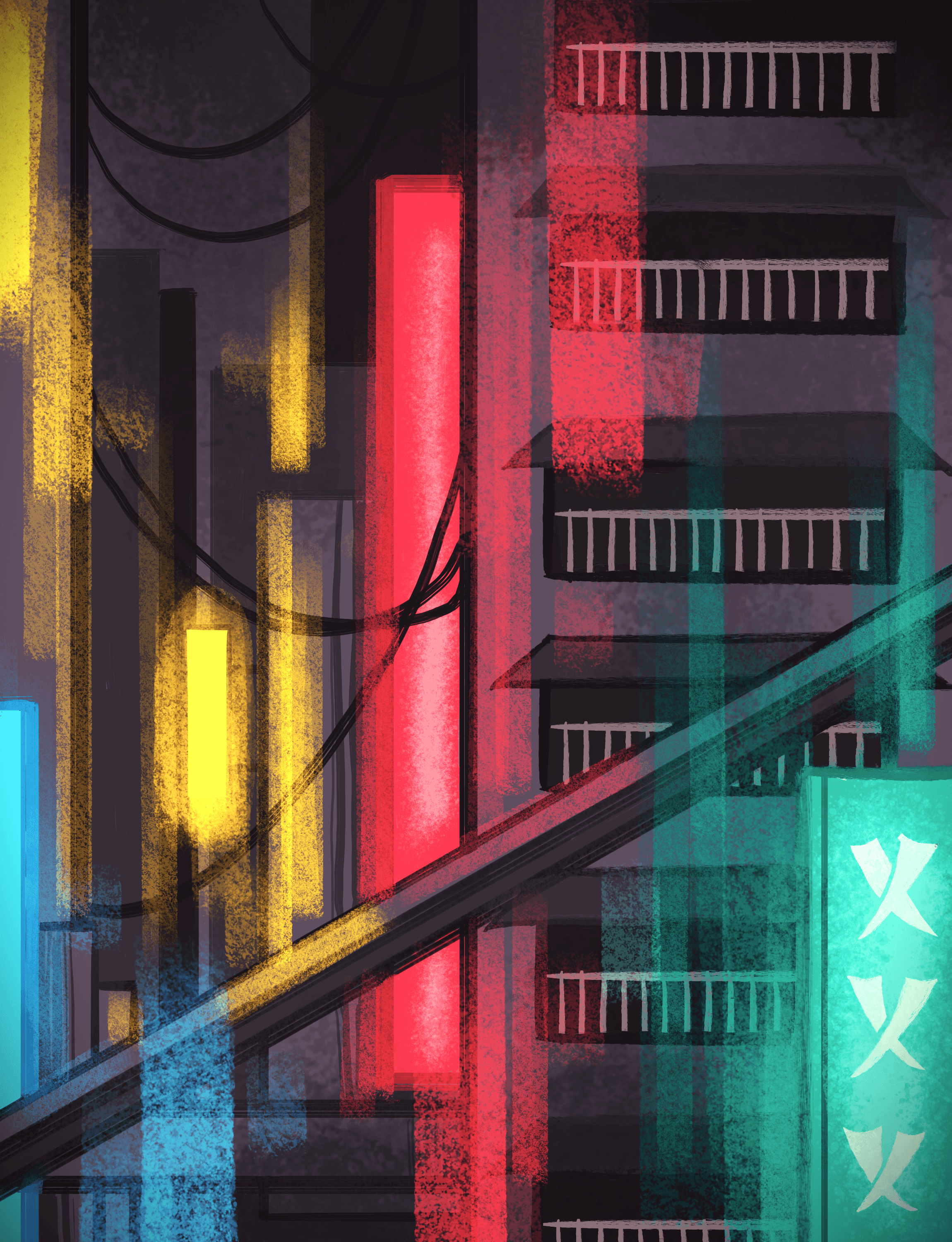
The times they are a-changin'
By YUENJO FAN — yafan@ucdavis.edu
While reading the original cyberpunk novel “Neuromancer” by William Gibson, I realized how recognizable the subgenre has become in contemporary media. From the “Cyberpunk 2077” video game and “Edgerunners” TV show to the never-ending Ryan Gosling “Blade Runner” memes, it seems that the popularity of the cyberpunk subgenre persists within its already considerable fanbase.
Cyberpunk is a subgenre of science fiction that blends high-tech with low-life, envisioning a dystopian, ultra-futuristic world that may look stylistically appealing — with prosthetic limbs and laser guns — but in reality, it isn’t. National governments have lost power, making way for the domination of transnational megacorporations that employ private armies and market monopolies. The digital world has bled into the physical world, and reality is no longer separated by what is tangible. Environmental collapse has forced humans into densely packed urban megapolises, which resemble technological confinement more than urban innovation. These conditions, alongside other elements of the genre, convey cyberpunk’s distinct commentary on the deterioration of both society and the human condition.
By comparing these tropes to real life, it’s no wonder that we are so drawn to cyberpunk — we like it because it feels true. The parallels are stark: megacorporations echo capitalist expansion, cyberpunk transhumanism mirrors modern genetic engineering and low-life reflects increasing economic difficulties. If you are afraid of the domineering Tyrell Corporation of “Blade Runner” or Arasaka Corporation from “Cyberpunk 2077,” then best look away.
Companies like Google and Nvidia have reached market capitalizations of over $4 trillion and $5 trillion, respectively, surpassing the nominal gross domestic products (GDP) of nations such as Japan, India and the United Kingdom. These sorts of numbers, largely held by high-tech companies, mirror the same scenarios seen in cyberpunk media.
The similarities don’t just end there. In “Neuromancer,” nature is virtually absent due to ecocide, save for rare instances of artificially created scenery. Considering the threat of climate change or the overall ratio of time we spend in artificial, man-made environments versus the true outdoors, this feels all too familiar. In “Cyberpunk 2077,” neuralware chips connect to the human mind to control cybernetics and alter the host's cognitive processes. Today, we have Neuralink chips, or more commonly, smartphones and social media apps, which are staggeringly similar technologies that have essentially hijacked our minds, affecting our brain functions.
The real-life developments that emulate cyberpunk motifs all begin as seemingly insignificant ideas. Introductions are small, and developments are nudged along, but within the blink of an eye, they proliferate society and become permanent and integral. Take the development of artificial intelligence (AI) as an example, as it is a key topic in both modern-day society and cyberpunk literature. Five years ago, had you described ChatGPT to a friend, you would have likely been accused of lunacy. Yet today, AI’s abilities have become well known.
In general, science fiction times predicted future outcomes by diagnosing the present-day situation. In his 1914 novel “The World Set Free,” H.G. Wells foretold the atomic bomb 31 years before its invention. Jules Verne’s 1865 novel, “From the Earth to the Moon,” gave an eerily similar account of the Apollo missions that would ensue over a 100 years later. It’s wholly likely that the themes of cyberpunk can be another one of science fiction’s accurate prophecies, if not already.
Obviously, predictions can be wrong; who doesn’t remember “Back to the Future” claiming flying cars in 2015? Perhaps the AI bubble will explode, and the futuristic technology that we all believe is in store will taper off. However, as each passing technological advancement continues to impact society, a cyberpunk-style future seems increasingly likely.
If this is the case, it becomes necessary to look beyond the allure of a futuristic world and understand that, at its core, cyberpunk is a cautionary tale about a future that brings more harm than good — it is a warning. The worlds of “Neuromancer,” “Cyberpunk 2077” and “Blade Runner” are not meant to be reproduced, but instead avoided, no matter their aesthetic or romantic appeal.
The similarities between a cyberpunk dystopia and present-day occurrences should concern us all, given how cyberpunk alludes to looming threats to our humanity. It doesn’t indicate that all future advancements will be harmful, but that we must instead take the lessons from the cyberpunk subgenre and proceed with caution. And although we may all want to have a robotic arm, we must not lose our own arm in the process. Just because the world doesn’t look like cyberpunk today, doesn’t mean that it won’t tomorrow.
Written by: Yuenjo Fan — yafan@ucdavis.edu
Disclaimer: The views and opinions expressed by individual columnists belong to the columnists alone and do not necessarily indicate the views and opinions held by The California Aggie.