






ASUCD Judicial Council hears impeachment case of Senator Aaron Heth
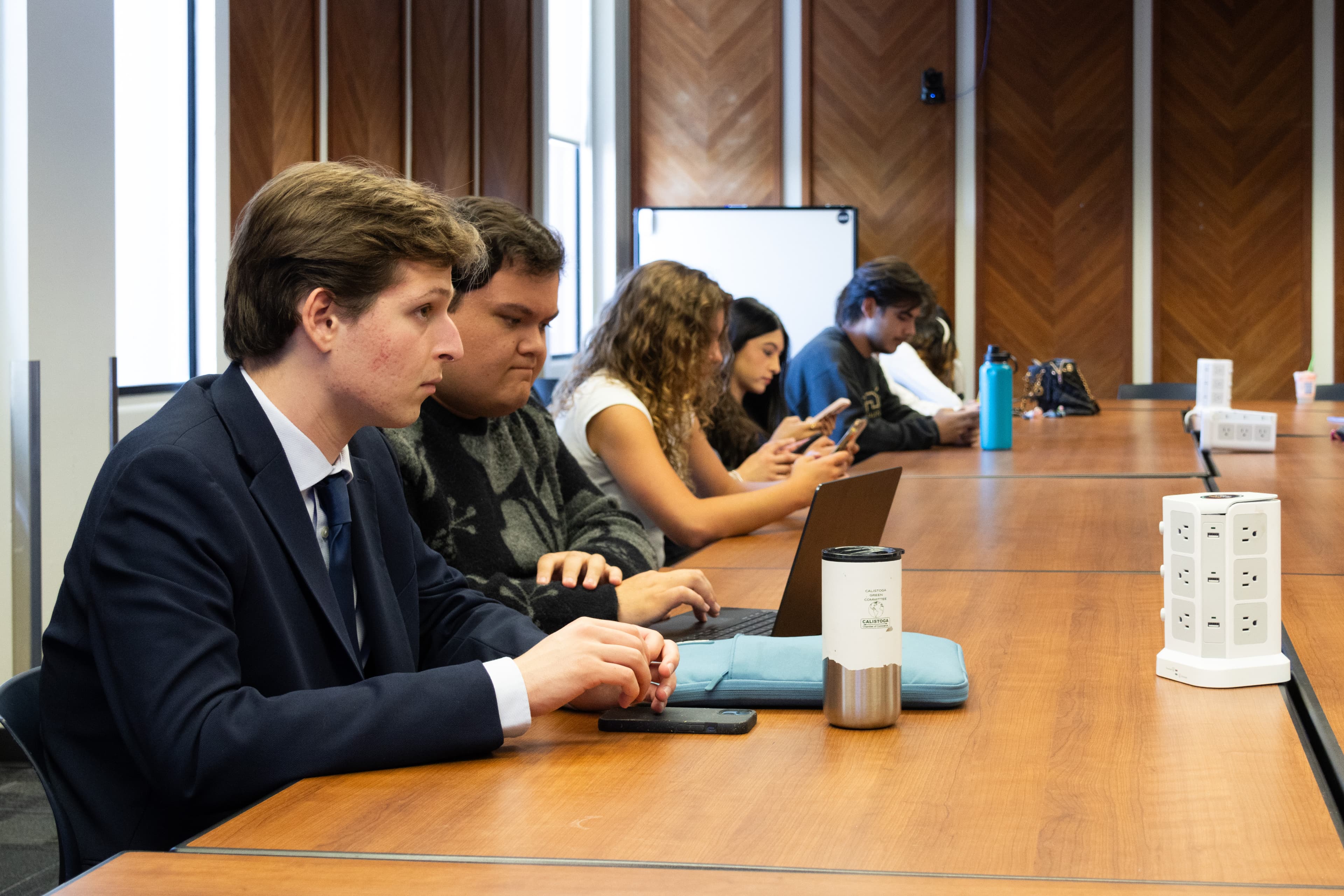
The justices questioned the arguments that Heth’s attendance at a TPUSA-affiliated conference warranted removal from office
By LILY KENROW AND VINCE BASADA — campus@theaggie.org
ASUCD Senator Aaron Heth, a third-year political science major, defended himself at a 4-hour impeachment hearing on Wednesday, May 13, in front of the ASUCD Judicial Council.
The hearing was a result of the ASUCD Senate’s passing of an impeachment resolution against Heth during their April 30 meeting over his attendance at a Campus Victory Project (CVP) conference in December 2025. The conference, funded by conservative nonprofit Turning Point USA (TPUSA), was designed to help guide students and CVP affiliates in winning student government elections around the country.
The impeachment resolution argued that Heth’s attendance at the conference violated ASUCD Bylaws, Section 1406, and the ASUCD Code of Ethics. The former establishes senators’ obligations to act in the public’s interest, while the latter oversees campaign finance, limiting the monetary amount of donations and who can donate to election campaigns.
Heth had run to be ASUCD president in the student government’s spring election, but he dropped his campaign after his attendance was made known to the student body following reporting done by The California Aggie. He has maintained that he is no longer affiliated with the group and did not accept any financial support from CVP for his campaign.
The petitioner against Heth, Senator Pro Tempore Jaliah Payne, a third-year political science major, argued that Heth had been deceptive in misrepresenting his political views and violated ethical guidelines on transparency.
“The evidence presented demonstrates conclusively that the respondent deliberately misrepresented his beliefs while serving in office,” Payne said. “Members of the council, today you are not only evaluating the conduct of one senator, you are establishing the first meaningful precedent for what gross misconduct means in this Association.”
Payne also called on Gender and Sexuality Commission (GASC) Chairperson Catalina Silva-Oliveira, a second-year communication major, and ASUCD President Amrita Julka, a third-year political science and human development double major, as witnesses to the stand.
“In the time that I have known him and worked with him, I can firmly say that he has demonstrated a dereliction of duty,” Silva-Oliveira said. “In my interactions with him, I have found him unprofessional and difficult to work with.”
Senator Ezra Rubin, a third-year international relations and classics double major and Heth’s representative counsel, argued that Heth was being tried over his perceived conservative viewpoints and that his attendance did not meet the grounds for gross misconduct.
“The case brought against Senator Heth tonight is baseless,” Rubin said. “It reflects little more than a petty attempt by members of the ASUCD Senate to shut out individuals that may offer a different political view than the consensus. It marks an effort to eliminate political diversity and enforce the homogeneity of opinion on the table.”
Rubin called no witnesses to testify on Heth’s behalf.
The seven justices of the Judicial Council questioned both sides, expressing skepticism over the petitioner’s arguments that Heth’s actions warranted impeachment. If impeached, Heth would be removed from office; his seat on the Senate would be filled by an interim appointment.
Payne and her co-counsel, International Student Representative Robi Castaneda, a fourth-year political science and music double major, were questioned over the substantiveness of their evidence, the political discussion surrounding it and if Heth had conducted gross misconduct. Their argument largely relied on Instagram followings and Heth’s voting patterns as a senator, though those voting records were not submitted as evidence.
Payne also argued that Heth had deceived the table and the student body by misrepresenting himself and his ideologies as being less conservative than his actual views.
“Misrepresentation in the sense that he openly lied about what type of ideologies that he supports,” Payne said. “When I say misrepresentation, I mean lying and jumping around the truth of why he attended.”
The justices also questioned the grounds for the impeachment and whether Heth deserves further reprimand, given he had dropped out of the ASUCD presidential race.
“He was affiliated with CVP as a candidate running for president,” Justice Adithi Sumitran, a fourth-year political science and data science double major, said. “But he dropped out of that race, so that connection doesn't exist. You're trying to establish a quid pro quo here, but to me, the quid pro quo is broken because he's not a candidate.”
Furthermore, the justices stressed the need for the petitioner to show how the argument is non-partisan, after Castaneda brought up the potential influences CVP has over candidates and the intent of the conference Heth attended. The ASUCD Constitution bars impeachments from being levied on political grounds.
"That's political judgment, right?” Justice Diego Quintero, a fourth-year political science and English double major, said. “Free speech applies to both [sides]. The ASUCD Senate can only initiate impeachment proceedings on non-partisan grounds. The talk about intent and political beliefs, that's not non-partisan grounds.”
The justices also pressed Heth and Rubin, primarily about the personal versus professional nature of the conference attendance and whether it influenced Heth’s actions as an ASUCD official. They also took the opportunity to question the funding of his attendance and whether the paid-for plane ticket and accommodations should be considered as a material donation or as a service.
Heth explained that the conference had people speaking on CVP and student government, in addition to giving testimonials and advice.
“What sort of advice were they telling you?” Deputy Head Justice Katherine Zhang, a second-year economics and political science double major, said, directing the question at Heth.
“I would say standard things,” Heth said, in answer. “I’m trying to think of specific things. It was half a year ago.”
Heth later shared one piece of advice he remembered: to not get disqualified. He said this is something he had already known after being initially disqualified in his Senate election campaign in fall 2025.
Before closing statements were given, there was an opportunity for members of the public to comment. Most notably among those who gave comment was current Senator and ASUCD President-elect Luis L. Garcia, a third-year political science and Chicanx studies double major.
“While his beliefs are okay to have, he continued to push [TPUSA values],” Garcia said. “Turning Point USA opposes [Diversity, Equity and Inclusion (DEI)] programs. He voted to try to silence GASC and [the Ethnic and Cultural Affairs Commission] ECAC, both that uplift minority communities.”
Castaneda and Rubin then gave closing comments.
“After the respondent made the decision to campaign for ASUCD, the counsel for the respondent stated that it never occurred to them that a fully funded retreat for Campus Victory Project could potentially go against something in the bylaws,” Castaneda said.
Rubin then went to the stand, arguing that while Heth may have some views that were more conservative, he did not receive support from CVP and that the Senate should be welcoming to students of different political ideologies.
“This case is about more than just the violation of bylaws,” Rubin said. “It’s about whether ASUCD will continue to be a place that welcomes and celebrates political diversity."
The Judicial Council began closed deliberations almost immediately following the May 13 meeting, though a decision has not been published as of time of publication.
Written by: Lily Kenrow and Vince Basada — campus@theaggie.org