






UC Davis English professor hosts first annual World Tarot Day at UC Davis
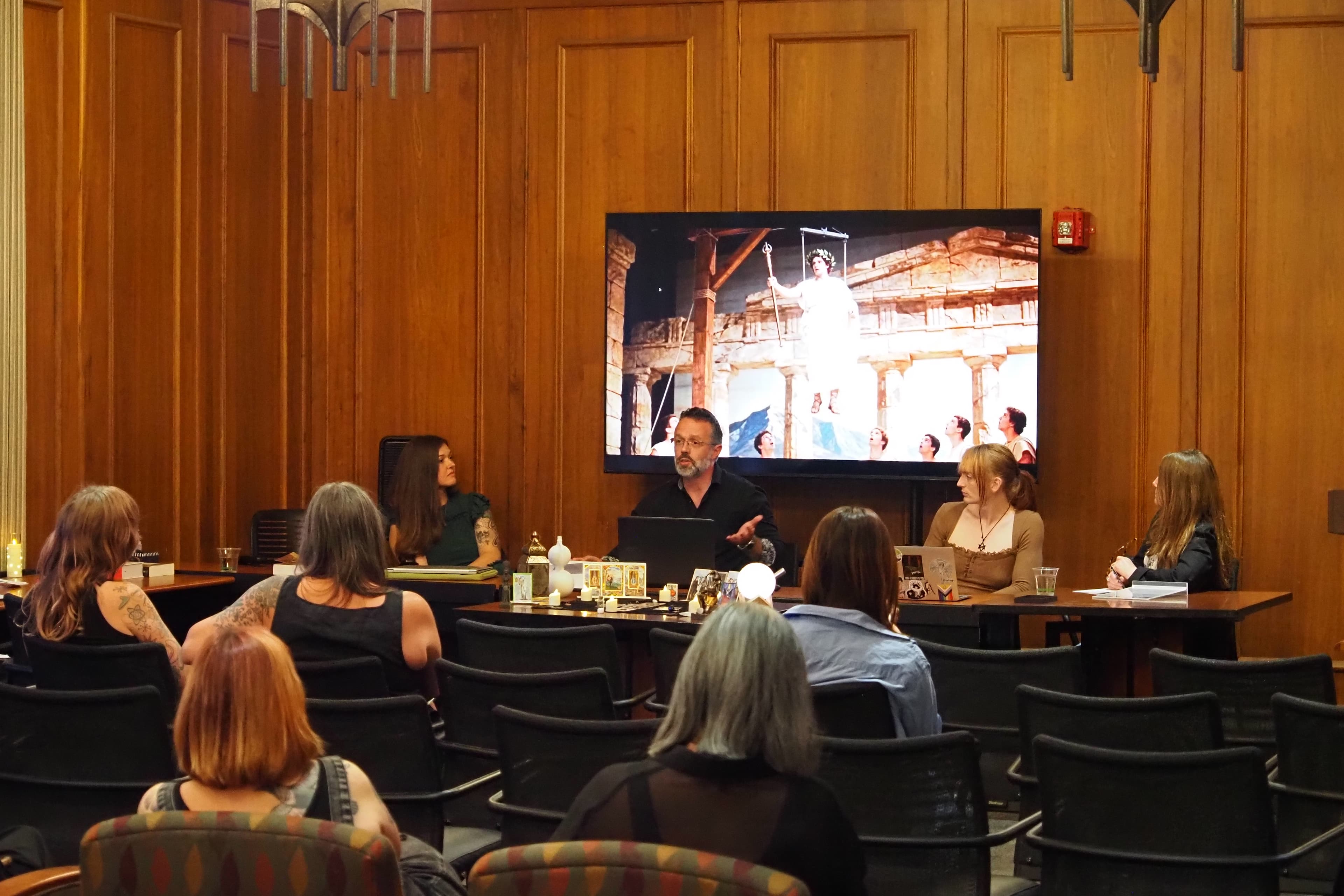
The event explored the intersections between academia, neurodiversity and tarot
BY JULIE HUANG — arts@theaggie.org
On May 22, UC Davis professor in the Department of English Gregory Dobbins hosted World Tarot Day, a new annual event that aims to showcase tarot-related academic and creative work from UC Davis students — ranging from the undergraduate to Ph.D. level — while also serving as a celebration of tarot’s diverse culture and community.
Dobbins’ inspiration for holding an event dedicated to the significance of tarot as a form of knowledge originated from his role as an educator, specifically his lessons on modernist poets like William Butler Yeats.
“I was struggling to figure out how to teach it, because I found a lot of students were really struggling with the poetry,” Dobbins said. “And it wasn’t because they were unfamiliar with the historical context, but rather, the way that Yeats’ poems worked. Students were reading in a linear fashion for the information, which isn’t how the poems are structured or meant to be read.”
Yeats belonged to a group called the Hermetic Order of the Golden Dawn, a 19th century secret society interested in mysticism, the occult and spiritual development. In the 18th century, the tarot transcended its previous status as a card game and gained deeper esoteric significance, leading the Golden Dawn to adopt it as a form of spiritual knowledge.
“The Golden Dawn decides that the tarot is their main sacred text, like their Bible,” Dobbins said. “The tarot can be rearranged, and it holds all the magical, mystical knowledge of the universe, if you know how to read the symbols.”
Yeats’ membership in the Golden Dawn crucially informed his approach to his poetry, and he often practiced tarot as part of his creative writing process, according to Dobbins.
“Yeats understood himself as not only writing symbolist poetry in English, but he also understood that he was writing spells and conducting magical acts by writing his poems,” Dobbins said. “The poems need to be understood as exercises in magic, not as lyrics to document feelings or ideas or allegories.”
The possibility of incorporating tarot into one’s personal creative process is still a promising and potentially fruitful option for creatives today, according to Curtis Devlin, a first-year graduate student in creative writing who participated in a panel of creative writers at World Tarot Day by giving a presentation on the role that tarot has played in his own academic and creative work.
Devlin explained that the tarot can be used as a schematic through which people can think about and represent feelings and phenomena that are otherwise difficult to describe or define.
“Tarot can act as a map that shows the similarities and correspondences between things that we encounter every day, and higher ideas — the lyrical, the divine, the things that inspire us and are hard to name,” Devlin said. “But we know what is out there, what we feel when we encounter or create art, that sort of ineffable feeling, and there is a way to describe that [through tarot].”
Tracing these connections can illuminate a link between the world of tarot and the principles of modernist poetry, revealing tarot’s historical influence on poets and artists conventionally deemed highbrow or academic, according to Dobbins.
“There’s a whole line of people after Yeats like T.S. Eliot and Ezra Pound, who were drawing upon the mechanics, aesthetics and formal structures of the tarot to write their poetry,” Dobbins said. “I realized that if I could just teach students the basics of how to read a tarot and explain how Yeats’ poems are written exactly the same way tarot cards are arranged, then they’ll have a better understanding of how to read modernist poetry.”
The seedling beginnings of World Tarot Day as a personal project of Dobbins’ were planted when he taught several classes on reading the tarot as an introduction to modernist poetry.
“Something clicked last year, at the end of winter quarter, and I just got really into tarot, and I became obsessed with it,” Dobbins said. “I’d be awake at night, trying to sleep, and I’d be thinking about the tarot and what we could do. Within a few weeks, it became, ‘Let’s have a big massive celebration of the tarot on campus and involve everybody that we can find.’”
In addition to the academic panels featuring graduate students’ presentations and some events involving first-year undergraduate students, two prominent figures in the tarot community made appearances as keynote speakers at World Tarot Day.
These were Marcella Kroll, an author, spiritual consultant and artist who has designed her own tarot deck “Initiates Oracle,” and Benebell Wen, designer of the “Spirit Keeper’s Tarot” and author of “Holistic Tarot: An Integrative Approach to Using Tarot for Personal Growth.”
“Benebell is Taiwanese-American, and she is really invested in incorporating Chinese folk magic and spiritual traditions into the world of tarot,” Dobbins said.
Wen’s participation in World Tarot Day included an interview by first-year Chinese international students about the possible intersections between practicing tarot and Chinese folk traditions. Kroll and Wen also took part in the culminating event of the day alongside Dobbins, a roundtable conversation on the subject of “Neurodiversity and the Tarot.”
“I began to understand the nature of my own neurodivergent qualities at the same time that I was getting into the tarot,” Dobbins said. “There’s a big Venn diagram between neurodivergent people and people obsessed with the tarot. Not to say that everyone who is into tarot is neurodivergent, but there’s a massive amount of people who have both those qualities, and I’m one of them.”
Each of the speakers identifies as neurodivergent, and they discussed their experiences with being neurodivergent, especially in relation to their interest in tarot.
Wen explained that her mother sent her to monasteries in Taiwan during her childhood summers as a form of medicating her neurodivergency, in order to help her learn how to blend in with others.
“There are pros and cons to the cultural ways that my family dealt with my neurodivergence,” Wen said. “It created new struggles and stumbling blocks for me to deconstruct now in my 40s, but I am grateful for my traditional experiences because they have allowed me to position myself in spaces to advocate for neurodivergent people.”
Dobbins drew links between modernism as an abstract art form and the abstract ideas represented within tarot as one potential explanation for why both subjects may resonate with the nonlinear fashion of neurodivergent cognitive processing.
“We experience time differently,” Dobbins said. “I’ve always struggled reading realist novels, where things progress in a chronological fashion. Discontinuous narratives are like our own narratives — time is jumbled up for us, which is all over the Irish modernist literature — but also, all over the tarot.”
The participants of the roundtable conversation explained that tarot is a self-medicating tool with practical effects. Its myriad of symbols and patterns has the potential to help ground subjective experiences and perceptions and make them more easily understood by others, according to Kroll.
“It’s storytelling,” Kroll said. “My autistic brain is [such that] I can feel into a moment and feel that it just happened. It activates the part of my brain that starts to see the parts moving all together. It’s another language, another way for me to communicate and understand.”
Tarot’s intrinsically abstract nature allows for readers to perceive multiple possibilities of meaning, according to Dobbins.
“In tarot, we have symbols that have 25 different meanings, possibly more,” Dobbins said. “That’s what we love. Reading these symbols with other symbols, which can be used in so many different ways, is the kind of neurochemical experience that we’re in search of.”
Dobbins noted other personal experiences that informed his vision for the roundtable conversation and approach to World Tarot Day: One such experience was founding a support group for neurodivergent-identifying English majors navigating academia. He has also served on the Grade Changes Committee for several years, which reviews student petitions to remove quarters from their academic transcripts in cases of personal emergencies or crises.
“The vast majority of our cases are mental health cases, and I’d say 50-65% of those cases every month have to do with [attention-deficit/hyperactivity disorder (ADHD)],” Dobbins said. “This is a crisis on campus. I think this is a major issue that is affecting our students.”
Dobbins shared his belief that faculty are also affected more than the relative lack of discussion of such struggles might suggest.
“I’ve really struggled at this university, being openly neurodivergent, and what I really want to do is start a neurodivergent faculty association,” Dobbins said. “I’ve been looking for other neurodivergent faculty for two years now and I haven’t found a single person. We need to be out. We need to be open. We need to assert our presence on campus, and play a part in discussions about us.”
Ultimately, Dobbins’ approach to the tarot is one of self-learning and growth via engaging with mystic elements, and he carries this perspective into his position as a university instructor.
“The way I teach tarot is for personal use, to serve as self-clarification,” Dobbins said. “I don’t teach the model where one person’s the reader and another person’s the seeker. At the level of teaching students, I think there’s the threat of a potentially uneven relationship there, and I don’t want to encourage anyone to take advantage of someone else’s vulnerability.”
Devlin shared that the practice of tarot is not synonymous with fortune telling, though often depicted as such in popular culture.
“When you approach tarot from the point of view of crystal balls and fortune tellers, like it’s going to give you some specific predictions about the future, that’s not the most helpful frame to look at it,” Devlin said. “If you can look at tarot as something that has tried to take all sorts of different philosophical positions and put them together in a way that can be understood, then you’re on better ground.”
Like the nature of tarot itself, which allows for endless generation of meanings without fixed limits or definitions, World Tarot Day affirmed the creation of meaning when people with a shared interest come together — something that Dobbins emphasized as a great success of the event.
“I’m just blown away by these students of mine,” Dobbins said. “This is probably the happiest moment of my career and the proudest moment I’ve had at UC Davis, and I’ve been here since 2002. This is a huge, huge success.”
Written by: Julie Huang — arts@theaggie.org