






Shakespeare’s legacy shines through reimagination
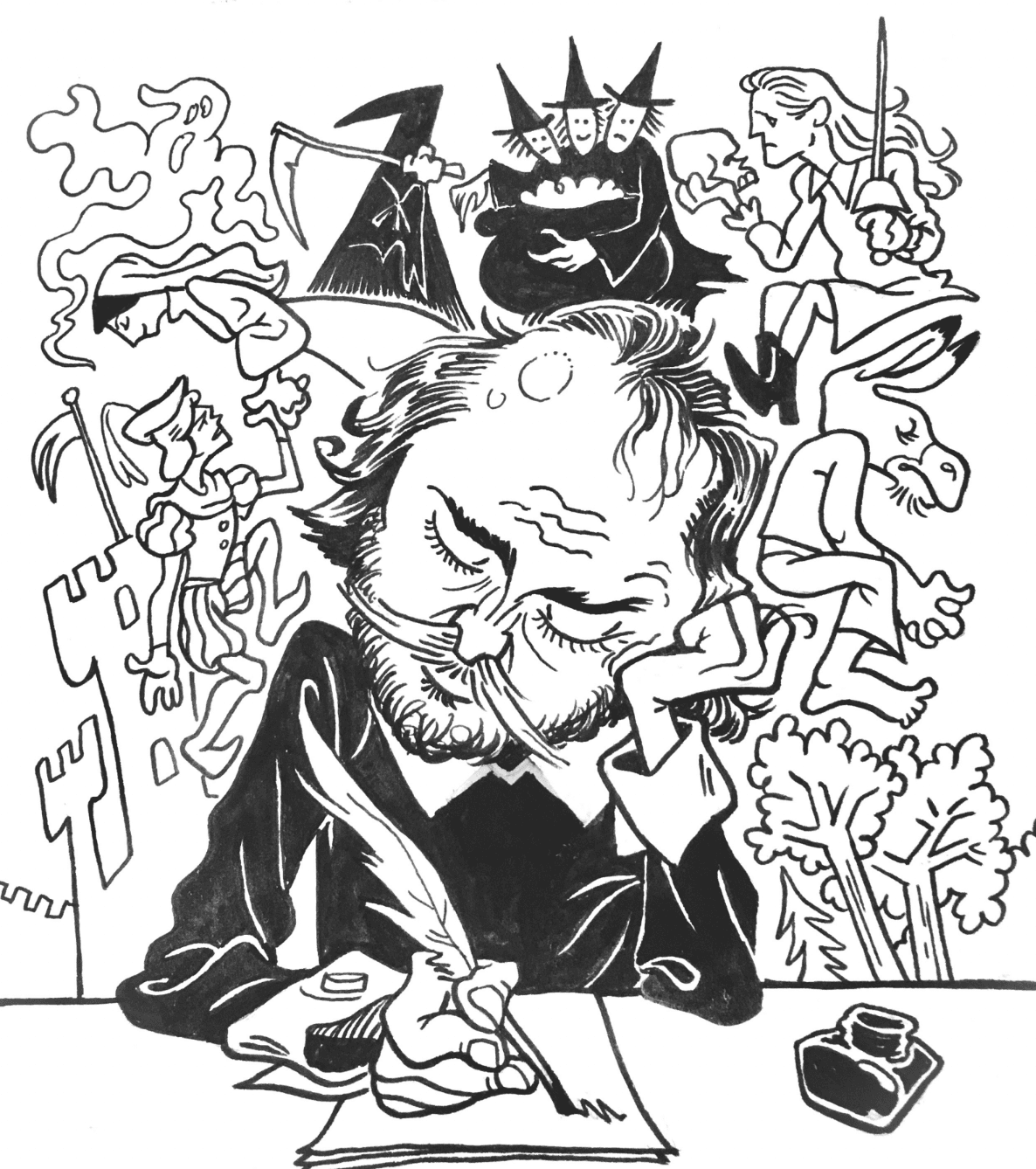
UC Davis students and faculty reflect on their favorite adaptations of Shakespeare’s classic plays
By TALAR KESHISHIAN — arts@theaggie.org
On April 23, the world celebrated the birth and death anniversary of English playwright William Shakespeare, commemorating his profound legacy in literature, theatre and the English language. In honor of Shakespeare Day, students and faculty in the UC Davis English Department shared their favorite contemporary Shakespeare adaptations.
“10 Things I Hate About You” dir. Gil Junger (1999):
Whether it’s a serenade from the bleachers or a heartwarming paintball date, “10 Things I Hate About You” has proven to be a staple in teen romance comedies. The film derives from Shakespeare’s “The Taming of the Shrew,” a comedy that centers on conventions of marriage and love during the Italian Renaissance. Anna Dobrowolski, a second-year English Ph.D. student, reflected on her love for the iconic film.
“My not-so guilty pleasure is ‘10 Things I Hate About You,’” Dobrowolski said. “It’s fun to see how contemporary film directors play around with the themes Shakespeare introduced in his plays. I grew up watching this movie and found it hilarious. Who doesn’t love a good bleacher montage?”
In the play, main character Katherine’s strong-willed personality is seen as “shrewish,” a more derogatory term embedded in misogynistic connotations. The film, however, subverts these traditional gender roles by characterizing Kat as a feminist, embracing her intelligence and wit as a rejection of patriarchy.
“I always liked how Kat and Bianca were figuring out their way in the world through the education system,” Dobrowolski said. “It resonates with some of the play’s themes, like women’s education. I like how in the play we have Bianca, who is being courted by her Latin and math tutors, but Kat’s already kind of shrewd because she is very well-educated and well-spoken. It’s a battle of wits to that extent.”
Dobrowolski also discussed how her involvement in Shakespeare theatre productions has made her realize how his plays serve as playgrounds for creativity and innovation.
“Seeing behind the scenes makes me appreciate how loose Shakespeare is,” Dobrowolski said. “As we know, he doesn’t include a lot of setting dynamics in his staging, and that’s what makes it special. He’s almost welcoming to these adaptations. This tradition of adapting is kind of like the artist’s provocation in life, which is fun.”
Dobrowolski expanded on the importance of transforming these works into something modern that audiences can empathize with.
“The movie is fascinating because you get not only references to Shakespeare, but witty banter that resonates with us as audience members,” Dobrowolski said. “‘10 Things I Hate About You’ is not a faithful adaptation, but at the same time, that’s the whole point of playing around and enjoying the material.”
“Ran” dir. Akira Kurosawa (1985):
Akira Kurosawa’s epic historical drama “Ran” incorporates the plot of Shakespeare’s “King Lear” with a backdrop of a 16th-century Japanese empire. As an aging ruler deliberates on how to divide his kingdom among his three sons, tragedy and destruction ensue as his power slips away. Professor Chip Badley, a lecturer in English, shared his appreciation for Kurosawa’s vision.
“I think ‘Ran’ is one of the more imaginative adaptations of Shakespeare’s plays that I’ve seen,” Badley said. “Part of the way ‘Ran’ works so well is that it tells the story through images as much as language. Even if it is spoken in Japanese, and a lot of the dialogue sounds very Shakespearean, I think arguably you could watch the film as a silent film and still get a lot of the plot through the iconography and visual information that Kurosawa conveys.”
Badley described how film is a powerful medium for staging Shakespeare’s written storytelling.
“Even with seeing Shakespeare live, I think so much of the power of his plays comes through visual communication strategies that I think this film does really well,” Badley said. “[This is] especially [true] because it’s in color with a big budget, and it’s an epic in every sense of the word. There are huge battle scenes and set pieces, and the costuming is incredible. I think Kurosawa can communicate nonverbally what a lot of other people resort to language to convey.”
Badley then discussed how Kurosawa’s film visualizes the intricacies of the human experience on such a grand scale.
“For me at least, I think there’s a bittersweet poignant overlap between Kurosawa and Lear himself,” Badley said. “I don’t think Kurosawa self-identified as Lear in any way, but I think there’s something stirring in thinking about Kurosawa toward the end of his life, using the story about an elderly man thinking about what kind of mark he wants to leave on the world. ‘King Lear’ and ‘Ran,’ both in very different ways, are working through what it means to age and hopefully the gracefulness we can all take into aging.”
“The Lion King” dir. Roger Allers and Rob Minkoff (1994):
Though it may not be common knowledge, Disney’s beloved animated film “The Lion King” is loosely based on Shakespeare’s widely considered magnum opus, “Hamlet.” Charlie Roussel, a third-year English major, expressed his love for the film’s classic animation style.
“I like that era of Disney movies and that style of animation,” Roussel said. “Like most kids, I didn’t know it was a Shakespeare adaptation until later on. I didn’t read ‘Hamlet’ until my second year at UC Davis, but when I was reading it, I realized it’s exactly that.”
Roussel described how the film incorporates the character dynamics of “Hamlet” in a way that’s accessible to all ages.
“The way that they used Mufasa’s spirit was really interesting from an artistic perspective, and the way it followed Simba as he grew up,” Roussel said. “The parallels between the way Mufasa’s spirit came to Simba in a more positive and influential force — compared to other not-so-positive forces in Hamlet’s life, such as his dead father — are interesting.”
The film’s exploration of Hamlet’s tumultuous plot within the natural world sets it apart from other iterations of the play, according to Roussel.
“The thing that always stuck with me from it was the representation of the animal kingdom and environment in the African savannah,” Roussel said. “The wide array of animals they animated and the scenes of the environment really contributed to the circle of life theme. It’s a very liberal adaptation, but [it] definitely brought new life to the play.”
Shakespeare-inspired games:
Shakespeare film and stage adaptations are cherished and highly regarded, but there are many other emerging approaches to bring his plays to life. English Professor Gina Bloom researches the historical intersection between Shakespeare and games. The adaptations she studies, teaches and develops range from video games, board games, social media and various other mediums.
“The idea of video games as adaptation is that they allow you to explore different narrative pathways, different ways that the play could go if circumstances are slightly different,” Bloom said. “I’m really interested in that idea of changing the narrative and having a part in it, how you can come to understand the narrative and characters through making choices while interacting with this media object.”
One of the classes Bloom teaches at UC Davis is ENL 052: Pop Culture Shakespeare, in which students learn how Shakespeare can be adapted across various kinds of media. The class will be available to register for this upcoming fall quarter.
“One of my favorite games we play [in the class] is called ‘Elsinore,’ which is an adaptation of ‘Hamlet,’” Bloom said. “In ‘Elsinore,’ you are Ophelia [from ‘Hamlet’] and you are going about the play. Things seem very normal, and then, suddenly, you die. What happens is that Ophelia continues to replay the day, learning new information as she goes along by talking to people and listening in on conversation[s] in order to try to stop the tragedy of the play.”
Bloom also highlighted the importance of redefining the ways we represent these canonical works within our advancing technological landscape.
“At this current moment, we use a range of different media forms in our lives,” Dr. Bloom said. “Any media form that exists can be used for adapting literature and particularly for adapting plays, which are already a kind of interactive media. I think that it’s important for students to critically examine the media they use in their everyday lives, and what better way to do it than Shakespeare?”
Shakespeare’s plays have endured for their immense entertainment and educational value, but most of all, they serve as a way for us to understand how the human condition is in dialogue with our evolving world — whether it be through films, animation or video games, according to Bloom.
“What I like about all adaptation is that people take liberties with Shakespeare,” Bloom said. “You don’t want plays to stay the same; they should change with us. As our ideas and social norms change, Shakespeare should change with them.”
Written by: Talar Keshishian — arts@theaggie.org