






‘It was simply home’: 1882 Foundation to host film screening at UC Davis
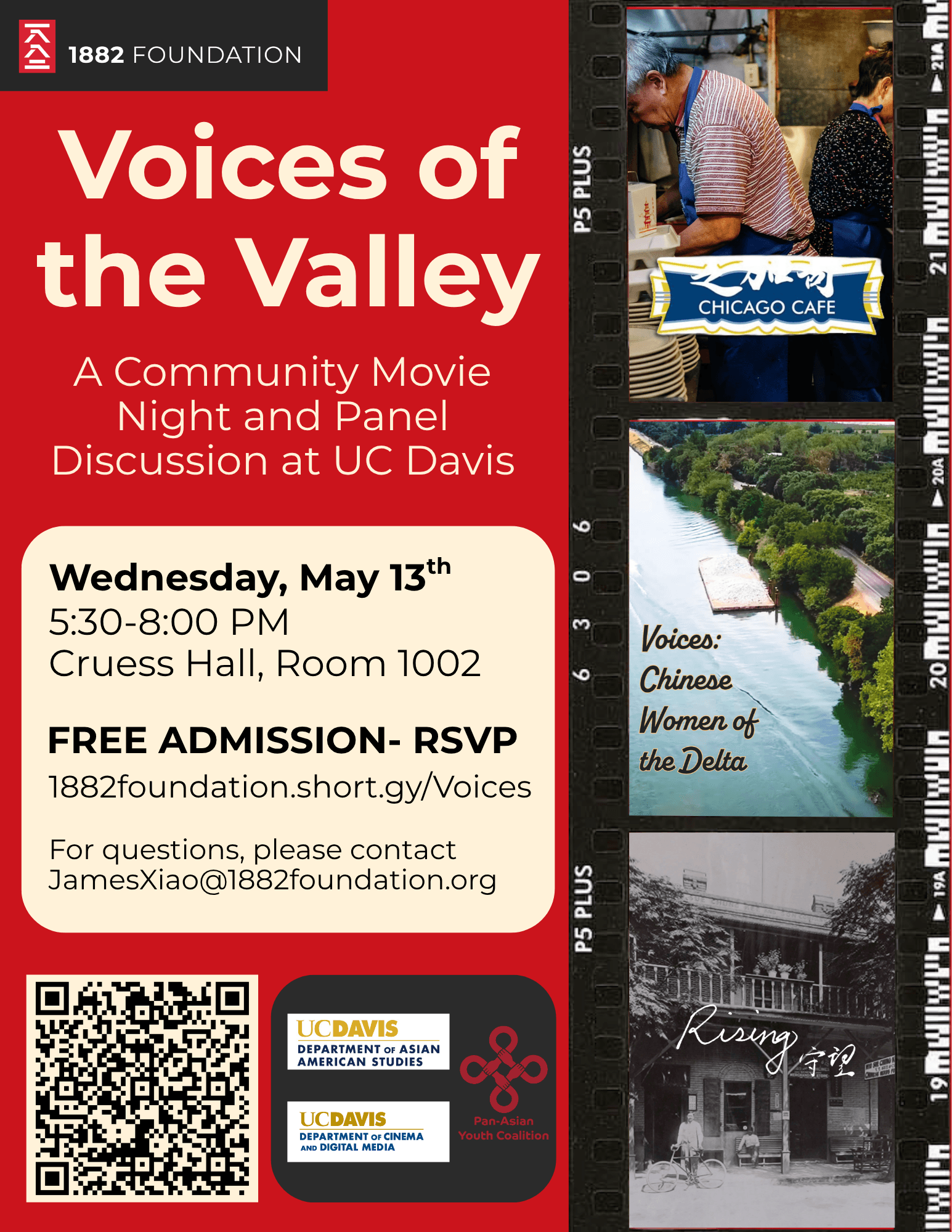
Scheduled for May 13 at Cruess Hall, the nonprofit aims to foster student awareness of the history of Chinese Americans in the Sacramento Delta region
BY JULIE HUANG— arts@theaggie.org
On May 13, the 1882 Foundation, a nonprofit organization dedicated to spreading awareness of the enduring impact of the Chinese Exclusion Act of 1882, will be holding a film screening and discussion panel of three short documentaries from 5:30 to 7:30 p.m. in Cruess Hall, Room 1002.
The event is a collaboration with the UC Davis Department of Asian American Studies, Department of Cinema and Digital Media and Pan-Asian Youth Coalition.
James Xiao, manager of the foundation’s Sacramento office, explained that the film screening aims to increase visibility of Chinese American stories and experiences that are less known and recognized among the general public.
“When people think of Chinese American communities, they often think of big cities like San Francisco and Los Angeles,” Xiao said. “They don’t often think of Chinese American communities in rural areas, like Hanford and Woodland.”
The three documentaries being shown, “Chicago Cafe,” “Rising” and “Voices: Chinese Women of the Delta,” all speak to the long and varied history of Chinese communities in the United States, denying any misconceptions that Chinese Americans are a recent development.
“Most people think of Chinese communities as a recent thing, but there are communities that have been around for almost a hundred years,” Xiao said. “These are rural communities, and they’ve existed for a long time.”
One of the films being shown, “Rising,” is a documentary that depicts the Wing family’s generational connection to the city of Hanford’s China Alley District and their dedication to its preservation, especially through the aftermath of a fire that destroyed its Taoist Temple Museum.
Arianne Wing, a writer and president of the China Alley Preservation Society, spoke about her feelings on her familial history and the experience of seeing it brought to a wider audience through the screen.
“When I was younger, my connection to the China Alley Historic District was both personal and lived,” Wing said. “The Alley was woven into [my family’s] daily lives through our restaurants, gatherings and traditions. It wasn’t something I thought of as ‘history’ at the time. It was simply home.”
“Rising” and the other documentaries do not only aim to communicate historical information to audiences, but also to emphasize that these stories belonged to real people who lived them.
“I hope audiences come away understanding that Hanford’s China Alley Historic District is more than a collection of old buildings,” Wing said. “If ‘Rising’ inspires even one person to care about places like China Alley and the histories they hold, that would mean a great deal.”
The 1882 Foundation held a previous film screening in Sacramento in January, which Xiao deemed a success by all measures — especially in its emotional resonance and relevance to attendees.
“We had a really good reception after the event,” Xiao said. “People told me how moving it was. Some even cried at the discussion afterwards, because they found the stories so meaningful.”
The audience at the Sacramento screening mostly represented an older demographic. Xiao shared her hopes that the upcoming screening reaches the Davis student community and spreads awareness of the rich history of Chinese Americans in the Central Valley to a younger population who may not have known its full depth.
“We’re holding [the event] on campus to make it as easy as possible for students to access,” Xiao said. “This is an experiment, to be honest. We’re trying to do something a little bit different in terms of programming, because these stories are stories that we want to bring to the student population.”
Genevie Hong, a third-year cognitive science and sustainable environmental design double major, interns at the 1882 Foundation and serves as co-president of the Pan-Asian Youth Coalition. Hong framed the documentary screening as part of a larger mission to encourage bonds of community and kinship across generations.
“A core part of the Pan-Asian Youth Coalition is our desire to bridge generational gaps,” Hong said. “On a college campus, you’re surrounded by people who are all of your generation. It’s hard to connect to people who aren’t your age.”
Hong explained that the shortage of third spaces and environments specifically designed for community engagement makes it harder to foster and maintain intentional connections between generations.
“Not a lot of people in Davis are aware that there’s such a rich Chinese American history just 30 minutes down the road,” Hong said. “The importance of youth engagement is why we’re bringing the films into Davis.”
Some members of the Davis community are already invested in telling these stories. Davis undergraduate students, graduate students and the Department of Asian American Studies were involved in the planning and organization of the event. Furthermore, Jack Chin, a professor at the UC Davis School of Law who specializes in immigration law, will be a member of the discussion panel.
Yansong Li, a graduate student in geography and a volunteer who helped plan the documentary screening, shared their hopes that the film screening helps create bonds of community that can combat feelings of alienation among minority groups, especially those who may lack strong support networks.
“As a Chinese international student, I remember what it was like to feel disconnected and unwelcome, especially during the COVID-19 pandemic,” Li said. “I remember how hard it was for Asian students, specifically Chinese students.”
Experiencing stories of the past through the medium of film helps clarify the similarities between historical circumstances and their parallels to more recent events, according to Wing. Most resonant and timeless are the enduring emotional experiences that generations within a community can share with each other through storytelling.
“Film has a unique ability to preserve emotion as well as history,” Wing said. “The film captured not only history but resilience in real time. It documented a moment when our community was hurting, yet still determined to move forward.”
Reflecting on his initial reaction to learning the history of Chinese American communities in the Sacramento Delta, Li explained that he had initially felt surprise, then pride and sorrow.
“I want to show other students like me that there is a long history of their people who lived on this land, built it up [and] created the infrastructure and railroads,” Li said. “I hope that it helps them feel more connected to this part of the world.”
Learning more about the history of local communities — in providing greater perspective on the links between the past and present moment — may also lead to challenging questions about the current state of events and one’s place within them, according to Li.
“Resilience is the experience of minorities in America, but is that really a compliment?” Li said. “Is it just sort of laughing through the pain? Why do we have to be resilient?”
The film screening event aims to offer an opportunity to learn more and become a part of the ongoing discussion.
“My hope is to find young people who are curious about this aspect of history that they might not know much about,” Xiao said. “We want to connect to students who might feel inspired to become ambassadors of this knowledge.”
The documentary screenings will be held in Room 1002 of Cruess Hall on May 13, from 5:30 to 7:30 p.m. More information about the 1882 Foundation and its mission can be found on their website.
Written by: Julie Huang — arts@theaggie.org