






How light can both increase and impair plant growth
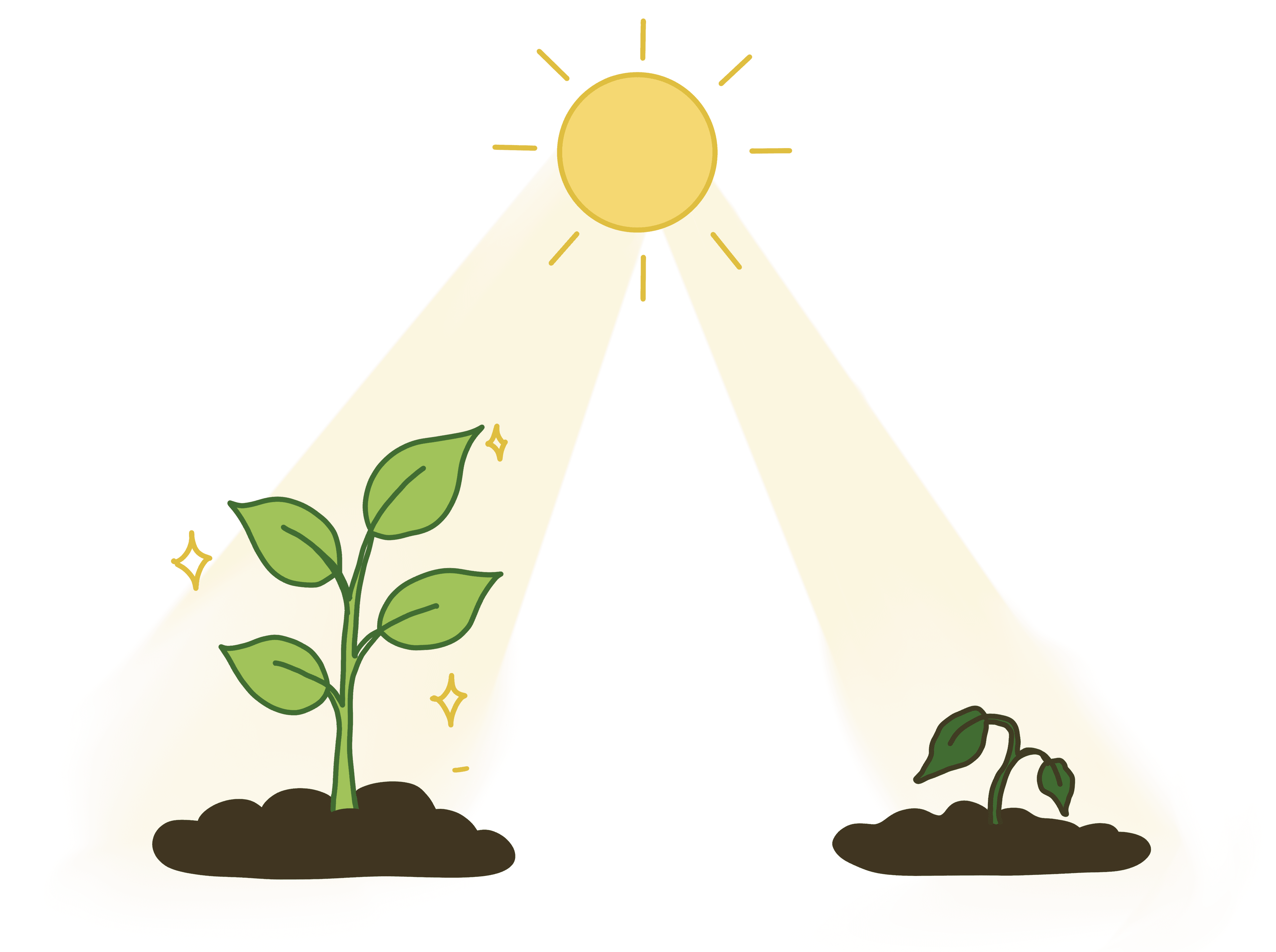
New research reveals that certain wavelengths of light cause plants to secrete a chemical adhesive that limits stem growth
By EMILIA ROSE— science@theaggie.org
Most people learned in middle school science that light serves as the main energy source for plants; it allows them to take that energy from the sun and use it to convert water and carbon dioxide into sugars that fuel growth, maintenance and reproduction — a process called photosynthesis.
However, new research out of Osaka Metropolitan University (OMU) in Japan signals that this very source of life may also slightly restrict a plant’s growth. For plants, light is more than just food — they are constantly responding to their environment, and we can especially see this with light.
Stacey Harmer, a plant biologist at UC Davis, explained the many stimuli that light gives to plants.
“Plants use light to carry out photosynthesis,” Harmer said. “But plants also have photoreceptors, analogous to the photoreceptors we have in our eyes, to sense the environment and change their growth and development accordingly.”
In this way, plants not only use light to grow, but also to perform a myriad of other functions, such as sensing their environment.
Oscar Garrett, a Ph.D. student in plant biology at UC Davis, further discussed the ways in which plants continuously respond to external stimuli.
“Despite looking rather inert, plants are constantly responding to stimuli,” Garrett said. “Since they do not move and have to put up with essentially whatever the environment throws at them, they’ve evolved very complex systems to respond to all kinds of different environmental changes.”
Garrett also explained how light itself is an environmental change that does more than just feed plants.
“Light is detected by photoreceptors,” Garrett said. “They absorb photons of certain wavelengths, leading to changes in gene expression, hormones and ultimately physiology.”
Light exists in different wavelengths that essentially vary in the amount of energy they have. Each kind has a different effect on plants — a more complicated system than just a food source. New research poses a trade-off stemming from this idea that different light has different effects on plants and how they react to it.
Scientists Yuma Shimizu and his team at OMU studied young pea stems, specifically the connection between the outer skin (epidermis) and the inner supporting tissues. The researchers measured how strong this physical connection was when exposed to various lights.
“The irradiation of white light […] resulted in significantly higher adhesive strength between epidermal and inner tissues, as well as inhibition of elongation growth,” Shimizu said.
When exposed to light, the very thing that helps plants grow also holds them back, limiting their stem elongation and growth. When Shimizu and his team looked closer, they found an increased autofluorescence, or a stronger glow in the cell walls after light exposure. This pointed them to the compound known as P-Coumaric Acid, which seemed to accumulate in the epidermal tissue. This compound reinforces the cell wall and strengthens the connection between a plant’s outer skin and its inner tissues — like a glue holding it together.
Light is not just a means to grow taller; the functional outcome of this biochemical mechanism gives plants their structure, even if that means holding them back.
Based on this new research from OMU, the light that fuels a large part of life on Earth both encourages and limits its growth — sometimes, a trade-off occurs where growth is restrained so that stability needs can be met.
Written by: Emilia Rose— science@theaggie.org