






UC Davis students on online versus in-person activism
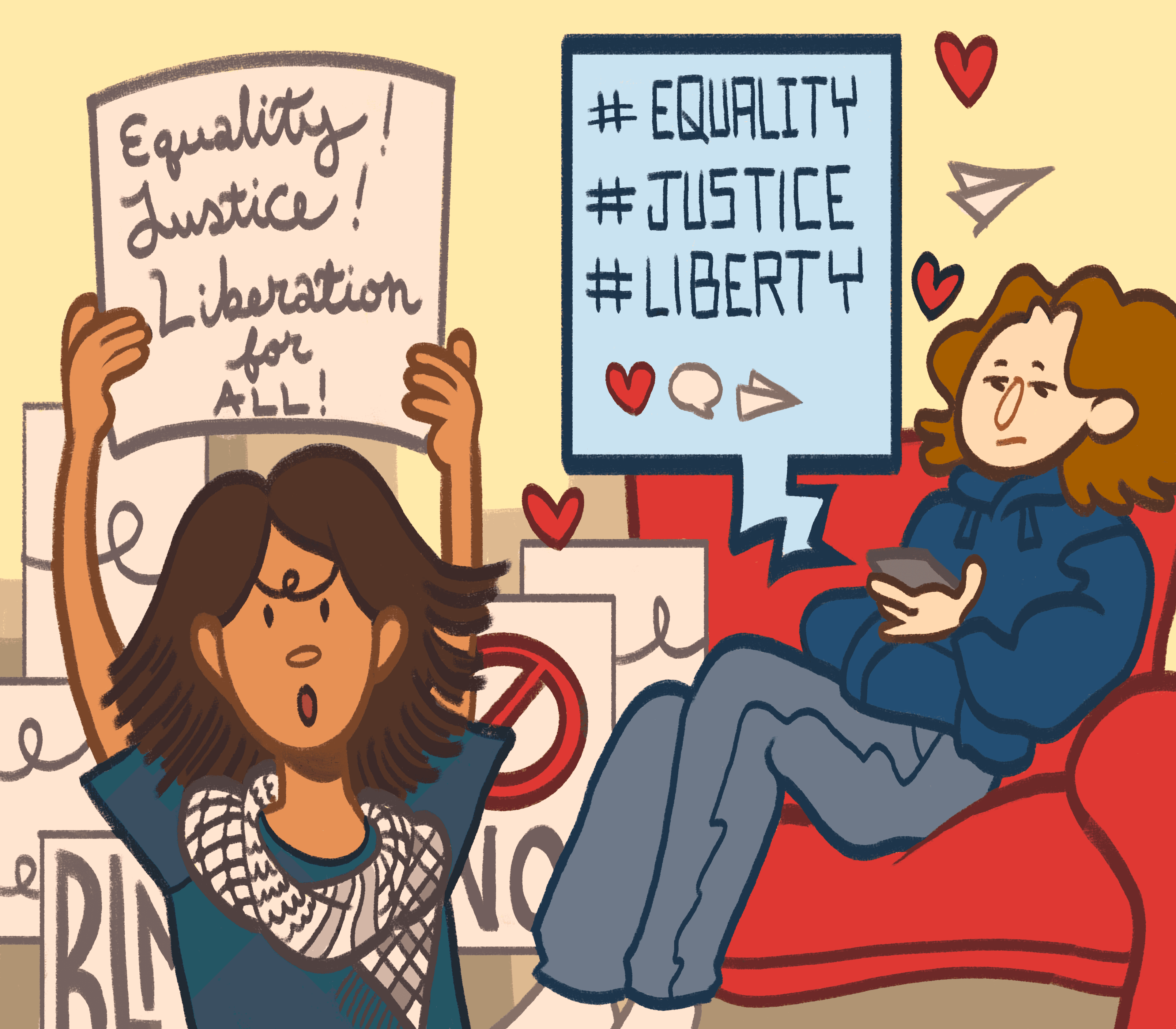
Aggies discuss changing roles and forms of advocacy
By AMBER WARNKE — features@theaggie.org
Universities are known to be highly political environments for young people, encouraging students to delve deeper into their personal political and social beliefs and to learn how to better express those ideas. While students still participate in traditional methods of activism, including protesting, striking and boycotts, the digital sphere has also opened up a new line of raising awareness via social media.
Charles Quest, a second-year law student, said he learns a lot about his friends’ political ideas based on what they post online.
“I think [social media] is an effective way of getting [out] the message that people want to get out there into the marketplace of ideas,” Quest said. “If one of my friends posts something, and then I see that [...] it does get me thinking about it, which may influence my voting preferences.”
The concept of digital activism has only become more widespread over time, with 42% of social media users labeling their sites as important means for them to learn about and get involved with social and political topics, according to Pew Research Center.
Dara Farnoush, a third-year environmental policy analysis and planning and economics double major, shared their belief that social media helps make activism more accessible to people who may otherwise not be able to access in-person efforts.
“Online activism makes being involved easier,” Farnoush said. “While it’s harder to find community and friends, it’s much easier to keep the momentum going even if you are away for a while. Despite spending the quarter in [Washington] D.C. and not being able to participate in events, I can still help organize events and plan from afar because of the online-offline mix — which is keeping me involved and engaged in ways I couldn’t be otherwise.”
Despite the ways in which online platforms for activism have transformed how people organize, digital activism is also often associated with many problematic elements, according to the Humanitarian Academy for Development.
Laila Waddell, a first-year political science Ph.D. student, explained that she is critical of those who only use the digital sphere to discuss politics, even if it does have its perks.
“I'm always a pro-cross-checking sort of person, and so when people see stuff online that are headed with these huge headlines and the big font and the attention-grabbing pictures, before you post, before you engage, before you form an opinion, read and follow the history of where these things [come from] or how they got to these places,” Waddell said.
Waddell described encountering people who, while meaning well, lack some of the foundational knowledge behind the topics they express such strong opinions about.
“A lot of people think that this whole call to free Palestine and criticizing Israel comes off what happened on Oct. 7, when really this has been a 60 [to] 70-year struggle for these people,” Waddell said. “Always have an educated stance; you should never have a stance that is based just on what you see online.”
However, for students who want to explore activism off the Internet, many can feel disillusioned with the political climate, believing that protests in the face of large issues are ineffective. However, Farnoush encouraged students to be optimistic, as many people working together for a cause can have a larger impact than it first appears.
“Protests, boycotts and talking with our representatives actually does make a change,” Farnoush said. “Decision makers see ‘Oh, there's like a thousand people in this city that care enough to spend their Saturday morning [protesting] out at the park, standing, walking, chanting. These people that I'm supposed to represent do care about this.’”
History tends to back up this mindset, with protests — often peaceful ones — being proven to affect elections and lead to direct political outcomes. Calling representatives is likewise effective, creating a record each time a call is logged. When enough people call to make the same complaint, a representative takes notice, which may influence their decision. Students looking to learn more about calling their representatives can access the University of California’s guide online.
Likewise, there is also evidence to support boycotts' ability to enact change, a form of activism that can be integrated into someone’s daily life. Ethicalconsumer.org has a list of companies consumers can consider boycotting, for those who want to learn more about where to start.
Farnoush’s main form of creating change, however, is through the direct impact of playing an active role in his community.
“A lot of what I like to do is hands-on volunteering,” Farnoush said. “With CALPIRG, I’m the campaign coordinator for a homelessness campaign [...] We’ve done a food drive out by the Davis Food Co-op, and we raised $400 worth of stuff over the course of a couple of hours that we donate[d] to food banks. Almost every night we're out at the Night Market, helping out, handing food to people who need it.”
Students looking to get more involved in community action have ample resources at UC Davis that they can join. Students interested in aiding the homelessness issue can volunteer with Aggie House, those aiming to support the environment can join the Rewilding Society and Aggies interested in giving back in other ways have a host of options available to them.
Even when political and social issues can feel overwhelming, Waddell reminded students to stay focused on the power they do have to make a positive difference in the world.
“I think young people sometimes forget that some of the most prominent and intellectual movements in this country were spearheaded by young people,” Waddell said. “And it feels like for us right now it’s just impending doom, but it's really not, and being involved in that sort of low-level organizing really helps you see [it] that way. The impact doesn't feel like it in the broader sense, but on the lower level, the impacts really do matter.”
Written by: Amber Warnke — features@theaggie.org