






All4Yolo: ‘Don’t Promise. Prove.’
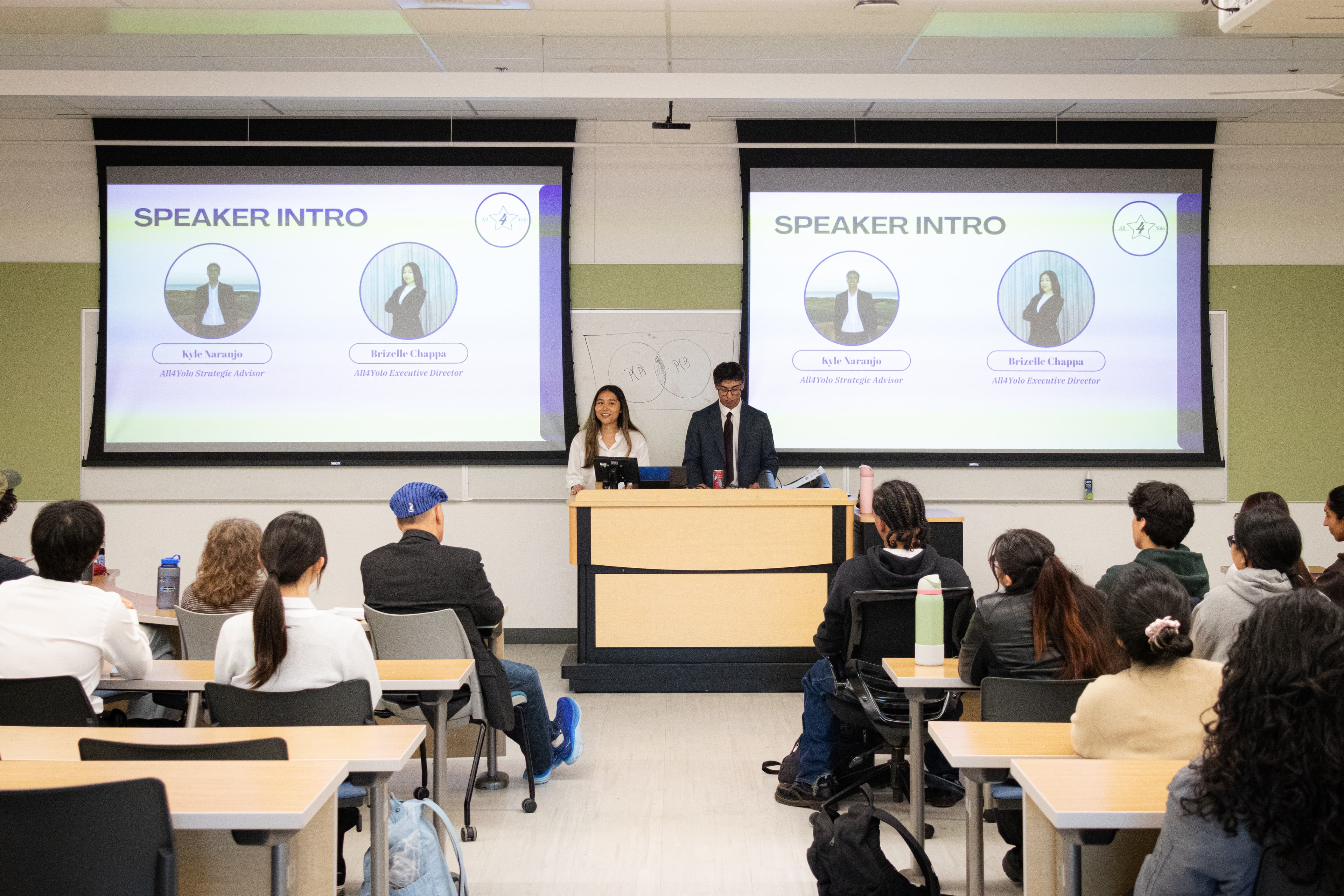
All4Yolo, a support-based organization, coordinated the creation of UC Davis’ first safe parking program for students
By DOMENICA PELOSO — features@theaggie.org
Between 2017 and 2018, the UC Davis Housing Affordability and Insecurity Report indicated that 18% of all Davis students experienced some form of homelessness or housing insecurity within that year. However, determining the true percentage of burdened college students has historically challenged institutions, as student homelessness is frequently hidden, and therefore easy to miss, according to SchoolHouse Connection.
Among those often underrepresented are students who commute up to three hours a day to campus and students who live in their cars.
Bearing this in mind, All4Yolo, a registered student organization (RSO) and nonprofit, spearheaded an initiative to establish UC Davis’ first ever student-only safe parking program starting fall quarter 2026.
All4Yolo was first ideated in 2025 by co-founders Brizelle Chappa, a third-year political science major, and Kyle Naranjo, a 2026 UC Davis alumnus with a Bachelor of Art (B.A.) degree in political science and history.
“We are an organization that has contributed a lot of time and effort into volunteering and community outreach, as well as working with six other nonprofits,” Chappa, who also serves as the executive director of All4Yolo, said. “We're a dedicated group that has seen that there needs to be change in certain areas — not solely in Davis, but in Yolo County as a whole.”
Though All4Yolo has dedicated time to multiple service projects — such as repainting Empower Yolo’s domestic abuse treatment center in January — Chappa emphasized that creating a safe parking program has become the nonprofit’s shining “star.”
In May 2025, Naranjo and Chappa met Natalia Baltazar, the director of development and community relations of Empower Yolo.
“In my speeches, I always say that I need you guys in partnership with me, because these movements are bigger than us,” Baltazar said. “I feel like they heard that, and that they are trying to figure out ways to engage young college students and stay involved with different nonprofits. I could tell when I met with them how dedicated they were.”
Over the summer, Naranjo and Chappa arranged a meeting with Baltazar to introduce their upcoming student-run service organization.
“If anyone's going to get any recognition for the overall start of All4Yolo, it goes to [Baltazar],” Chappa said. “I think she saw something in us that we didn't see for ourselves at the time, which was that potential of creating something a little bit bigger than ourselves. I think she, without even knowing it, pushed us in that direction.”
In their meeting, Baltazar connected Naranjo and Chappa to the director of Yolo County’s Homeless Poverty Action Coalition (HPAC) — who went on to introduce them to Robb Davis, the assistant director of the Aggie Compass Basic Needs Center and former mayor of Davis from 2014 to 2018.
Drawing inspiration from Long Beach Community College and purchasing a manual from the long-standing Safe Parking program in Santa Barbara County, Robb Davis initially reached out to the Homeless Emergency Assistance and Rehousing Team (HEART of Davis) regarding a safe parking program in September 2023. They officially launched the volunteer-based Safe Heart Safe Parking program in July 2025.
Around the same time, Robb Davis also proposed a student-based safe parking program to Naranjo and Chappa, who he emphasized took the idea and ran with it.
“All of us who work in basic needs have recognized that there are an unknown and very difficult-to-count number of students who either live in their cars or students who I call ‘long commuters,’” Davis, who also serves as All4Yolo’s club advisor, said. “I don’t think it’s a choice that people sleep in their cars; that might be one of the only real options they have. For those students, we need to provide a safe place for them to be, with at least a limited amount of services where we can try to connect them to more permanent housing options.”
In January, All4Yolo members became the first students to wake up at 3 a.m. and help conduct the Yolo County Point In Time (PIT) Count — an annual census that estimates the number of unhoused individuals on a given night. Of the 194 identified individuals experiencing homelessness in Davis, two students were found sleeping in their cars on campus, according to Naranjo.
Shortly thereafter, All4Yolo partnered with HEART of Davis, under the advisement of the Aggie Compass Basic Needs Center, to launch the Heart Initiative. This campaign assessed the need for a safe parking program among undergraduate commuters who are financially insecure or unhoused.
Throughout February, All4Yolo contacted an estimated 500 undergraduate students with unhoused advocacy and commuter advocacy surveys.
Based on 42 completed surveys (28 from commuters and 14 from unhoused students), 43% of respondents reportedly stayed in Davis overnight instead of commuting home, 50% indicated that their main source of shelter at some point was the vehicle they drove to campus and 82% reported that they would use a safe parking program at least once a week.
By contrast, the 2017-18 UC Davis Housing Affordability and Insecurity Report found that only 2% of students slept in their cars within the past year — highlighting that housing insecurity is an ever-growing issue.
“In high school, my family lived in our car,” an unhoused student’s survey response reads. “Students at UC Davis and the greater Davis community would benefit from a safe place to park and take care of themselves.”
After successfully establishing the need for safe parking, All4Yolo faced their second challenge: finding volunteers to execute the program.
On April 22, All4Yolo met with representatives from SHIFT, the Student Commuter Organization, Human Kind Movement, HOPE at Davis, the ASUCD External Affairs Commission and HEART of Davis at the Community Service Coalition (CSC). Here, they confirmed each organization’s commitment to the volunteer-based program.
Volunteers are needed to check students in and out of the host site — one shift in the morning and one in the evening. In total, each shift requires just two volunteers.
“I would say the most important speaker of the night was a previously unhoused student who gave a testimonial for about 10 minutes,” Naranjo said. “There were people crying. I've never seen a room of 100 people so silent and so starstruck. It's one thing to understand the importance of the program, but it's another thing entirely to understand the emotional depth of everything we're creating.”
After successfully demonstrating the need for a safe parking program and sourcing volunteers, the final hurdle for All4Yolo was securing the host site’s approval. The precise location of the host site remains confidential for safety purposes, but it is within a half-mile of campus.
On May 6, Naranjo met with representatives from the host site, HEART of Davis and Aggie Compass Basic Needs Center to discuss the logistics of the program.
“If our survey had fallen apart, if we didn't find enough volunteers, if we didn't find some sort of supplemental funding — none of this would exist,” Naranjo said. “The host site would only expressly agree if we were able to prove that these people were students, there was funding and there was some sort of legal stipulation for them to be there. It came down to negotiating details as small as snacks, where to put the volunteer clipboard, where they would sit and if they could have a bench.”
After nine months of unwavering dedication and an estimated 35 meetings, according to Naranjo, a safe parking pilot program for six students will launch during week two of fall quarter 2026.
“There is a lot of really poor leadership being modeled to students these days,” Davis said. “It's all about power, acquiring it, using it, enriching yourself from it. Meaningful public health challenges, like this one, can only be done when we collaborate, when we put aside ego and when we work together on a clear end goal that we want to achieve. This has been one of the most satisfying things I've seen evolve in my career.”
In terms of the future, All4Yolo is planning to expand into other basic needs sectors, such as food service, while continuing to maintain their existing commitments to other organizations.
Though All4Yolo debuted just nine months ago, they have worked hard to uphold their slogan of "Don't promise. Prove.”
“‘Don't promise. Prove.’ should be a way of life,” Chappa said. “I definitely live by our slogan. It hasn't just stuck to me within our organization; I take it with me on an everyday basis.”
For more information on finding resources for those facing housing insecurity or homelessness, inquire at all4yolo@gmail.com.
Written by: Domenica Peloso — features@theaggie.org