





Davis Drag Club: ‘a playground to experiment with drag’
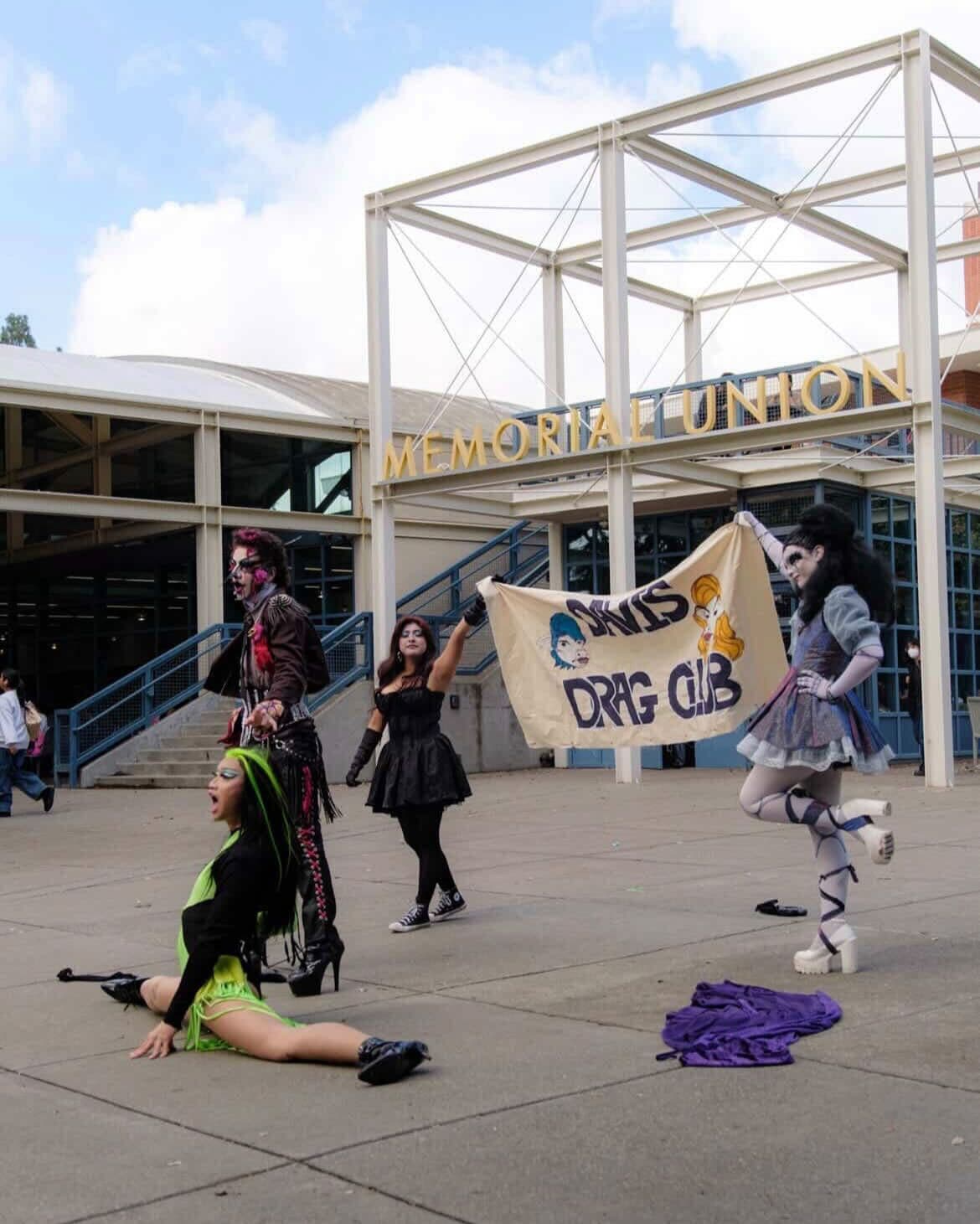
The Davis Drag Club challenges narrow perceptions of drag
By LAILA AZHAR — features@theaggie.org
As the club’s Treasurer, Hazel Tepper (known as Amoretto when in drag), a fifth-year animal science major, recalled that the officers of the Davis Drag Club had been discussing forming a club long before it was officially established.
“We’d all be independently invited to a lot of the same gigs and every time we’d be like, ‘Oh my god, this is so fun, we should have a club or something,’” Tepper said. “And people would even be like, ‘Do you guys have a club I can reach out to to book?’ Many times. It kind of stayed as like a ‘We should do that sometime — anyway, see you in the next four months I guess.’”
The long-running idea finally materialized this academic year, when Dani Cuevas (known as Barbie Knu when in drag), a fourth-year communication major and the club’s president, took the initiative to organize a group. Drawn to drag as an outlet to challenge gender expectations, Cuevas reached out to others involved in the Davis drag scene, hoping to create a space for others to enjoy the art form.
“I’ve always been raised in a Mexican household with the idea of, ‘Oh this is a picture-perfect woman,’” Cuevas said. “She should look like this, she should act like this, she should talk like this. And my whole life, I’m like, ‘But I know that I’m not like that. Does that make me undesirable?’ As I grew older, I really put my foot down. Like, ‘Hey I am the way I am.’ And I feel like I really take that into my drag as well. I am my own ideal woman, and this is how I’m going to show that.”
Since its formation, the Davis Drag Club has opened for the Rocky Horror Picture Show, hosted makeup and wig workshops and held socials such as movie nights and study jams. The club promotes an expansive view of drag.
“There is a huge misconception in the public image that [drag] is just gay men dressing as women,” Tepper said. “But at the end of the day, drag is just an art form that’s all about self-expression and playing with gender presentation.”
Dominic Lui (known as Jenny Tells when in drag), a fourth-year sustainable environmental design major and the club’s social media chair, added on.
“Drag is an amalgamation of pop culture and references, and it creates new references,” Lui said. “It’s always about pushing and breaking boundaries, especially ones around queerness and gender.”
Performers often use drag to explore both aesthetic and creative visions alongside social commentary, drawing inspiration from anything and everything. Kai Tuzzeo, the club’s vice president and a fourth-year design major, took inspiration for their drag persona, “Aphyd,” from aphids, the insect.
“I love those little bugs,” Tuzzeo said. “They’re really cute. But they’re also a pest insect. They can duplicate really quickly through obligate parthenogenesis. They’re everywhere and they all look the same, and I wanted to lean into that and make fun of the fact that queer people are often fit within such tiny stereotypes. Within the queer community, there’s visible stereotypes of, you have to be this and this and this. And so I title myself as that, even though I’m not that, to make fun of it. To be like, ‘There’s no consistent one mold that a queer person fits in, and what their life is and how they should look.’”
While TV shows such as Rupaul’s Drag Race have helped to popularize the art form, the officers’ approach is distinct from mainstream drag.
“If you google what a drag queen is, we’re not going to be the people who show up,” Tepper said.
Tuzzeo pointed out the limitations of more popular approaches to drag.
“Drag Race often takes this art form and condenses it into this thing that can be commercialized,” Tuzzeo said. “There’s this idea of ‘You’re not a good drag queen unless you do this, this and this,’ and they’ll make fun of people who are fat or make fun of people who are older or push racial stereotypes. And that’s what’s always bothered me about Drag Race.”
In contrast, the Davis Drag Club prioritizes accessibility and experimentation.
“I always tell new performers, it’s not about being perfect, it’s not about looking amazing, it’s not about having the most polished eyeliner ever,” Tuzzeo said. “The most important thing about drag is your willingness to just go up on that stage. That is the most fierce thing you can do.”
This inclusivity extends to anyone with an interest in drag in any capacity.
“This is a club for people who like to watch [drag] but have no interest in performing,” Tepper said. “This is for people who are intrigued but not sure if they want to perform. This is for people who want to perform but don’t know where to start. And this is for performers. It’s a space for everyone with an interest in drag, regardless of what that interest is.”
Lui noted that this openness sets the club apart from other drag spaces, which can often feel competitive.
“This club is able to be like a playground to experiment with drag, whereas if you go to Sacramento or [San Francisco], a lot of these performers are doing it because they need to do it to survive, which then creates this competitive environment,” Lui said.
Particularly during a period of rollbacks of queer rights, spaces such as the Davis Drag Club provide a necessary outlet.
“I hate how much fear and uncertainty there is right now, but I also feel like it’s kind of causing a more authentic, energetic and passionate representation of weirdness than what we’ve seen before,” Tepper said. “Through the 2010s and early 2020s, there was a lot of that corporate, capitalistic, commercialized pride. While I’m grateful for the visibility and the rights that came with it, what we’re seeing now is that people have so much energy and so much anger and so much passion for this community.”
Tepper continued, pointing out drag’s political origins.
“Drag has always been political,” Tepper said. “So much of this art form has been inspired as responses to oppression. And so, I feel like we’re seeing a move towards those original representations of drag that were focused around gender exploration and subverting social norms, and being in-your-face, f*** you, as a protest, as opposed to polished and perfect.”
This sense of authenticity and community has fostered a deep sense of connection to the club for many.
“So many people have come to us and said, ‘Hey I found community in your club that I didn’t have before, and I’ve been able to experiment artistically with my performance and my identity in ways I never would have if it wasn’t for this club,’” Cuevas said. “We say to each other all the time, ‘I wish we started this sooner.’ It’s a place to call home and I’m really glad that it’s been that for a lot of people.”
Students interested in keeping up-to-date with the Davis Drag Club’s events can follow them on Instagram at @davisdragclub.
Written by: Laila Azhar — features@theaggie.org