






A sit-down interview with outgoing ASUCD President Amrita Julka
‘We have really lived up to our promise that we would unapologetically fight for what's right’
By AALIYAH ESPAÑOL-RIVAS — campus@theaggie.org
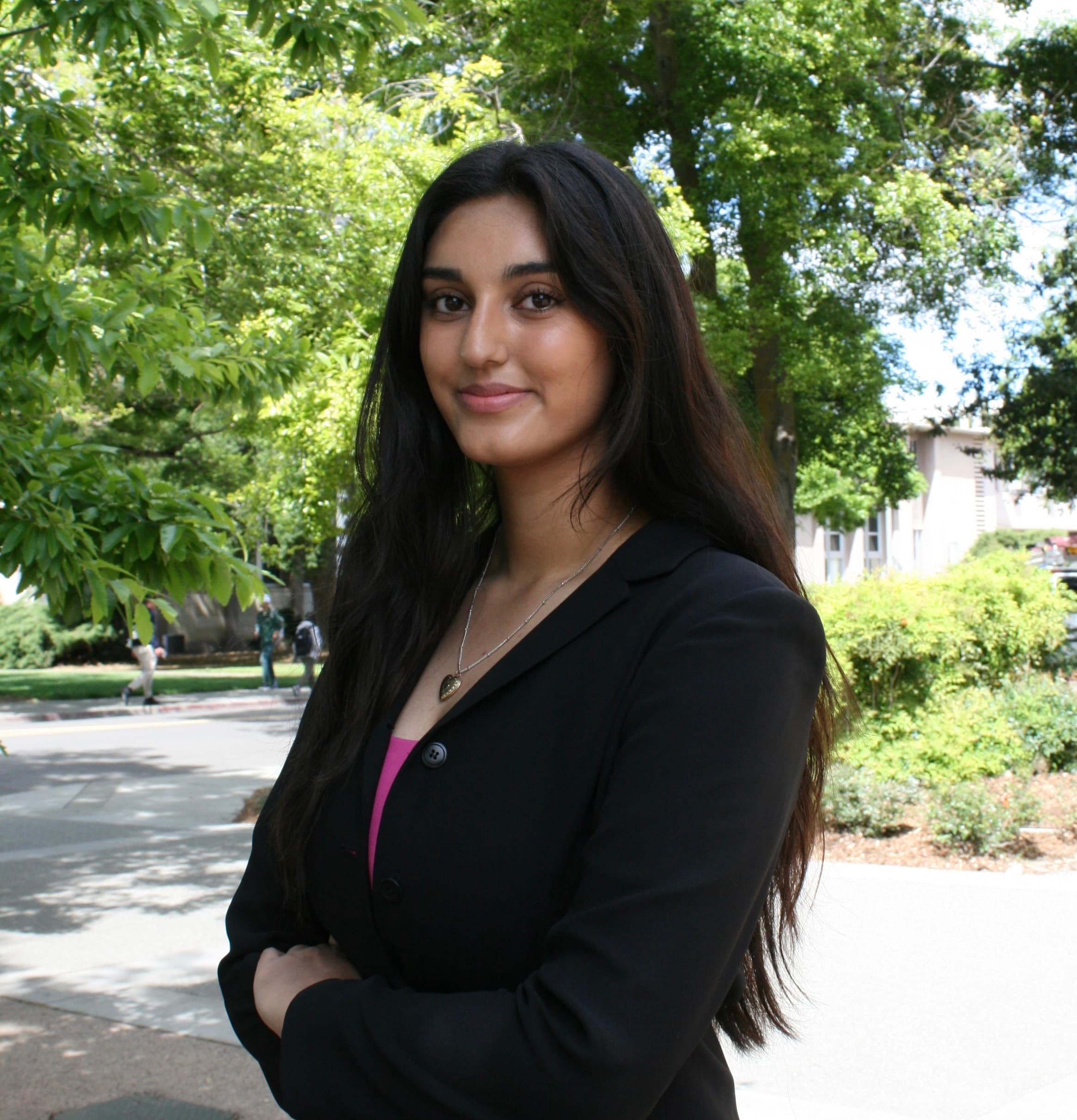
ASUCD President Amrita Julka, a third-year political science and human development double major, is set to leave office this Thursday, June 4, after serving a year as the student government’s chief executive. She sat down for an interview with The California Aggie on Wednesday, May 27, to reflect on her term, discuss her hopes for ASUCD’s future and share advice for her successor.
Below is a transcript of Julka’s interview with The California Aggie, edited for length and clarity.
Q: Next week is the last Senate meeting of the quarter. How are you feeling about the Association and its accomplishments this year?
Julka: I felt like we made a lot of really great progress, especially internally. I think we've gotten ourselves a bit more together. And I think externally, we've managed our relationships with administration and other campus partners really well. I'm super excited to pass it down to the incoming president. I think he's [Luis L. Garcia] going to do a really great job in keeping up and maintaining the good work and progressing even further.
Q: How has it been being ASUCD president? How do you feel about your term?
Julka: I think it's been pretty good. I feel really strongly about my term. I think that we've made a lot of great progress, and I think I've honored pretty much all of the goals that I set for myself at the beginning of the year by prioritizing student safety, basic needs and health and wellness.
Just looking back on the year, the fact that I got to honor all those things while also managing the personnel side of ASUCD, keeping drama and other things to a real minimum, has been great. I'm pretty proud of my term. I feel like I'm ending on a good note.
Q: What do you think you did well and what do you think you could have worked on more during your term?
Julka: I think the things that I did really well had to do with the different projects as well as student outreach. I think the task forces that I had with menstrual equity, student safety and activism as well as our equitable parking initiative, all performed really well and all made tangible improvements in student life. I do wish that my social media kind of reflected those more. I am not really good with social media. I think it would have been better to highlight more of those achievements that we were making throughout the year to keep the student body more aware.
Q: In terms of accomplishments, are there any specific ones that you'd like to highlight during your term that you feel really strongly about, in addition to the task forces?
Julka: The biggest project that I worked on that I wanted to accomplish was getting free [sexually transmitted disease (STD)] and [human immunodeficiency virus (HIV)] testing for all students, regardless of their insurance plan. Right now, it's only free if you have [University of California Student Health Insurance Plan (UC SHIP)], which is only like 50% of our students. Originally, I tried to do this by creating wellness-to-go vending machines, or you could go and get a free kit and have it delivered.
Unfortunately, the university didn't think this was tangible, but because I advocated so strongly for it, what they ended up doing is looking back over student health fees and reappropriating that. So next fall, they're actually launching a pilot program for free [sexually transmitted infection (STI)] and HIV student testing, and also using some online appointment systems as well. I'm really proud that I was able to advocate for that, having them go look back over those fees and make that change for students.
Q: Now to shift to the budget. This year, there was a 10% cut across all ASUCD sectors. How did you come to your proposed budget and what was your goal when tackling the deficit from last year?
Julka: Honestly, our whole ideology going into budget hearings was to keep things as equal as possible. I think when I was a senator, I was definitely more like: “We have to prioritize basic needs, even if that means cutting units like Entertainment Council.” I think that's always a very big issue. People want to cut Entertainment Council to fund basic needs resources, which I think is a fair argument to make. But I think when we look at the Association as a whole and units that have really big impacts, it's unfair of us to choose what units help more students than others, because they all are so meaningful to student life.
The 10% cut across the board was a way to keep that fair. And also, to allow the senators to make those changes that they wanted to make if they did choose to prioritize one unit over the other, then that's a choice that they could make. But as an executive office, we care about all parts of the Association equally and do our best to promote them all equally as well.
Q: How would you compare the budget hearings this year with the ones that you had last year, especially from the perspective as a senator to now president?
Julka: I think it was a lot more tense last year, and that's also kind of why we did this whole 10% cut across the board. I think as an executive team, not pushing any certain agenda — by being really neutral and equal going into hearings and showing the senators a lot of respect and deference in their decision — helped ease tensions because no one came into budget hearings, ready to necessarily fight us, which I think was a difference from last year.
As a senator myself, I knew that certain cuts were coming last year. And it was also the first year that they were doing budget hearings in the winter. So there wasn't a lot of transparency about the process. And so it was just a lot of high tensions and people just ready to fight, which didn't happen this year.
Q: In the same realm of working with the table this year, how would you compare being a senator last year to now kind of presiding over them and watching the senators do their work this year?
Julka: It's definitely a different experience for sure. My philosophy has been to kind of stay out of Senate drama. I don't choose certain senators to work with over others. If they want to work with me on a project, I'm happy to lend anyone and everyone my support. The only advice that I'll offer to others is advice on personnel-related things, like keeping the peace, being respectful and being professional. Because I have found that when the executive office gets too entangled with the legislative branch, things can get pretty dramatic and intense quickly.
Q: During the Senate meetings this year, you would make announcements at the beginning and end of meetings saying things like, “let's remember to be respectful and treat each other with kindness.” Were there any other strategies that you implemented internally with the Senate table to keep the peace?
Julka: I established at the very beginning of the year my personal work boundaries. So I told everyone at the table I'm only working 9 a.m. to 5 p.m. If you contact me outside of those hours, you're not getting a response. I have had certain senators send me messages that were pretty unprofessional in tone, and I've reiterated to them that that is not professional. I expect professional communication. This is a workplace.
I think those announcements at every Senate meeting helped establish that precedent. Also, really good communication with the internal vice president, our controller and our executive team as a whole helped. It ensured we were always all on the same page. There are times, like when the senators are talking about certain issues, we feel passionate about those issues too. But we remind ourselves that we need to step out of it or not give our opinion on something because that's their decision at the end of the day, and we don't want to get entangled in that.
Q: On the same note of the Senate table, you recently testified in the impeachment hearing against Senator Aaron Heth. Why did you choose to testify and what was that experience like for you?
Julka: I testified because I had, in another senate meeting, called out his behavior and asked the Senate to pursue impeachment. When I was asked to testify, I thought that it was only fair that I do so. I will say that although I did testify and I did ask for his impeachment, I still feel like my dialogue with him has been very respectful and I have asked that other senators also engage with him respectfully as well.
I think a really important thing is knowing that you can disagree with someone professionally, but to keep that professional and not let it infiltrate on a personal level. I think that got really hard, especially during the impeachment hearing in the Senate when we did have certain community members come up and say different things that attacked our personalities and our ideologies and things like that.
Even though I testified against him and a lot of the other senators voted in favor of the impeachment, I just [wanted] to make sure that we're remembering, this isn't a fun thing. It wasn't something I wanted to do and it wasn't something that I wanted to happen at all. But at the end of the day, I do have a duty to represent this Association in the best interests of the students and I felt that I was doing that.
Q: Moving away from the Senators, what has your working relationship been like with the incoming executive team?
Julka: It's been really great. Me and the incoming president, Luis L. Garcia, have had a lot of transitional meetings and I'm really excited for him to take on this responsibility. I think he's more than ready. He's been handling all of the incoming unit interviews and he's been doing a great job with that. I've just been providing him with my personal insights, things that were passed down to me, the documents that we have, the [Memorandums of Understanding (MOUs)] that we honor in the years to come just to make sure that he knows what's going on with the Association. He’s served this whole year as a senator, he's been an interim senator before, so he knows a lot about the Association as well. I think he'll be really great in this role.
Q: Is there any piece of advice that you would give to Luis that you haven't already told him or that you want to emphasize to him?
Julka: I think the biggest piece of advice that I did already share with him, but I do really like to emphasize, is this: I think a lot of people coming in this role think working with administration can be really scary and it's really hard to stand your ground and not just try to appease them. But at the end of the day, they respect the fact that we represent the student voices and it's our job to represent the student voices. So, really just having those difficult conversations and making sure that we're having those difficult conversations is extremely important, and they respect us for it because they know that it's our job and they know it's what the students are asking for.
Q: What have been some of your favorite memories this year working in the Association? ASUCD has increased outreach so much this year — all the Creative Media stuff that you do, the t-shirts, Instagram reels, executive team photo shoot, is so fun to see. How has that been doing more of the fun promotional stuff within the role?
Julka: It's really fun. Sometimes it's a little bit of an aura loss because I'll watch those videos back and I'm just like, “Oh my god I can't believe this is like my social media footprint.” But, we have a lot of fun in this role and I think honestly, just working as an executive office, I feel like I'm friends with everyone in the office and we get along so well. My chief of staff is now one of my closest friends. And so just making those relationships — even with the senators, I'm really close with some of the senators as well. Those relationships are so meaningful. I'm still going to be here next year and I'm just excited for those relationships to continue.
Q: On that note, why did you choose not to run for re-election?
Julka: It was a decision I made after I got elected, like immediately. I think — and I mean we saw this again this year — election season comes with a lot of drama. It's very stressful. And I knew that if I had engaged in that in this upcoming year, I would definitely lose some focus on my platforms and priorities that I said I wanted to accomplish this year.
And one of those specifically had to do with Aggie Aid, actually, because we were doing work with Aggie Aid as elections were going on to open up those grants for students and get through as quickly as possible, which is not something that happened last year, unfortunately. And honestly — the years prior as well. But this year we've been able to be really on top of it. And that's because I haven't really had to worry about necessarily doing anything for re-election. I haven't had to worry about making myself look super good. I can just focus on actually doing the things that improve student life rather than worrying about re-election. And so I'm happy I made that decision. I'm happy to stay out of the drama. It's also a stressful job. I'm a human development major and so I have to take my practicum, which would get in the way of this job as well. I just wanted to explore more of the student life experience, being in registered student organizations and being on board for some of the clubs that I'm super interested in next year as well.
Q: What are your post-ASUCD plans?
Julka: So this upcoming year, I'm going to be vice president of Students for Reproductive Freedom. I'm really excited about that role. I'm personally really interested in reproductive healthcare and my goal is to do health policy after I graduate. So I'm very excited about that.
On top of that, I'm the social welfare lead for a club called Azaad and they are a South Asian pre-law organization. We do a lot of community service work within our community, going out, using our bilingual skills to talk to different community members as well. Aside from that, as I mentioned, I have my practicum for human development, so I'm going to be working in a [Transitional Kindergarten] TK classroom next quarter. So I'm really excited about that as well.
Q: Going back to talking about the Association, what are your hopes for the future of ASUCD?
Julka: I just hope that we're able to collectively be stronger and more intertwined with one another. We have so many different units and increasing the connection between them can be very difficult.
One of the things that I did this year was bring back the Board of Unit Directors, but it is a little bit hard to keep up. So I'm really hoping that the incoming president [Garcia] should be able to keep that up, increase connection between all parts of the Association. It's wishful thinking, but I also hope that the drama next year is minimal as well. Elections always, especially in the spring race, raise issues. But I do hope that goes down so we're able to focus on doing meaningful things rather than internally fighting as well.
Q: During your term as senator and now as president, are there any ASUCD hidden gems that you'd like students to know about, whether it be events or units that are just under the radar that you think students should know about?
Julka: I think a big one that a lot of students don't know about are the Whole Earth Festival house shows. They do a lot of house shows throughout the year and they're super fun and while they're not necessarily super ASUCD related, they're really cool.
I also think that KDVS is like a hidden gem. I don't think a lot of students listen to KDVS or know too much about it, but they're really cool and really fun. You can be a DJ for KDVS, which is also really cool if anyone wants to learn how to be a DJ.
Q: Is there any advice or anything you'd like to say to the incoming Senate table?
Julka: I just want to emphasize the importance of respecting one another and setting your own boundaries. I think a really hard part about this job is that you really take home a lot of this stuff with you because a lot of it is personal to you. When we talk about food insecurity, a lot of students who work on the table feel that they've lived that. So just setting those boundaries with yourself, knowing when it's professional, knowing when it's personal, recognizing that, addressing it and just trying to leave as much behind in that professional space as you can without taking it out.
Also, just remembering that everyone is a student, too. I think egos can get a little bit inflated sometimes in this position, and I think it can also be hurtful when students come up to speak to us as if we're not also in their class tomorrow. So just like keeping yourself grounded, knowing that you have class tomorrow. It's just not that serious.
Q: And then my final question to you is, do you have any final comments that you'd like to make to the student body?
Julka: I would just like to emphasize that this year we have really lived up to our promise that we would unapologetically fight for what's right. We've done that with the administration. And there is a lot of behind-the-scenes work that doesn't get translated to students and I wish it did, but I just want them to know that we have been fighting for their safety and well-being all year. Everything that they've cared about, that they've talked about on Yik Yak, that they've talked about on Reddit, I see it and I am bringing it up. And I know the incoming president will as well.
Written by: Aaliyah Espanol-Rivas — campus@theaggie.org