






In memory of Lincoln Sabini
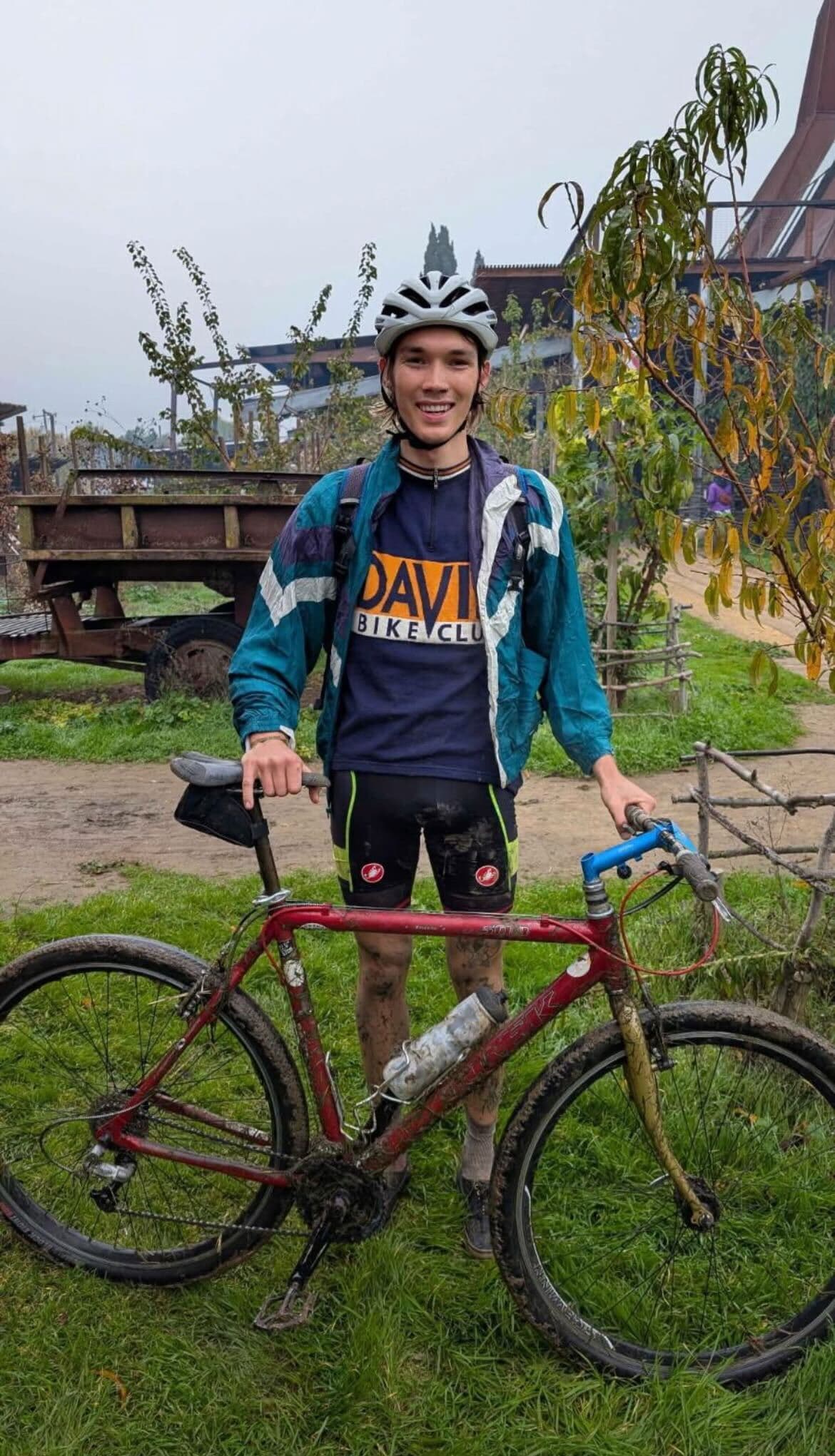
Friends and loved ones share memories and reflect on Lincoln’s life
By ZOEY MORTAZAVI — features@theaggie.org
On April 13, Lincoln Sabini, a second-year sustainable agriculture and food systems major, was hit by a car and killed while biking down Hutchison Drive in West Davis. Lincoln’s death has deeply affected the Davis community: Those who were connected to him have come together in solidarity to call for improved infrastructure throughout Davis to protect cyclists, sharing stories in memory of him and conducting bike rides across Davis in his honor.
The activism and community solidarity that has sparked following Lincoln’s passing is a result of how deeply integrated he was into spaces in Davis: a sentiment echoed by his loved ones. Lincoln was involved in countless activities — including the Davis triathlon team, the Davis Bike Collective and the Davis Student Farm — with passion reserved for all of them, according to his parents.
He is described by his friends, family and loved ones as someone who was larger than life — a motivating force to his family, friends and all of the communities he was a part of.
“There’s nothing like having children to really put you in the position to evaluate yourself as a person — what kind of person you think you are, what kind of person you actually are and what kind of person you want to be,” Keith Sabini, Lincoln’s father, said. “Well, it’s all of our kids, but specifically Lincoln — I mean, I wouldn’t be the person I am today without having him in my life, you know, pushing me to be the person that I want to be, or that I should be.”
Lincoln was a gifted athlete and swimmer, having achieved the second-fastest swim time in the history of Davis’ triathlon team for the 500-meter race, according to two of his teammates. His parents noted that he was always setting new goals for himself, both inside and outside of his athletic pursuits.
“He was just a real self-starter; he was incredibly self-motivated,” Sabini said. “When we would go to swim meets, he was just focused on, ‘Well, it doesn’t really matter if I win this race or not. I’m just going to improve my time.’ He would just always set these goals and work toward them; he was constantly doing that.”
Lincoln’s passing has inspired significant local activism in Davis, including a proposal called the Lincoln Loop: a series of protected and connected bike paths along Hutchison Drive, County Road 98, Levee Road and Hopkins Road that will work to prevent future collisions in the West Campus area.
Lincoln’s parents detailed his ability to build up others around him, emphasized through his connections to his siblings and family members. They cited his younger brother as an example.
“He was always a really good cheerleader,” Rucha Powers, Lincoln’s mother, said. “His younger brother boxes and he has a fight coming up, and I just said to him, ‘You’re going to have just the best coach in the world in your head.’ You know, like you’re going to have that person just like, always hyping you up from the other side.”
Lincoln was well known for his passion for cycling, reflected in his participation on Davis’ triathlon team, his consistent visits to the Davis Bike Collective and his love for building, taking apart and fixing bikes, according to his friends and teammates.
“He had one of these huge bike manuals that he would always bring out — he was so proud of that thing,” Billy Goater, a second-year sustainable agriculture and food systems major and one of Lincoln’s best friends, said. “There was nothing he didn’t know about bikes.”
Goater met Lincoln during orientation week of their first year as UC Davis students, describing that their friendship quickly grew strong.
“I feel like we just riffed so well off one another,” Goater said. “He just had the most adaptive sense of humor; he could get on anybody’s level, but at the same time he could get really serious, and we would have really deep emotional talks. He had two very distinct sides.”
Logan Ley, another one of Lincoln’s best friends and a second-year plant sciences major, described that the three of them would go on Friday night bike rides, often along the same route that makes up the now-proposed Lincoln Loop.
Ley emphasized that Lincoln and his friendship was built on small acts of support and being there for one another, in addition to the bigger activities they shared a love for.
“Since we were living together, he really had an everyday impact,” Ley said. “We would always just slowly chip in small things for each other and our daily lives to help each other, you know, because we’re both so busy. [...] But we also had a lot of major moments, our big bike rides, working on bike projects together and other things like that — those really monumental expressions of ourselves that we found connection with, [...] just exploring who we were and kind of figuring out who we were together.”
Ley noted that Lincoln was known for his openness and acceptance.
“He was a very open person — you very much felt his presence and his energy when he walked into a room,” Ley said. “Not only that, you felt almost encouraged to be yourself more when he was around.”
Leonardo Giessmann, a fourth-year sociology major and one of Lincoln’s triathlon teammates, described Lincoln as the glue of the team — someone who could always be counted on to bring everyone else’s energy back up. He also noted Lincoln’s passion for art and fashion, which he almost never stopped expressing even when in an athletic setting.
“Honestly, in the least superficial way possible, he was just so fly,” Giessmann said. “In everything he did — like, he would show up to bike rides not in some dorky biking outfit, but like in bellbottom jeans and a thrifted ‘70s shirt — and he would just do everything in style.”
Giessmann also noted that beyond his participation on the team, Lincoln showed a special type of work-life balance that not many college students demonstrate.
“I want people to know that yes, he was an exceptional athlete and a really good student, but he also honestly knew how to have the perfect kind of fun,” Giessman said. “Ever since he passed, I’ve been trying to embody this kind of ‘do everything’ [mindset]. Like, go train hard and study hard, but also, like, go have fun, go out, dress up and don’t take yourself too seriously, you know, like nothing is too deep — he did that to the max.”
Lincoln’s parents emphasized his aptness at balancing between continually striving for progress and staying true to his personality, something they admired about Lincoln throughout his life.
“[One of his teachers] once said, ‘The one thing [Lincoln] taught me is that a little mischief is good for the vibes,’” Sabini said. “He was really just, all about being real to yourself, and just being real. Some people are waiting to be perfect or, you know, to just have it all figured out. And I really don’t think he was doing that. He was walking the walk, really in a lot of the way he lived his life.”
Leah Ozgun, Lincoln’s longtime girlfriend and a second-year animal science major, shared that she and Lincoln began training for a triathlon around the same time and would often prepare for their events together.
“He would always hype me up, even when I was doing terribly,” Ozgun said. “I remember, I didn’t even know I was going slowly, but now I look back and it’s like, ‘Oh, my pace was terrible,’ but the whole time he would be like, ‘Dude, oh my god, you’re going so fast’ and I was like ‘This is crazy, I’ve never done this before.’ He would always just tell me how much potential I had, and he was always cheering me on in ways I could never encourage myself to do.”
Ozgun and Lincoln were close to inseparable for the two years they spent together at UC Davis, which made the loss all the more difficult.
“I keep hearing about all of this community, you know, that he built here — and I was right by his side while he was building it,” Ozgun said. “We shared a lot of the same spaces, so this loss is really heavy for me, but also for everyone that knew him.”
Lincoln was also passionate about farming, cooking for his loved ones and his studies, as all of his friends and parents individually noted. Ozgun emphasized how much he cared about his classes, often bringing out enthusiasm for academics among his friends by always asking them questions about the things they were learning.
“I’ve never met someone who was so infatuated with their major,” Ozgun said. “The only way we could productively study together would just be to talk to each other about our classes and ask each other questions, so I would have moments during my exams where I’d think, ‘Oh, Lincoln asked me about this,’ and it would come to me. [...] He was just so inquisitive and curious about life.”
Powers expressed her gratitude for Lincoln’s passion for life.
“It just made me so proud that he’s so interested in everything,” Powers said. “I’m proud that on the day he died he was on his way to do something that he was excited about doing: He was supposed to be taking care of sheep. And I’m just like, ‘Well, how many people are riding their bikes to go be a shepherd, you know?’ So, yeah, I’m just really proud of the way he lived, and I’m really devastated that he had to die.”
Goater noted that, above all, Lincoln was someone who always strived to connect people in his life to one another.
“Whether he was talking about sustainable agriculture or bikes or cooking or anything else, it was mostly about people — he just loved to learn about other people, learn from them and befriend them,” Goater said. “It’s nice to see and spend time around and meet all of these people that knew him and love him and exchanging stories. It’s a really beautiful thing to see all the people he’s brought together — even now, you know, he’s still bringing people together.”
Similar to Goater, Powers described Lincoln’s natural ability to empower those around him through kindness.
“I was just reflecting on the day of his viewing — seeing how he really went out there and built community,” Powers said. “He really treated everyone in his community the way he would want to be treated or with kindness, or invited them in or shared something of his with them. That really is the only way through — in cooperation, community and love with other people — and he just made that happen.”
Written by: Zoey Mortazavi — features@theaggie.org