






Manetti Shrem spotlights UC Davis arts and humanities graduate work
The annual exhibition closes out two years of student research with interdisciplinary and immersive pieces
By MOLLY WILKINSON — arts@theaggie.org
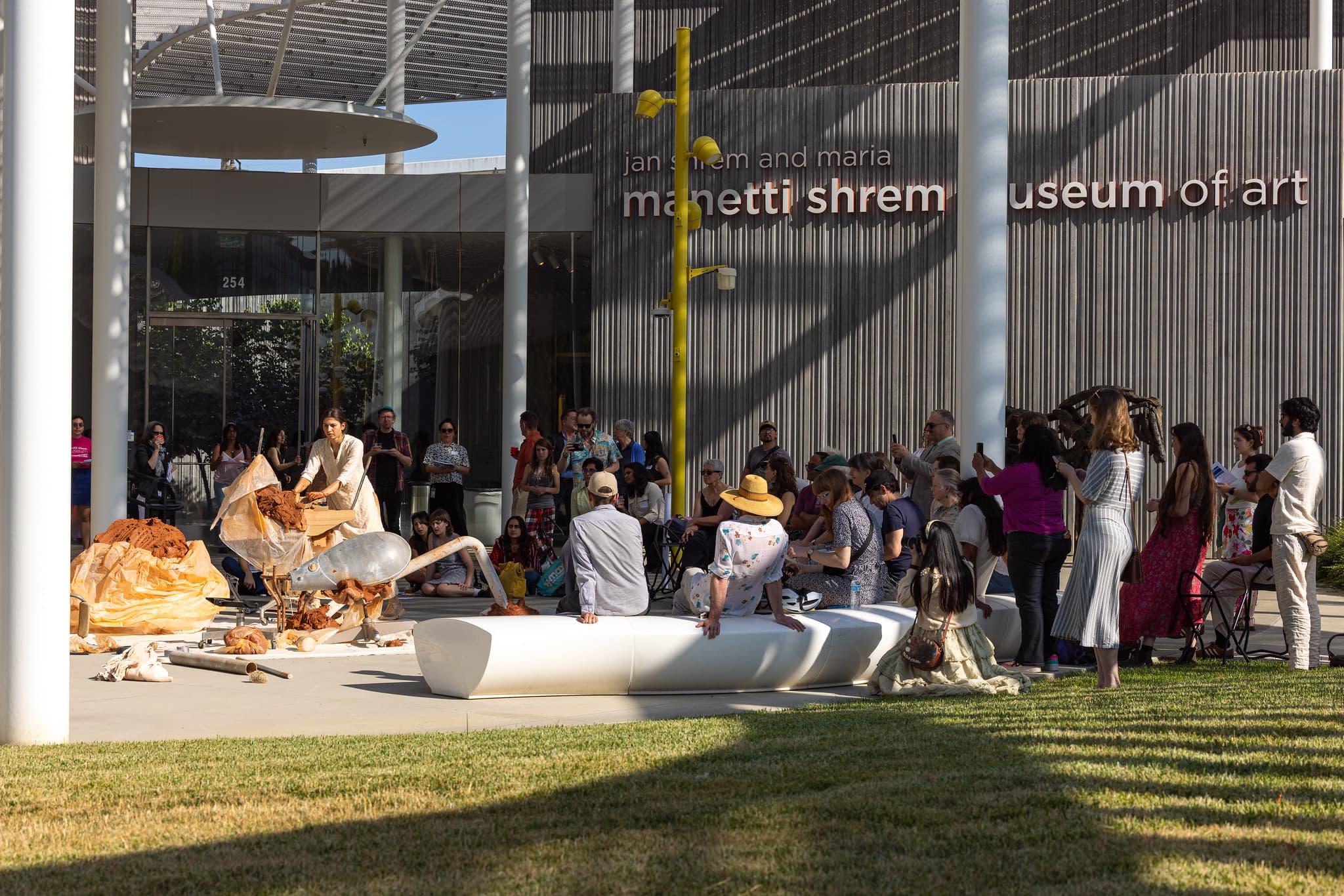
The Arts & Humanities Graduate Exhibition will open at the Jan Shrem and Maria Manetti Shrem Museum of Art on June 4, with a public celebration from 5:30 to 9 p.m. It will remain on view through June 20.
The annual multidisciplinary exhibition showcases work from UC Davis graduate students across design, art studio and art history, while performance studies students present live works during the opening celebration.
Prize winners for the LeShelle and Gary May Art Purchase Prize, the Keister and Allen Art Purchase Prize, the Letters and Science Prize and the Savageau Award in the Department of Design will also be announced during the event. From these awards, the museum acquires and stewards artwork from three students for the Fine Arts Collection at UC Davis.
This year’s exhibition reflects the diversity of students’ contemporary interests and research practices, while also considering the broader implications of their work across disciplines.
Curatorial Assistant Grace Xiao, who helped shepherd the exhibition’s installation and organization, described it as an invaluable early career opportunity for students to present the culmination of two years of research and experimentation in a museum context.
“It feels very wide ranging, and that's what's always exciting about it — the intersection of design and art and technology,” Xiao said. “There are quite a few students who are working on research about health and the body, which is really exciting. I think those are all really pressing concerns right now, so it does feel like it's of the moment.”
Xiao shared that several design projects this year invite audience participation, incorporating elements like games, touchscreens and other immersive media into the gallery experience.
“It's always fun having the design students there, especially because there is that visitor interaction component that's embedded in their work,” Xiao said.
One such installation was created by Master of Fine Arts (MFA) design student Emily Tonnos, whose work centers on narrative experience design. In the exhibition, Tonnos documents the iterative creative process behind her immersive narrative exhibit, “Embodiment,” which was previously staged twice at the UC Davis Design Museum.
The original exhibit guided visitors through a six-scene experience that explored themes of childhood innocence, anxiety, depression and emotional healing. With stagehands reconfiguring each space behind-the-scenes in order to shape the emotional progression of the narrative, Tonnos’ exhibit explored how movement impacts storytelling in immersive spaces.
“It definitely felt like I was choreographing movement — like I was choreographing a dance,” Tonnos said. “I had to figure out which ways the audience was moving and which ways we could move the props in a way that [was] safe and efficient.”
The experience was designed to evoke a universal emotional journey, encouraging audiences to connect its themes of struggle, growth and healing to their own lives, according to Tonnos.
“We all get our simple happiness from different places, and we all go through different experiences that hurt us in different ways, and I didn't want to paint a personal narrative,” Tonnos said. “I wanted to set a general theme of emotion and let audiences fill in the gaps.”
Given the temporary nature of the original exhibition, Tonnos translated the experience into a museum gallery display through various forms of documentation: a documentary-style video featuring clips from the show and its creation, a bird’s-eye animation visualizing movement patterns, a wall displaying audience survey responses, a scrapbook of production images and a miniature replica of the experience.
“I wanted to make it clear that when people see the exhibition, they know that this is not ‘Embodiment,’” Tonnos said. “This is not the show — it's a documentation and a quick snapshot of what came out of it.”
The audience feedback became an unexpected extension of Tonnos’ research. She found little common ground among visitors’ descriptions of what made the experience immersive.
“It was really interesting to think that experience is such an individualized thing for us,” Tonnos said. “We all get that feeling of immersion from different things. We have different sensory needs. And that got me questioning: Is it ever truly possible to create an immersive experience that is immersive for everybody?”
The rotating miniature replica of the original exhibition offers the closest approximation of the experience itself. Constructed from laser-cut and 3D-printed elements, the model reconstructs all six scenes from the exhibition, allowing viewers to trace the entire journey.
For Tonnos, the project reflects the broader potential of immersive experiences to create not just entertaining journeys, but emotional ones as well; their appeal lies in their ability to provide both escapism and connection.
Elsewhere in the exhibition, MFA art studio student Marjorie Williams presents a sprawling collage that transforms an 11-year archive of personal photographs into a meditation on the fragmented, associative nature of memory.
“I've lived all over at this point — Nevada, Oregon, New Hampshire and now California, and did road trips across the United States when I was moving, so there's a little bit of every place,” Williams said. “The times are all mixed together, because that's sort of how memory feels for me. It fragments and changes, and you revisit things and they mix with other experiences.”
Set against a photographic backdrop of a swimming pool reflecting clouds overhead, the collage, “All the Fullness of the World is Yours,” takes its title from Sufjan Stevens’ song “Djohariah.”
“It's sort of inspired by the way that song sounds too,” Williams said. “It's really full and orchestral. The [title] line is the very last line of the song when things have calmed down, finally. I was trying to reference that overwhelm.”
Williams turned to pinned collage after encountering the work of artist Elliott Hundley at the Minneapolis Institute of Art, drawn to the medium’s capacity for rearrangement and depth.
“[Hundley] also does use pins,” Williams said. “I thought there's so much possibility in using that because it gives you so much flexibility to move things around and allows for a sense of depth.”
Williams’ embrace of flexibility and experimentation is wholly evident in “All the Fullness of the World is Yours.” What reads largely two-dimensional from a distance reveals a layered composition upon closer inspection, with photographs protruding at varying depths and inviting viewers to experience the piece from multiple perspectives.
“There's no one way it should be read,” Williams said. “I like the idea of looking at it from afar as one big composition and then getting close and being able to walk along it.”
The collage represents half of Williams’ thesis project; the other is a collaborative photobook pairing their photographs with poetry written by their partner, Mallory Elliott.
“The photos are mostly of my partner, and it's sort of about our life here in Davis and our relationship, and also her experience of being photographed and our view of each other — her view of me in the poetry and my view of her in the photographs,” Williams said.
Though different in form, both projects reflect Williams’ interest in using arrangement and sequencing to reframe personal memories into shared experiences.
“I think they're both really about sequencing and being able to mess with time and create an experience for the viewer,” Williams said.
For Xiao, the breadth of approaches on display for this year’s Arts & Humanities Graduate Exhibition is what makes the show distinctive. The opening celebration represents the culmination of years of work, bringing together students, mentors, family members and the broader community to recognize each student’s accomplishments.
For Tonnos, that sense of connectedness is at the heart of immersive storytelling.
“We all have times in our lives where we experience negative emotions,” Tonnos said. “In a world where there's so much disagreement on a lot of other things, I think that's one thing that we can all have common ground on — our human emotion. That was the core of what ‘Embodiment’ was trying to pull at. It was trying to be a beacon of hope, to unite a community and to hopefully shed some light on how we're not all that much different from each other.”
Whether attending the opening festivities on June 4 or stopping by later in the month, visitors will have the opportunity to experience a wide-ranging collection of graduate work that reflects both personal experiences and contemporary context. Open to the public at no cost, the Manetti Shrem exhibition highlights the culmination of years of research, experimentation and artistic growth.
Written by: Molly Wilkinson — arts@theaggie.org