






Let’s read the fine print
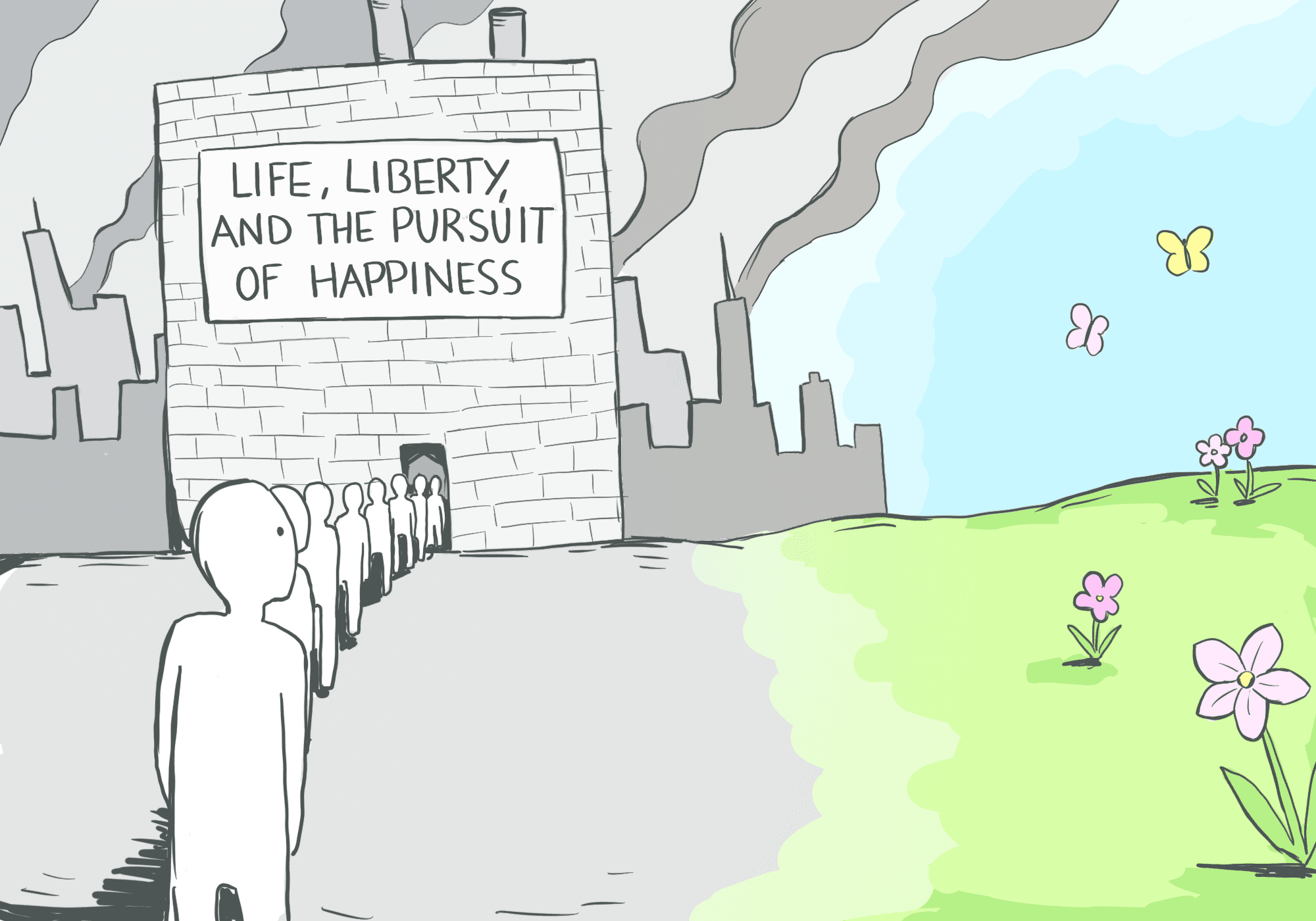
Are citizens really to be blamed for being tricked?
By ABHINAYA KASAGANI — akasagani@ucdavis.edu
What is more astonishing than the fact that people frequently sign contracts without ever reading the fine print is how many continue to do so despite knowing the extent to which social, economic and political systems wish to disorient them. These systems often operate by making their participants dependent on institutions for things like employment, healthcare and financial security while simultaneously making no moves toward using their time or resources to teach their citizens how these institutions function. We are constantly buying into the cyclical nature of an exploitative system and are, more often than not, unable to do anything but partake — even rebelling is partaking.
While some scholars argue that those who buy into these social, economic and political systems lack conviction, others believe that those who resist them are foolish. Although the former is a privileged stance, the latter risks endorsing passivity as a form of existence. The real question, however, seems to be: if understanding is a precondition for responsibility, and systems become so large as to prevent understanding, then the difference between truth and lies becomes almost inconsequential. In other words, if a public is wholly immersed within pervasive systematic forces, can they really be blamed for "buying into" anything?
Most of society is organized to accommodate varying modes of power — we are built of bureaucracies engineered to overwhelm the average citizen. For instance, despite it being an annual necessity, filing your taxes is meant to confuse you so much so that you swindle yourself out of a good deal. Now, focused on social governance that consists primarily of systems rather than individuals, we find ourselves unable to understand most things without the help of those we deem “experts.”
By deferring these concerns to those in the profession — economics to economists or law to lawyers — we not only guarantee that we never learn to understand the processes with which our world is organized, but also become increasingly susceptible to misinformation. It is exactly this lack of understanding that led several voters to believe President Donald Trump, with the help of tariffs, would make America affordable again. When observing this from afar, it seems almost as if participation occurs with partial information.
Assigning responsibility under the law requires locating a “whodunit”; without identifying a guilty party, regardless of the situation’s severity (it doesn’t matter whether it involves a breach of contract or harm to another individual), one cannot be held responsible. The issue with most structural injustices is that they cannot be attributed to a single individual, and therefore cannot be identified as cases in which one person will be held responsible.
Responsibility, firstly, depends on one’s understanding of their societal roles; and secondly, on one's adherence to them. We tend to be judgmental of people who act in certain ways based on what they know and understand; for instance, we more readily blame someone who knowingly spreads misinformation than someone who accidentally does the same thing. However, unless people distinguish between what is true and what is clearly a lie, they cannot meaningfully participate in society. In other words, can people truly be held responsible for upholding systems they cannot even understand?
Iris Marion Young, American political theorist and socialist feminist, insists not on blame for the past but on responsiveness to unjust structures that limit individuals. Young’s theory of “forward-looking responsibility” posits that one “seek[s] to assign responsibility for structural social injustice that has existed recently, is ongoing, and is likely to persist unless social processes change.”
“Forward-looking responsibility can only be discharged only by joining with others in collective action,” Young said.
The idea of people “buying into” a system that they haven’t themselves created feels more judgmental than it needs to be — as though individuals are able to make informed decisions and simply choose wrong. Everyone’s social and political assumptions are largely shaped by the spaces they inhabit, the worlds they frequent and the beliefs they internalize. This does not mean we shouldn’t hold ourselves to a certain standard — or that anyone should be treated as if they were entirely without agency or responsibility — but rather that no one should be reduced to complicity without factoring in privilege and access to accurate information.
While the issue used to be that most systems leveraged misinformation in order to propagate to the masses, systems nowadays have become too large and abstract for individuals to understand. Areas like financial markets or supply chains that influence day-to-day decisions are getting more and more obtuse in order to alienate its participants. The ability to reject pervasive systems that govern what you do and who you endorse also depends on your access to these systemic resources: namely, education, financial aid, security and free time. It is easier to denounce institutions that you are not already reliant on and that you have the luxury to opt out of.
As a college student who will probably be plagued by debt for the first half of my adult life, my first solution to systemic injustice will probably not involve political dissent. I do not endorse most things I am forced to buy into, and I attempt to consider ways of removing capitalism from my life and creative practice. However, the extent to which I can reject these systems significantly differs from those without these considerations. This is not to claim that social participation doesn’t largely reflect citizens' beliefs, but that we must ask ourselves not how people are complicit, but how we determine that they are. Are we responsible for attempting to understand purposefully deceptive systems, or must we accept that these systems are designed so that they cannot be understood?
Written by: Abhinaya Kasagani— akasagani@ucdavis.edu
Disclaimer: The views and opinions expressed by individual columnists belong to the columnists alone and do not necessarily indicate the views and opinions held by The California Aggie.