






Can we talk?
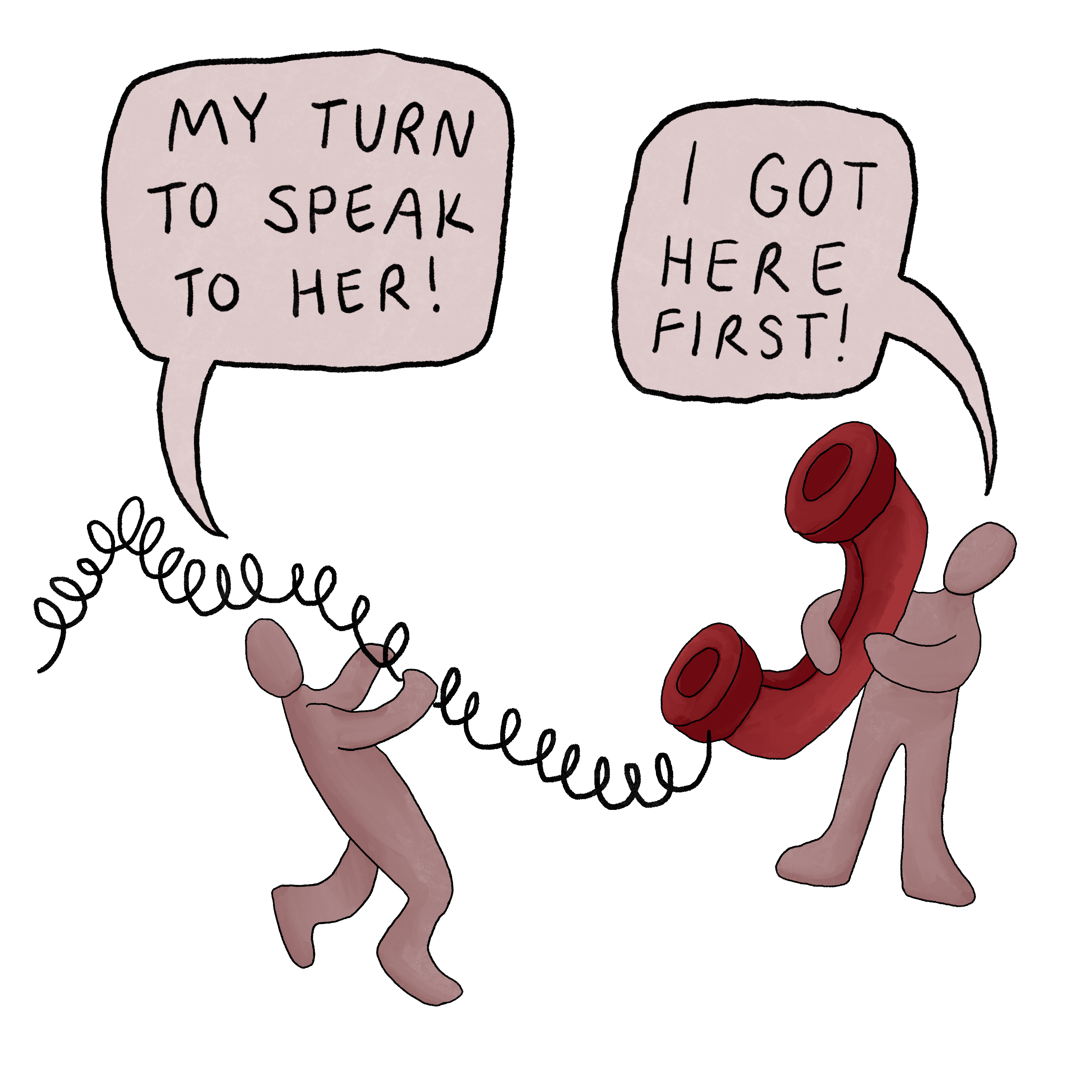
Is digital access making us ask too much of each other?
By ABHINAYA KASAGANI — akasagani@ucdavis.edu
Millions of hearts (and stomachs) have been conditioned to drop at the invocation of the question “Can we talk?” I am someone who avoids my phone like it's the plague, and anyone who knows me knows this. Yet for years, this has caused a strain on my relationships; my belief that I’m allowed to opt out of frequent conversation contrasts with another’s belief that I must participate, regardless of my comfort. The question this raises, however, is how newfound technology exacerbates our access to one another: How much agency do we truly have to either participate or opt out of digital intimacy?
Our regular line of communication to each other manifests as a twinge in our chests when we get left on read or delivered; no one has an excuse anymore — now that we are on our phones 24/7 — to unintentionally ignore a message. Claiming that we’re “missing in action” simply because we are busy or feel tired, comes across as dismissive. Despite categorically being the worst responder of all time, I occasionally feel ignored in the same way: understanding that this expectation is unrealistic doesn’t erase the subsequent anxiety.
However, the time and energy involved when you hang out with someone in person is weighted differently than with someone you frequently text. Our relationships have become defined by the frequency with which we respond, not the quality of our interactions.
Still, we are hardwired to want human connection and desire to reciprocate that equally.
“Not everybody needs the same level of connectedness […], but there’s always got to be this backstop, this return to the safe base that even the explorers need,” Louise Hawkley, a senior researcher at the University of Chicago, said.
With this sudden shift towards wanting to be in the loop at all times, we have set ourselves up for the deadliest of spirals and the worst of the ringers. The Studio in Grey — a photography, arts and design space — recently released a Substack article titled “Is access now a form of intimacy?” In the article, they claimed that “Digital life has not made us more connected or more distant; what it has done is reorganise proximity.” So, rather than claiming that the everyday access we have to one another is alarming, they comment on how we falsely tend to believe that we are well-connected; not because we constantly stay in touch, but because we are simply always capable of reaching one another.
Having a constantly open line of communication causes us to mistake connection for intimacy, creating frustration when our efforts aren’t reciprocated and making our present mode of intimacy confusing to read. Our inability to gauge how much someone cares for us rids us of the ability to ever know where we stand with one another.
Let it be said that my exposure to technology is less common than that of someone entering their adolescence in the present day. I did not have conversations about artificial intelligence (AI) until my first year of college, and I have never made an AI best friend. To understand my digital behavior, it’s crucial to know that I did not have full-fledged access to my phone until I was nearly 18-years-old. My relationship with social media is occasionally callous. This is not to say I never fall down terribly narrow rabbit holes and have a tough time getting out, but it is not so integrated into the way I move through the world. This makes the constant influx of texts I receive an occasionally baffling concept.
None of this is to condemn any particular usage of technology. However, there is a reason for the slow evolution of it. If I had been propped in front of my computer and asked to speak to a language-learning model at an early age, I would only know how to speak in an artificial tongue and only know a bot as my friend. The precedence that relationships take cannot be filtered through the digital experience; otherwise, response times and modes of texting start being ranked and remain a lousy and inaccurate barometer of care.
Despite occasionally feeling bogged down by — and every so often participating in — the social ritual of staying in touch, we must constantly renegotiate the social participation we demand from our relationships. We must recognize that it is often technology that aggravates our feelings of disconnection, not true distance itself.
Written by: Abhinaya Kasagani— akasagani@ucdavis.edu
Disclaimer: The views and opinions expressed by individual columnists belong to the columnists alone and do not necessarily indicate the views and opinions held by The California Aggie.