





An interview with 2026-27 ASUCD President Luis Garcia
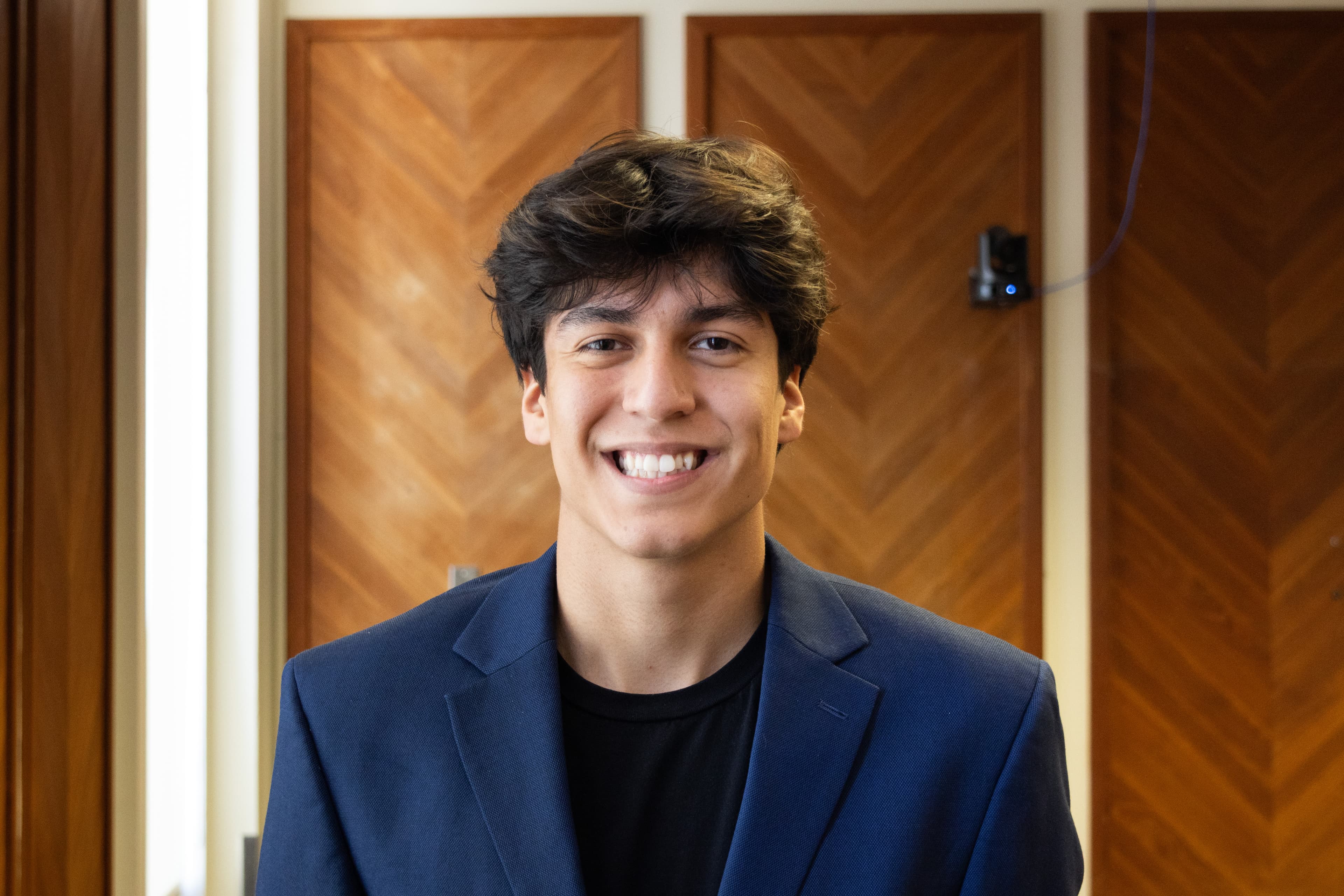
Garcia discussed his goals, historic slate win and controversy concerning the Senator Aaron Heth impeachment trial
By AALIYAH ESPAÑOL-RIVAS, for The California Aggie — campus@theaggie.org
Luis Leonardo Garcia, a fourth-year political science and Chicanx studies double major, has a big year ahead for him as president of the undergraduate student government, Associated Students of UC Davis (ASUCD). As the Association’s chief executive, Garcia will be responsible for running the largest on-campus employer of students and overseeing its $22 million budget.
Luckily for him, Garcia is no stranger to student government. With an extensive background within the Association as a senator, Garcia had a historic election slate sweep in the spring 2026 elections and ultimately ran unopposed for the ASUCD presidency.
Shortly before taking office, Garcia sat down with The Aggie on June 2, to discuss his goals for the upcoming academic year.
Below is a transcript of Garcia’s interview with The California Aggie, edited for length and clarity.
Q: My first question is, how are you doing today?
Garcia: I'm doing good. I'm very excited for this upcoming week because I get sworn in, and the rest of my slate gets sworn in and I know we're all super excited. We actually all went to go get lunch last week, just as the last final kind of slate bonding thing before we actually all sit on the Senate table together.
I'm also excited not to be a voting member anymore and just being able to continue pushing for what matters most, which the president gets to do a lot of that stuff behind the scenes and really work with the administration. Obviously, I have finals and stuff, but we're almost done.
Q: Talking about finals, the final Senate meeting is this Thursday. How do you feel about the accomplishments you and the table made as a whole this academic year?
Garcia: I think first and foremost, I've been super lucky to work on a table that has such diverse perspectives and diverse views on how we should be supporting the student body. I think as a senator, I've done what I was meant to do. I think I bridged every gap that I really wanted to. I was able to do professional development projects. I was able to bridge the gap between the Latine community and ASUCD. I was able to bridge the gap between other cultural organizations and cultural groups in ASUCD.
I've also been very honored to be on a table that really prioritizes basic needs. I think we've really seen that in the past couple of meetings. We gave The Pantry over $40,000 dollars extra from what they had in last year’s budget. So I think that's huge. Obviously, I think I've mentioned this before, but if we had all the money in the world, I would love to give The Pantry more. I think there's so many things that we did better this year, but obviously I see that there's some things that we need to continue to be better next year.
I think the Entertainment Council (EC) is definitely one of the units that gets a lot of division when we're talking about them in the Senate, but I love EC. I love everything EC represents. I think next year we're going to be striving for some greater accomplishments within EC to hopefully reduce student costs or potentially make it free for all students to come in the 2027-28 school year. I know it's sad that it won't happen during my time, but I think a lot of these projects take a little bit longer, and I think that's what we've seen with this Senate table. A lot of the longer term projects that we've been working on aren't going to be into effect until next year, but nonetheless I think we did a great job.
I want to give a huge shout out to my spring line — that's what I called them, Senators Harshpartap Dhillon, Siena Dill-Cruz, Jaliah Payne, Pattarin Khajornchaikul, Phoenix List and me. We all really created this amazing bond, and I feel so honored and blessed to be able to work with them and to be able to call them all my friends too. I know Senator Jenna Younes is also graduating, so special shout out to Jenna too. But I think they're so competent, and they're so amazing. I think it's awesome that we all had our very niche platforms, and we all pushed for our very niche platforms which made the Association better rounded as a whole. I think the fall line, which is a lot different than the spring line, had their own successes as well. I think we had a great table this year, and I'm just excited to work with our next table as well.
Q: Could you talk a little bit about your past with ASUCD? You started as an interim senator and then were elected a full-time senator and now president. Can you talk about how this journey has been for you?
Garcia: I think that experience of being an interim senator — I really saw it in like a bigger lens two weeks ago when we hired the interim senators for the fall. We hired two interim senators for the next academic school year, and when I talked to them I told them I value interim senators so much. I know that they only have 10 weeks to do the work they want to do, but I know the pressure of how much you're expected to do in those 10 weeks is a lot. And I was also very honored to be selected as an interim senator back then.
I mentioned to them that my selection process was so different. I hopped on a Zoom call with past ASUCD President Gaius Ilupeju and Internal Vice President Aaminah Mohammad, and they asked me questions. I was super scared. I was like, what's happening? There's no way I'm getting this. And then when I got the email, I was like, “Wow, people like me should be entering these spaces. People like me do deserve a seat at the table.”
It was definitely something I struggled with within my first senate table. I mean, I love the table I had when I was interim senator, but I feel like it's just different when you're an interim versus when you're an elected senator. I think people take you a lot more seriously once you're elected, which I think shouldn't be the case. Or should it? It depends, right?
But that's really how I started in ASUCD. I've been in student government for a lot of my life. I did it in high school, I did it in middle school, but that's like old stuff, right? But I think it was a very unique position to be in.
I don't know if any other interim senators have gone from interim to President-elect, which I think is beyond huge for me, and not just for me, but for my family and friends too.
So I started as an interim and was able to get a lot of good work done. I was able to really understand the Association during that time. It was the executive office that we had then that was able to really explain how everything functioned. But I also remember being with the now executive team on the Senate table where when I had questions, they were always very flexible, very open to answer all those questions. So I think it's just been great being able to work with both executive teams.
Q: What current projects are you working on as a senator and how do you plan to carry those out in your term as president?
Garcia: I think for a lot of my Senate term projects, I wanted to close them off before I started this new presidency just because I understand the roles are very different.
Some of the things that I worked on this year as a Senator was through the Equitable Parking Initiative. I served as chair for that initiative. I think that's been the biggest thing I've been able to do that I want to transfer over to next year. Next year will be the year that we hopefully secure something for students on campus, whether they're commuters, which is going to be my priority, and then hopefully move on from there.
I think our Student Activist Task Force, I haven't been super involved there, but I have worked with certain activist groups myself. I know exactly what the students are looking for, I know how to work, I know how to mobilize. I think that's definitely something I want to carry over.
But I think smaller things that I got done this year, like Banda Night, which I loved. It's very unfortunate to hear sometimes the negative views some people have within it just because they think it's not an appropriate use of student needs. And I think that's not fair to say, and I think it kind of goes back to the equality versus equity thing. Like, we've been disproportionately represented not only with the student government, but within the greater aspect of politics and the greater aspect of the community, right? That's definitely something I want to work with next year, senators, specifically like Senator-Elect Frida Alvarez. She's super excited to host it.
We have an executive budget, which I'm going to be more than happy to also work with her on to make it bigger and better. I think professional development has also been a huge thing that I want to carry over to next year.
I mean, we got nap pods approved last senate meeting. We got it approved, even though there was a lot of controversy. That was a huge project I've been working on this year. I think next year's going to be taking those small steps to get something bigger in the long run.
Q: My next question is, what motivated you to run for ASUCD president?
Garcia: The spaces that I've been involved with in the past four years have really taught me that it's up to us to really be the change that we want to see. I think my work in EOP always taught me if not you, then who? I think I really spent the last two years really advocating for the community, advocating for students that look like me and students that have similar backgrounds to mine. And I think the biggest thing that really inspired me to run is I know how to do the work, and I think being able to expand all the projects that were done this year and all the projects that I want to see flourish within the next couple of years — I knew that I was ready and I'm willing to do that work.
I think other stuff that inspired me had to do with the people that I was surrounded by. I know they asked me pretty early on in the fall, “Are you running? All the stuff that you're doing is really good, we want to see you run.” And I was like, “Honestly, I didn't know.”
I feel like it's such a huge responsibility. Like seeing both [Amrita] Julka and Gaius take on huge responsibilities has been kind of scary. They did such great things, and I know that I'm going to have big shoes to fill.
Q: Reflecting on this past year and President Amrita Julka’s term, what changes would you like to see implemented?
Garcia: My biggest thing is I want to make tangible change. This year we did a great job at it. But I feel like something that's really missing within our Association is tangible change, results that students see as they're in school. Don't get me wrong, change that takes a little bit longer is also great, but I think when we're able to see ourselves in its development I think it's even better.
Next year something I really want to push forward again is better passes for commuters, for parking specifically. I understand that commuters usually get like the short end of the stick. And being from Woodland, I understand a lot of these commuter needs, not because I'm a commuter but because a lot of the people I surround myself with are commuters. I work with recruitment and retention centers that work with commuters. I work with the commuter organization that's obviously based on commuters.
Something else I want to really look into is to go back and see some of the projects that kind of fizzled out throughout the last couple of years. When I was talking to a lot of the people that I was asking for endorsements for, they were like, “Tipsy Taxi disappeared and we would love to see something like that come back.” I've been in conversations with Uber, so I really want to see what's needed to bring that back and establish it so it could be something that actually stays long term. And it doesn't just go from term to term. I want to make sure the things I leave here are things that students just actually see a need for and don't just disappear.
I want to make sure to better strengthen the relationship with ASUCD and the CCC [Cross Cultural Center]. Right now we give them a lot of money to host a lot of their cultural events. But considering that we have low Senate reserves next year, I want to make sure that our current senators are also connected with the CCC to see how we can support their cultural events. I think just being able to connect these identity-based senators to their department would be huge.
I want to make sure that we do the similar things with the Club Finance Council, which we give a lot of money to. Next year we're going to be able to fund a lot of organizations, and I actually spoke with them already like last week to see how we can also support newer organizations too.
As someone that's been a part of these new organizations, I feel like there's a lack of support from ASUCD and just the campus as a whole. We're trying to figure out how we're going to bridge that gap, how we're going to make sure that the funding lasts the entire year, because that's also been an issue. We're looking into caps. We're looking into limiting different aspects to make sure that students that need the most actually get it. Keeping that strong outreach is going to be huge, because again, if we are able to get a strong visibility, I think that's going to trickle down into all our units.
Another one of the biggest things I'm going to be doing next year is working closely with other schools too. Other UCs specifically and seeing what works for them and what and how we can be better using their models. I know that UC San Diego (UCSD) and UC Merced have their 24-hour library. I know UC [Merced] is more like a pilot program through finals week. UCSD is more of a long-term thing. I want to get to where they're at. I love the work that they do. So I think getting to talk to the administration and seeing what's possible because students have been asking for that for years. So to be able to even get it for like just finals week — I think that would be huge.
Q: You ran with the Viva slate and all members of your slate won their respective seats, which is a first in ASUCD history. Could you tell me how the slate was formed and how you all came up with your goals?
Garcia: I love the Viva slate. I think that we all bring such different perspectives and different backgrounds and different identities. I think that's really what I was looking for when creating the slate.
Funny enough, me and Rosa Linda, my IVP, met our first year through a club. Frida [Alvarez] and I also met her during her first year here at UC Davis through different involvements. Caleb [Swaby-Pierce], same thing. Me and Caleb were actually both a part of the pre-law fraternity Phi Alpha Delta together. And we ran at the same time last year. And Maretta [Ardelia], we actually worked together in EAOP [Early Academic Outreach Program]. I was like, “I think I need someone that has a lot of involvement and we were able to find Maretta.” Then Liv [Sandhu] served as interim senator, and that's when I met her.
I met with all of them separately, and I was like, “Hey, I have this project that I want to talk to you about. I want to see what your thoughts are and I was actually like, you know what? This actually isn't for a project. Like I want to ask you, like if you'd be willing to run with us.” At the time the slate was called Excel. But then Frida came in and was like, “No, I want Viva,” and all of us were like, “Actually, that sounds a lot better.”
I'm so, so excited. Honestly words cannot describe how excited I am to be at a table with not just myself and Rosa Linda but the other five of them. And funny enough, Genesis [Arroyo], who ran our socials, she's an interim senator for next quarter. So I think that's like another W for Viva.
We had a lot of discussions about what we want to prioritize, because we understand that ASUCD lacks a lot of — for lack of a better words, a lot of promises are made, and we don't fully fulfill those promises. When I sat with them, I was like, “Everything you say is going to be done because you're telling people that you're going to fulfill these promises.” This isn't something where it's like, “Oh, I want to get this done, I'm just going to throw it out there and hope people vote for me.” I was like, “No, we're going to aim for tangible change.”
Q: Switching gears, you recently gave comment in the impeachment trials against Senator Aaron Heth, who you originally ran against in the executive ticket race this past spring. Why did you choose to give comment?
Garcia: I think it's definitely a tricky situation. I want to be super clear, like the impeachment was not against anyone's political beliefs or religious beliefs. I knew Aaron before he got impeached. We worked well together. The conversations we had before that were good conversations, I considered him a good colleague. And I think the Senate put out that statement as more of a — we see that this is an issue and we're not going to tolerate that as a student government senate.
So we put in the paperwork to lay out his impeachment, not because of any like beliefs or anything like that. And at first I was like, “You know what, I'm going to take a backseat on this.” Because obviously when he did drop out, I was going to be the next president. I wanted to make sure all my relationships were good. So I did take a backseat.
But when I was speaking to a lot of the current senators, they're like, it's not time to be taking a backseat, especially when something is on the line like this.
I think there's a lot of things within the impeachment trials that I was not the most content about. I think there are some things where they were like, “We don't see any of this. Like, there's no record of this.” But I was like, “Put me up there. Like I'll explain everything like the record of everything that's been said.” At the end of the day, I respect the Judicial Council's (JC) decision and what they decided. I know they're super impartial. Like, I know a lot of them outside of JC, and I've had great conversations with them. As senate pro tempore, I hired two of them. So I know how competent they are.
I think the reason I decided to give public comment was because I did see there was a gap there that I could fill. In all honesty, the reason for the comment was to address that there is a correlation between this conference that he [Heth] went to that was set to commandeer student governments and the decisions he made during the winter quarter, which I wanted to make sure that the Judicial Council took into account as well.
I know after there was a rebuttal with Senator [Mia] Oscanoa giving her comments as well, and we were able to address it outside. I spoke to her afterwards, and I think now we're on the same page. We're all like, “You know what? It didn't get passed. So what do we have to do to continue working as a table?”
Lucky enough, I won’t have to be involved in a Senate drama anymore, but I think what needed to happen happened, and I think the way it happened and the way it played out is the way it played out.
Q: How do you feel about the final verdict? Do you regret giving comment at all?
Garcia: I don't regret giving comment. I just wish I had more time to give comment. I actually went up to JC now and I was like, "Can I get three minutes?" And they're like, "No, you only have one minute.”
I did have a lot to say. And I wish that I was able to say it, not because I think it would change anything because I think the bigger picture and the way it was decided didn't have much to do with our main controversy, which is that he went to a full-funded conference by an organization that was trying to commandeer student governments. I think that's the biggest thing. I don't think that was seen as the biggest thing by our student body, the student government, the Judicial Council. I don't regret giving comment. But I think it's a difficult position to be in.
I respect the Judicial Council. I respect their decision, but I think there were some things that they didn't take into consideration that should have been taken into consideration, and they should have had at least a second trial.
Q: If you had to pick a song to define your mentality going into your term, what would it be?
Garcia: I think I would pick “Baile Inolvidable” by Bad Bunny. I think we have a lot of obstacles to overcome next year and I think the table we have next year is going to be fun. The people within our units — I've been able to hire units for the past few weeks and I'm so excited to work with all them. They're all such amazing people.
I know that next year is going to be a great experience for myself, for the table, for the units, for the commissions, for the committees, literally everyone on campus. I'm so excited to create a welcoming space within ASUCD and also bridge all the stuff that I've been trying to do before.
Q: Is there anything that you want our readers, the voters of ASUCD and the student population as a whole to know about you and your platform moving forward?
Garcia: First and foremost, I'm so grateful to be able to serve as the next ASUCD president. I’ve taken a lot of Chicano studies classes, so I've learned that institutions like these aren't built for people like me. And I want to make sure that we continue having open conversations with these same people. I'm a very community-oriented person, and I'm not going to let that change within this new role.
I want people to know that they're always able to email me. They're always able to DM me. I've responded to so many DMs on Instagram. People that aren't even in UC Davis, soon to be like transfer students, reach out to me saying like, “Hey, I love the work you do.”
I want people to know that I'm so ready to have these difficult conversations with the administration because difficult conversations make change and what creates change.
I really want students to feel like I'm approachable. I want students to not be scared of ASUCD and be motivated by ASUCD; we offer like a thousand students over a thousand jobs. I know that in the past there's been some lack in different aspects, and I think I'm ready to address them, but I also need student input. I don't know everything. And I'm willing to learn, and I'm willing to hear people out and hear people's concerns. I'm ready to work, and I'm ready to work with this next table as well.