






UC Davis prepares for Orange Shirt Day with remembrance events, vigil
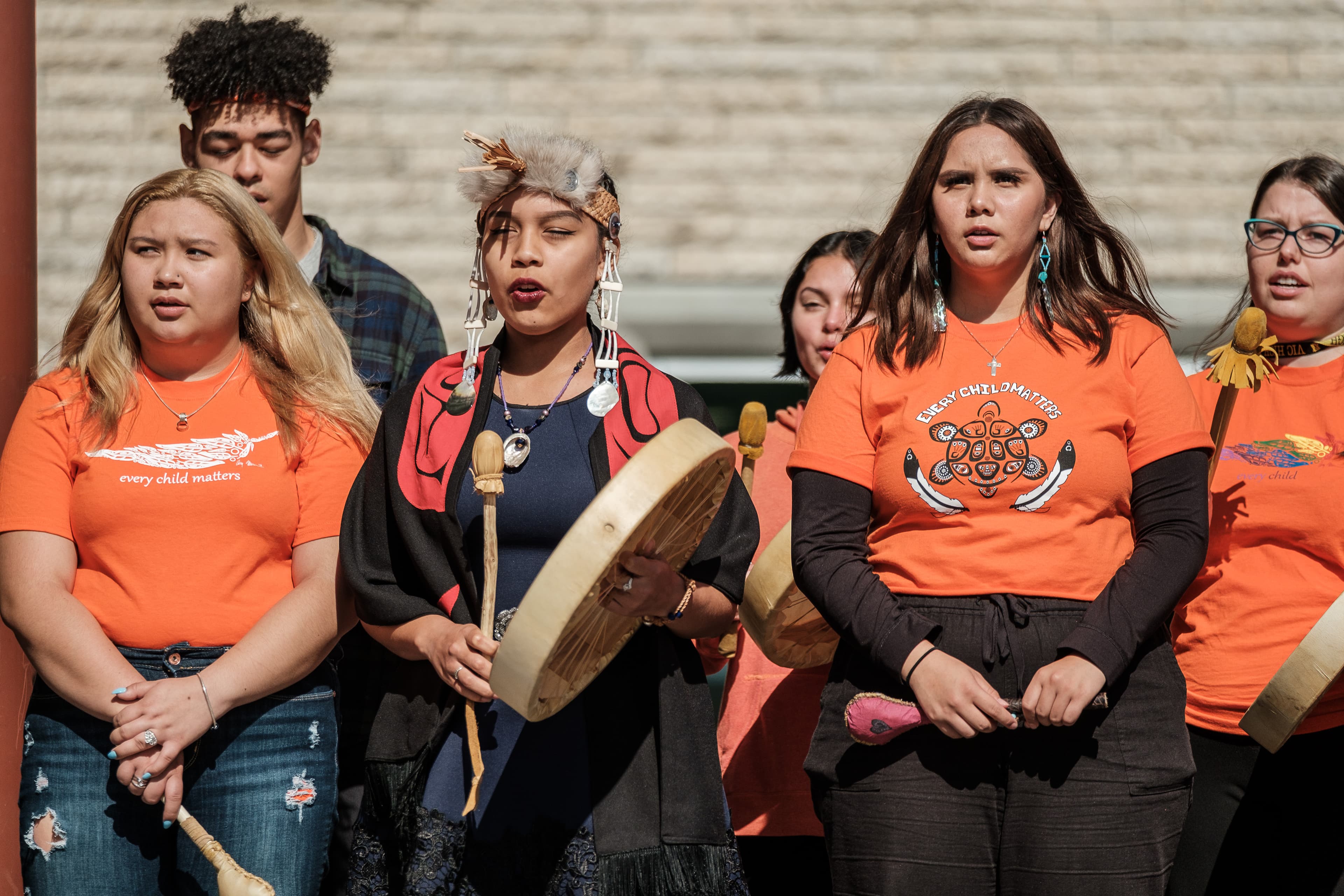
The day observes Indigenous children who lived through the residential school system
By RIVERS STOUT — campus@theaggie.org
Wednesday, Sept. 30, marks Orange Shirt Day in Canada and the United States, which observes Indigenous children forced into genocidal residential school programs. The UC Davis Native American community will be observing the day with events across campus, including a memorial and reception.
Orange Shirt Day is an official holiday in Canada but not the U.S., though it is still observed across Indigenous communities regardless of borders. In Canada, it is officially known as the National Day for Truth and Reconciliation.
At UC Davis, members of the Native American community will be active in the Quad, publicly acknowledging the day from 10 a.m. to 2 p.m. University community members from all backgrounds are invited to wear orange, observe and learn about the significance of Orange Shirt Day and the residential school program.
“Overall, it’s to honor and acknowledge what the survivors went through and also to acknowledge the people who didn’t return home,” Sequoya Waukazoo-Nakai, a Cross Cultural Center (CCC) employee and third-year psychology major, said in an interview. “We’ll have zines — little pamphlets that are easy to read with digestible information about Orange Shirt Day — because it’s such a heavy topic that it can be a lot for people in general. We’ll also have orange ribbons for people to wear if they don’t want orange shirts.”
Following the memorial, a procession will walk to the Native Nest, the university’s retention center for Native American students. From 4 to 6 p.m., a candlelit vigil will be held for the family members of UC Davis Native Americans who choose to participate, with a drum circle playing a healing song sometime before.
While all are invited, Waukazoo-Nakai says this time will function as a moment for the community to mourn and be together and is not necessarily an educational event for onlookers.
“I think acknowledging [the residential schools] is probably the biggest aspect, especially as UC Davis is on Native land,” Waukazoo-Nakai said. “The boarding schools did affect the Californian Natives as well. It affected almost everyone on Turtle Island, and so I think the main part for me and the community as well is to respect the California Natives and their traditional lands.”
Also, on Sept. 24, a beading event hosted by UC Davis Student Health and Counseling Services and The Nest will be held at the former from 1 to 2:30 p.m.
At UC Davis’ Sacramento campus, a ribbon making event will be held on Sept. 29 from 10 to 11 a.m., and an awareness event from 12 to 1:30 p.m. on Sept. 30. Both will be located in the MED ED Room 3202 and hosted by the Association of Native American Medical Students.
The day’s namesake comes from a 1973 event, when then-6-year-old Phyllis Webstad was interred in a residential school and her clothing — including an orange shirt given to her by her grandmother — was stripped from her.
“The color orange has always reminded me of that and how my feelings didn’t matter, how no one cared and how I felt like I was worth nothing,” Webstad’s testimony from the Orange Shirt Society reads. “All of us little children were crying and no one cared.”
As with many Native Americans, the boarding schools affected Waukazoo-Nakai’s family. Her relatives were forced to assimilate and to endure subsequent brutality.
“My grandma Helen Waukazoo, she went through a residential boarding school in Utah, the Intermountain Boarding School in Brigham, Utah,” Waukazoo-Nakai said. “She passed away recently; I know from close experiences that she would never talk to me about the boarding school system and her experience just because of how traumatic and horrific it was.”
Waukazoo-Nakai says the impact of her grandmother’s experience has spanned generations.
“Something that really hurt me growing up was seeing her tense up and get scared whenever the residential boarding schools were mentioned,” Waukazoo-Nakai said. “Because of the trauma and the horrific things they did, the murdering and cutting the hair of Indigenous children and not letting them speak their native languages. I feel like it’s just connected through generations of families, and that’s how I’m affected.”
The Intermountain Indian School began enrolling students in 1950 out of a defunct World War II-era hospital and housed students until 1984. In 1971, students of the school filed a lawsuit complaining that the school was enforcing segregation, drugging students and providing a poor education, amongst other things. Multiple students also died by suicide.
At least 526 boarding schools have operated in the U.S. between 1801 and present day. Waukazoo-Nakai wishes to remember those who have experiences through them, honoring them by educating others.
“Life can be demanding, but I think it’s important for the vast majority of UC Davis students to take a break and acknowledge the land that they’re on and to acknowledge the history and do their part to not forget the history as the Native community is doing [its] part,” Waukazoo-Nakai said. “Go to the Native community events, stand in solidarity with them.”
Written by: Rivers Stout — campus@theaggie.org