





UC Davis expands Safety Corridor program amid rise in e-device crashes
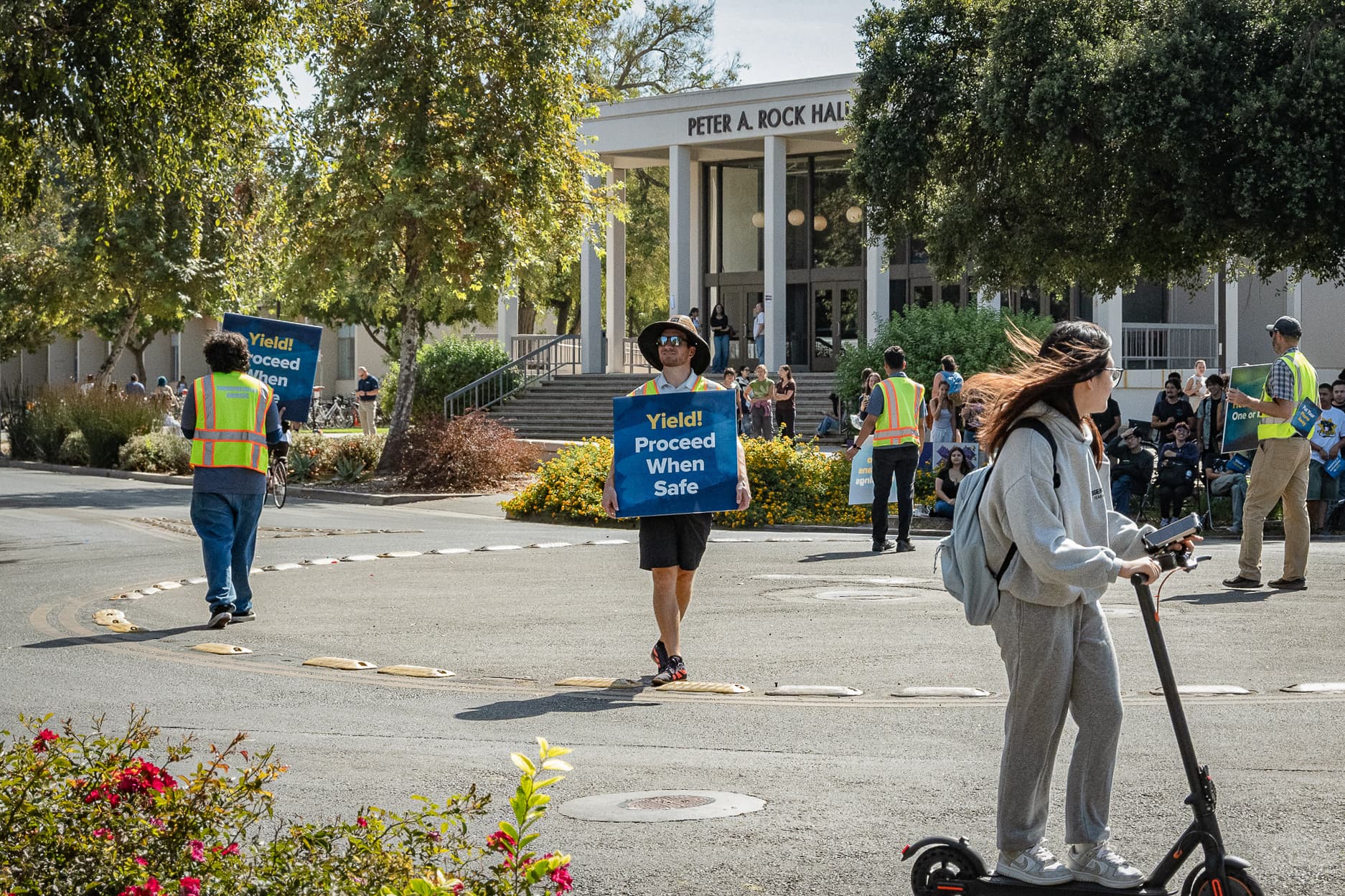
The program deploys students and signage to encourage safe traffic behavior at busy intersections and paths
By MICHELLE BEKHTEL — campus@theaggie.org
UC Davis is significantly expanding its Safety Corridor program this school year in response to a sharp rise in collisions involving e‑bikes and e‑scooters.
Since February, UC Davis has conducted 15 days of Safety Corridor programming across campus, stationing staffers with signage reminding bikers and scooter users to follow safe traffic rules. According to university organizers, the program led riders to slow down, stop at stop signs and yield more when staffers are present.
Based on that success record, the university is expanding the Safety Corridor for fall quarter in a relaunch that began on the first day of instruction, Sept. 23. The program will now see daily deployments of student safety staff across high‑traffic mobility corridors — a major increase from last year’s once‑weekly pilot.
The Safety Corridor initiative is a collaboration between Transportation Services, the UC Davis Police Department and Student Affairs. According to Active Modality Manager Jeffrey Bruchez, the program’s goal is to shift campus culture toward safer mobility through education.
“We’re really trying to start this year off with a proactive narrative,” Bruchez said. “These aren’t punitive efforts. We’re out here trying to promote safe messaging and safe habits.”
As part of the program, student staffers in orange high-visibility vests hold signs reminding riders of traffic rules, including: “Yield to pedestrians,” “Headphones, One or None,” “Put your phone away” and “Speed limit 15 miles per hour.”
On the first day of instruction, staff also handed signs to students at the roundabout near the Silo, at the intersection of Hutchison Drive and California Avenue, who had gathered for the annual tradition of cheering (and jeering) at passing bikers and scooter riders.
Crash data from 2024 and 2025 shows a steep increase in reported collisions involving personal mobility devices. In 2025, UC Davis recorded 150 crashes, up from 81 in 2024. E-scooter crashes more than tripled in that same time period, from 22 crashes to 79.
Bruchez said that the rapid growth of e‑device usage has outpaced the campus’ ability to manage them safely.
“As e‑scooters and e‑bikes have grown in popularity, their crash rate has grown even more,” Bruchez said. “The primary crash people are experiencing is due to unsafe speed.”
The university’s data shows that unsafe speed was the primary cause of the crashes in those two years, accounting for 79 crashes in 2024 and 2025. All other factors — including failing to yield and unsafe turns — were only attributable to 60 crashes in that time period.
Another major shift this year is the program’s emphasis on student staffing. Bruchez said that UC Davis found students respond better to peer engagement over warnings from professional staff.
"Students engage a lot better with students,” Bruchez said. “We’re putting a ton of effort and investment into our student employees.”
Eunhyeok Jee, a 2026 UC Davis graduate in cognitive science and trained traffic director, said the work is both preventative and community-building.
“It has always been about safety for me, prevention over trying to revive someone who has passed out on the sidewalk,” Jee said. “People have told me it is working. People have been very excited about it.”
While the program currently focuses on education, UC Davis is developing an enforcement component. The university plans to allow riders who receive citations to either pay a fine or complete an educational diversion program and is also exploring longer-term strategies, including integrating traffic education into student orientation.
“The goal with Safety Corridors is not to jump straight to enforcement,” Bruchez said. “Just our presence is really effective at getting people to follow the right behavior.”
For students interested in getting involved, Jee encourages simply showing up.
“Come out to one of our deployments and communicate the right messaging,” Jee said. “We want you to be safe everywhere you go.”
Written by: Michelle Bekhtel — campus@theaggie.org