






Review: ‘Practical Magic 2’ doesn’t hold a candle to the original film
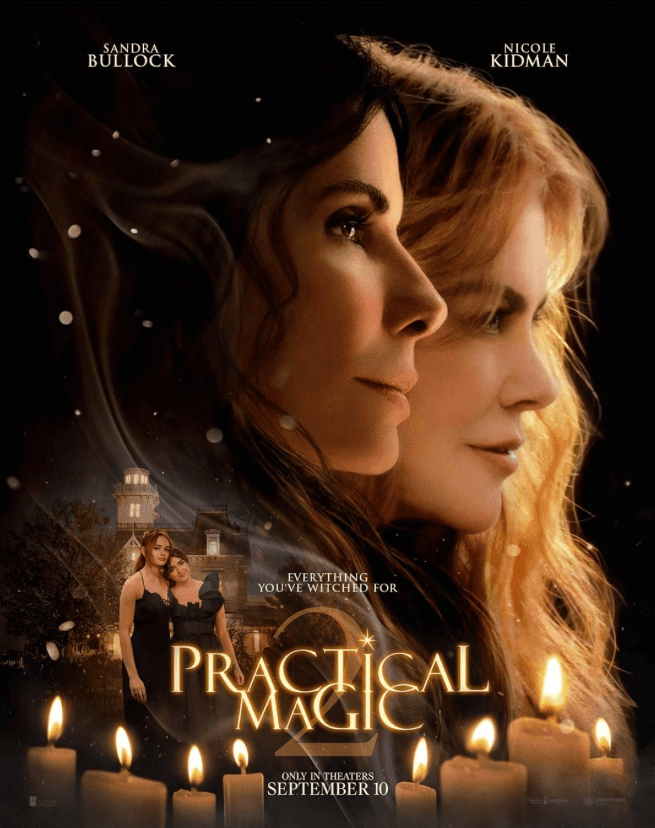
The sequel fights to keep the magic alive
By TALAR KESHISHIAN — arts@theaggie.org
The first signs of autumn prompt many fans around the world to light a candle, make a midnight margarita and watch “Practical Magic.” Based on Alice Hoffman’s original novel, the 1998 film follows Sally (played by Sandra Bullock) and Gillian Owens (played by Nicole Kidman), two sisters in a family of magical lineage, in their efforts to break an ancestral curse that dooms any man they fall in love with to an untimely death.
After nearly 28 years since the original film, the long-awaited “Practical Magic 2” was released in theaters worldwide on Sept. 11. The story is set 25 years after the 1998 film, introducing Sally’s grown-up daughters Kylie (played by Joey King) and Antonia Owens (played by Maisie Williams), as well as other new characters.
The first film’s satisfying ending is abruptly shattered in the sequel’s first scene, where we learn that Sally’s husband, Gary, has passed away and the curse upon the Owens women prevails. In an effort to protect her daughters, Sally tries to shield them from their magical heritage and the family’s curse, resulting in Kylie unwittingly turning to dark magic in an attempt to save her boyfriend, Gideon (played by Xolo Maridueña), when he falls into a coma. Sally and Gillian must then unite to save her from the effects of the dark magic and break the curse once and for all.
Bullock and Kidman’s sisterly dynamic is the grounding force of this sequel. They maintain the charisma and comedic moments with a maturity that makes this next chapter in the story feel familiar yet fresh. The pair also took on the roles of executive producers for “Practical Magic 2,” and handpicked director Susanne Bier to lead the project.
Dianne Wiest and Stockard Channing also reprise their roles as fan-favorite sisters Aunt Jet and Aunt Franny. Their unchanging eccentricity and humor reignite the comforting charm of the original film. Though their fate may be bittersweet, it gives the audience a sense of closure to their characters and enforces the unbreakable bond of their sisterhood.
The soundtrack was certainly one of the stronger areas of the film; Stevie Nicks, Olivia Rodrigo and Mazzy Star stack the lineup of the film’s needle drops. “Landslide” by Nicks brought the punch of emotion at the beginning of the film and called back to the use of her song “Crystal” in the original soundtrack.
Despite all this, the film features the infamous Netflix lighting, which utilizes excessively bright lighting to highlight facial features and minimize shadows. The warm tones, sharp color contrasts and shadows that shaped the mood of the original film and made it such an autumn cult-classic today are gone. The elimination of this key feature flattens the mystique of the Owens women and their witchy aesthetic.
Outside of Sally’s comforting wisdom and the sisters’ playful banter, the dialogue fails to impress. The lackluster writing made certain relationships feel forced; for example, the chemistry between Sally and her new love interest, professor of magic history Dr. Ian Wright (played by Lee Pace), feels rushed and flat. Pace captures Ian’s enigmatic and seductive personality, but the film’s uneven pacing makes his sudden romantic advances toward Sally come across as unnatural.
Additionally, the climax of the film felt uninspired and a bit cliché. The choice to introduce the antagonist, Thomas Lockland (played by Solly McLeod), well into the latter half of the story, stunts his character buildup and rushes the key reveal about the Owens family lineage. The most crucial moment of the film is also diluted with the heavy use of CGI, rendering the emotionally charged scene duller than its more impactful counterpart in the original.
“Practical Magic 2” attempts a satisfying and full-circle wrap-up to the story of the Owens sisters, but fails to exude the same charm of the original film. However, even with its flaws, it captures the same themes of womanhood, sisterhood and femininity.
Overall, “Practical Magic” enthusiasts will enjoy seeing where the Owens sisters have ended up. Sally’s words will always ring true: “No magic is stronger than sisterhood. Casted by fate, tested by time and never broken.”
Written by: Talar Keshishian — arts@theaggie.org