






UC Davis launches month-long safety corridor program for e-scooter, bicycle safety
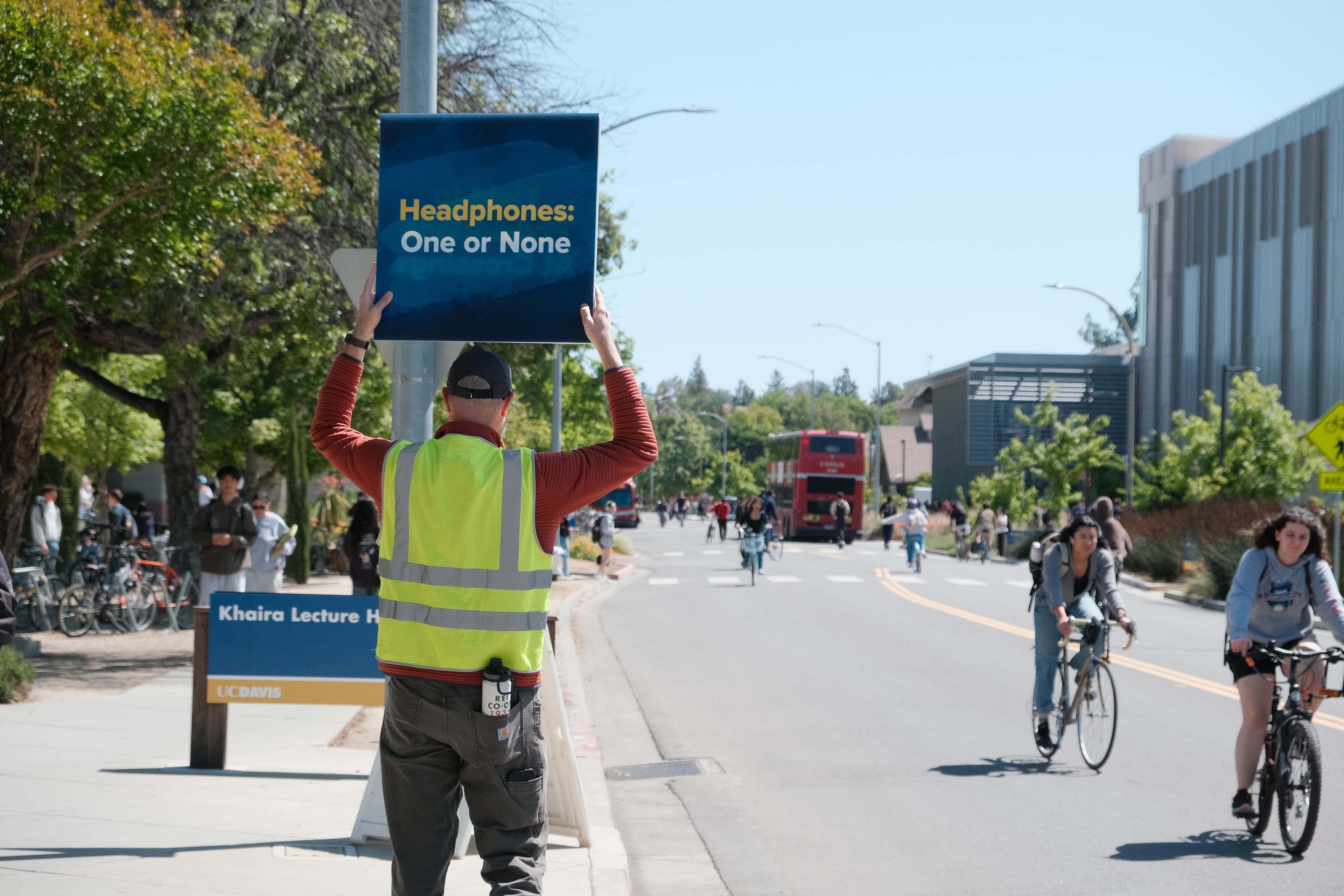
The program utilizes an education-first approach to promote a 15 mph speed limit and pedestrian safety
By MICHELLE BEKHTEL — campus@theaggie.org
This month, UC Davis Transportation Services and the UC Davis Police Department began stationing safety teams along campus pathways to address a dramatic increase in e-scooter and e-bike accidents.
The pilot program, known as Safety Corridors, deploys two-person units to high-traffic areas every Thursday in April to engage in conversational safety reminders with students and commuters.
The initiative follows a 15-month trend of rising incidents involving e-scooters and e-bikes, according to Transportation Services, and was launched before the fatal April 13 bike collision which led to the death of UC Davis student Lincoln Sabini.
UC Davis Police Department Sergeant Carl Walter noted that the issue extends beyond the City of Davis, and that the surge in accidents is not unique to the campus.
“California cities throughout the state have seen 200% to 300% increases in micro-mobility crashes,” Walter said. “These devices are inexpensive and easy to get on and go, but not everybody is driving them with the same care they might drive a motor vehicle.”
The safety teams focus on addressing eight prohibited behaviors, including exceeding the 15 mph speed limit, failing to yield to pedestrians and improper earbud use. Jeffrey Bruchez, active modality manager for Transportation Services, described the rule for the latter as “one or none.”
“We want people to have at least one ear open to the environment,” Bruchez said.
Bruchez, deployed to the April 16 Safety Corridor at the Hutchison Drive and Bioletti Way intersection, noted that the physical presence of the team created an immediate shift in behavior.
“Today, we were here for about 30 minutes before we deployed, and there were a lot of people cutting through the roundabout the wrong way,” Bruchez said. “Since we activated, we’ve only had one. We’ve generally gotten really positive reception.”
However, Bruchez acknowledged that the challenge lies in making those habits stick.
“The moment we remove ourselves from the intersection, the behavior goes right back to what it was before,” Bruchez said.
University officials are currently in a data-gathering phase, and while the team is currently using high-visibility vests and signs rather than ticket books, the university is evaluating other measures of enforcement.
“We’re looking at what happens once we’re done with this quarter’s evaluation,” Bruchez said. “Should there be some kind of enforcement, especially when someone is told to stop at a sign and still decides to run it?”
James Nash, a university spokesperson, said that while the current focus is on “shared responsibility,” UC Davis has not ruled out more stringent measures if accident rates do not decline.
“Enforcement tools, including citations, continue to be issued when appropriate," Nash said. “Our approach is to lead with awareness, while reserving accountability measures if unsafe behaviors continue.”
During the single 40-minute window the Safety Corridor was active at the intersection of Hutchison and Bioletti, Walter estimated that over 400 bikes and scooters passed through, along with double that many pedestrians. He emphasized the physical stakes of these collisions.
“A bike hitting someone at 15 miles per hour can do serious injury,” Walter said. “Be aware of what you're doing. Be considerate and pay attention.”
Transportation Services suggests that riders who are uncertain of their speed should not travel faster than rentable SPIN scooters, which are programmed with a 15 mph speed limit. Additionally, Student Health and Counseling Services offers free helmets under their “Helmet Hair Don’t Care!” program following the completion of a survey and safety training.
Written by: Michelle Bekhtel — campus@theaggie.org