






The Editorial Board’s spring 2026 interview with Chancellor Gary May and university leadership
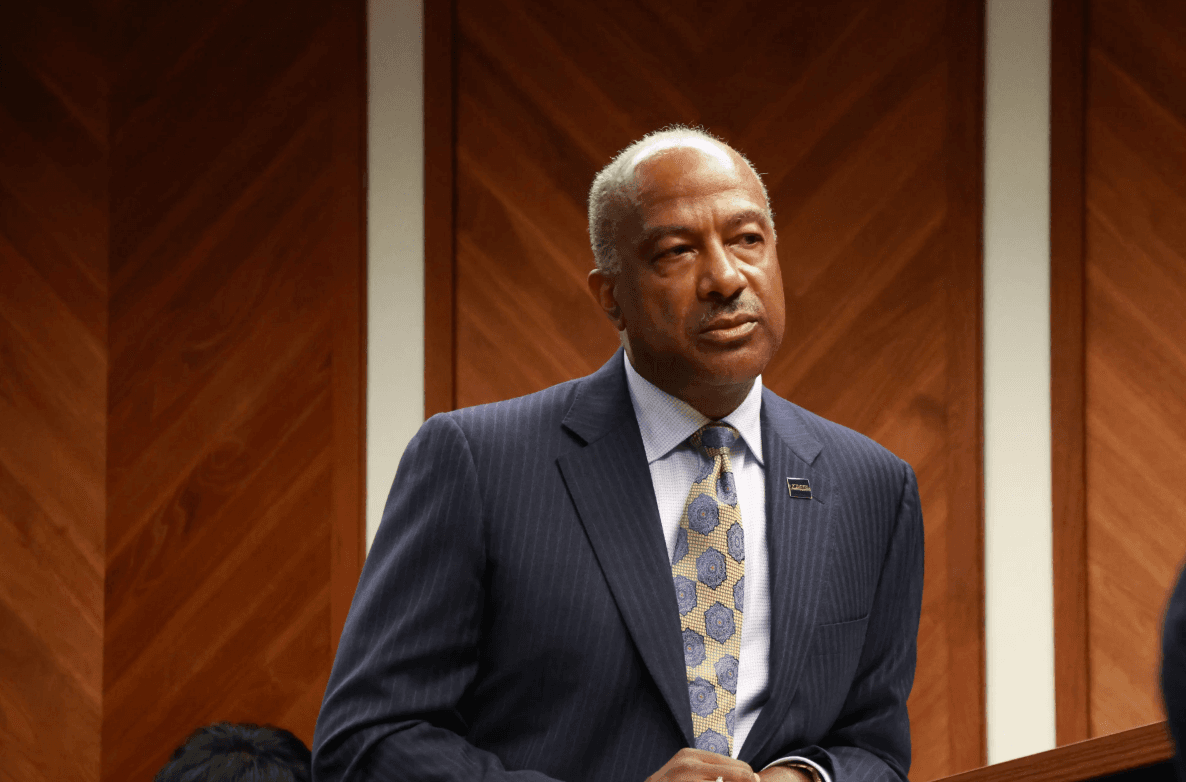
UC Davis administration discusses bike safety, equestrian team demotion and May’s position on Leidos’ Board of Directors
By THE EDITORIAL BOARD — opinion@theaggie.org
On May 15, 2026, The California Aggie’s Editorial Board met with Chancellor Gary May, Provost and Executive Vice Chancellor Mary Croughan, Associate Chancellor and Chief of Staff Carl Engelbach, Chief Marketing and Communications Officer Dana Topousis, Vice Chancellor of UC Davis Finance, Operations and Administration Clare Shinnerl, Vice Chancellor of Inclusive Excellence Renetta Tull and Vice Chancellor for Student Affairs Pablo Reguerín.
Note: The Editorial Board submits planned questions to UC Davis leadership prior to the meeting but asks follow-up questions when necessary. The entire list of questions the Editorial Board planned to ask, including follow-ups, can be found here.
Below is a transcript of the meeting that has been edited for length and clarity.
Editorial Board: The City of Davis is considered the “Bicycle Capital of America,” and biking culture is significant among UC Davis’ student body. In light of recent bike-related student deaths in Davis — including Lincoln Sabini in April and Trisha Yasay in 2022 — is campus administration taking any steps to improve bike infrastructure on campus and with the City of Davis?
May: First, let me just say we all remain heartbroken over these deaths. I have, and I continue to, extend sympathies to the families of Lincoln and Trisha and their loved ones. In recent years, the university has invested in a range of road and pathway improvements aimed at improving our micro-mobility and pedestrian safety, and we remain committed to continuing that work. One example is the Safety Corridors program, which takes an education-first approach to prevent unsafe riding on campus. We have safety teams now monitoring excessive speed, unsafe passing, failure to yield and other factors that put both riders, drivers and pedestrians at risk.
I would encourage all of our students to learn more at the Moving Forward Together website, and that talks about improvements to our transportation planning. We continually evaluate all information regarding transportation, including community input and reports of collisions, to inform our approach to designing better and safer transit corridors to help guide educational efforts for the community. Clare [Shinnerl], do you have anything to add?
Shinnerl: That's well said. We're very sad.
Editorial Board: Based on some recent information we received, we wanted to ask a follow-up question. A local cause, @justice4lincoln on social media, is calling for the implementation of a new bike and pedestrian infrastructure titled “Lincoln Loop” in the Hutchinson Drive area. Is UC Davis planning to support local advocacy for improved bike infrastructure in accident-prone areas of the campus and city?
May: We are in discussions with that group. We are aware of what they're up to, and we have a voice in that conversation.
Editorial Board: With the presence of bikes and electric scooters on campus, are there any conversations or plans centering pedestrian student safety measures?
May: I think I answered that. I don't know if I have anything else to add beyond what I said.
Shinnerl: Do you want more information on that?
Editorial Board: If you have anything, then sure, but if it's all what you covered, that's also totally fine.
Shinnerl: If you go to the website, it's there. I mean, I can tell you from my perspective, I’d really love it if people stopped at stop signs when they're riding a bike or a scooter, that would help immensely.
May: And helmets.
Shinnerl: Helmets would be super, super helpful.
Editorial Board: National Collegiate Athletics Association (NCAA) financial reports, obtained through a Public Records Act (PRA), show that over the past three years, equestrian’s reported equipment costs were nearly $700,000 higher than the actual costs as a result of the offsetting of in-kind horse donations as per NCAA reporting rules. Since these in-kind donations were a non-cash entry in the financial report representing the donated horses — instead of the team’s actual expenditures — can you speak on the claims as to why these adjusted expenditure lines were included in the overall financial report to make the case for equestrian being labeled as the second-most expensive sport?
May: I know you have three equestrian-related questions, and the answer is going to be the same for all three, so if you don't mind, I'll just give that answer. First, let me just say that the decision to transition the equestrian team was not an easy one or a quick one. It followed a comprehensive and deliberate review process that included detailed financial analysis; it also included an independent assessment conducted by an external firm with experience in collegiate athletics. We believe that all the policies and practices were followed and that the decision regarding the equestrian program was made with appropriateness and the best interests of the UC Davis community in mind.
At the same time, we at the university take concerns seriously that people have expressed. So, the UC Davis Audit and Management Advisory Services unit initiated a review to evaluate the financial records and reporting practices in Intercollegiate Athletics (ICA) to determine whether expenses were accurately represented to decision makers and other appropriate authorities. The review also assesses whether budgeting, planning and fundraising activities comply with applicable university policies; this includes system-wide policy, relevant laws and regulations and appropriate ethical standards.
The current equestrian student-athletes will retain their financial aid, academic advising, tutoring and other institutional support services through the completion of their undergraduate degrees. That's in accordance with university policy. Finally, I'll just add that we believe UC Davis remains fully compliant with Title IX requirements.
Editorial Board: Just a quick clarification question: Is the review currently taking place or has it been completed?
May: It's ongoing right now. It'll be complete by the end of June.
Note: As referenced by May, the Editorial Board intended to ask two further questions regarding the equestrian team’s demotion:
- Athletes were recruited and signed for the upcoming 2026-27 season during the period when the Athletics Department was finalizing the decision to demote the equestrian team. What obligations does the department and university have to those athletes and what support is being offered?
- With the demotion of equestrian from the Division 1 level, has there been a formal Title IX impact review considering the loss of equestrian as a women’s sport? If so, can you share what the findings were?
Editorial Board: Given the recent celebration of Picnic Day 112, are there new ways that UC Davis and the City of Davis will approach maintaining student and community safety in the future, while also not jeopardizing the lighthearted atmosphere of the event?
May: Our top priority is safety at all times, including Picnic Day. This year and every year we are in regular contact with the City of Davis to coordinate enforcement and public safety response and information to the community. The city outlines several measures to enhance safety off campus, including three safety enhancement zones where violations may carry increased penalties, a 48-hour ban on alcohol in city parks and increased enforcement throughout the city, which you may have noticed. Further, the city issued no special events permits on Picnic Day, and the parade route was shortened by one block.
On campus, we work to inform students of their role in making Picnic Day a safe celebration. We sent an email to all students and have encouraged them to sign a pledge to conduct themselves responsibly and to look out for one another during Picnic Day. We also reached out to residence halls, fraternities, sororities and other student groups to remind them of their role in making Picnic Day safe and enjoyable for everyone. We directly contacted any group that announced plans for social gatherings on Picnic Day to inform them of the rules around those events. Campus police, city police and the California Highway Control (CHP) enforced driving under the influence (DUI) and traffic laws. Penalties for violations were also enhanced that day.
We further reminded the community that DUI laws also applied to motorized scooters and e-bikes. I think all those measures were effective. We enjoyed a successful Picnic Day, and by working together, we demonstrated how to ensure a safe and enjoyable celebration for the university and the Davis community going forward. As we do every year, we have a comprehensive review of this year's event to apply the lessons to future Picnic Days. Along with the city, we're committed to continually learning and making changes to ensure that Picnic Day stays a safe, enjoyable event for the community.
Editorial Board: As high school seniors are accepting their offers to attend UC Davis in the fall, is there a current estimate on how many students will be in the incoming Class of 2030?
Croughan: It’ll be about 6,400 incoming first-year students and 2,700 incoming transfers, and realize that the Statement of Intent to Register (SIR) date, which you all remember, is May 1, but then people make decisions about other universities as well. So, those are rough estimates. That's what we projected for the class. If that occurs, that would be about 9,100 students that are new to Davis and about 366 less than we admitted last year. That is intentional, because we have been on a pretty strong growth trajectory. We're maxed out on our laboratories and classrooms, and all nine undergraduate University of California (UC) campuses have been asked to reduce this year. So, that's the plan. We'll see what actually happens with admission acceptances.
Editorial Board: As a follow-up to that: Given the heightened federal restrictions on immigration and international student visas, is there a difference in the amount of international students that are set to attend this upcoming academic year?
May: The answer is yes.
Croughan: It has been incredibly hard for international students to get visa appointments. We did have our usual number of international students actually submit on the SIR. That also happened last year, so we'll see how well they do. Last year and this year, we gave people until winter quarter. So, if they needed a deferral, because they couldn't get a visa appointment, an interview appointment, in time, we gave them an extra quarter. In fact, we'd give them an extra year if they thought they could then come. It has been incredibly challenging to determine ways that we can be more helpful to international students to actually arrive. And across the whole U.S., numbers are down for international students, presumably because our climate is not too conducive to people coming from other countries to the U.S.
To help with it, because there's international and then there's domestic out-of-state students, we tried an increased scholarship program, what we call the Provost scholarships — not like I give them actually or know who receives them — but it's been a great program for recruiting out-of-state and international students in the past, and we put about double the amount of money available in that program for this coming year, hoping that if international students are not at the level we'd like them to be, we can make it up with out-of-state students. Again, I'll note every UC campus was kind of undertaking the same approach trying to increase out-of-state.
Editorial Board: UC Davis launched a reusable container pilot program at the Coffee House to meet sustainability goals and reduce waste impact. Are there any updates on the success of this initiative? Are there any other new sustainability initiatives the administration would like to highlight on campus?
May: Clare [Shinnerl], do you want to take that one? Or Pablo [Reguerín]?
Reguerín: So, it is a pilot program. It is going to be ending in mid-June. The Coffee House team is working on a survey to inform next steps of the program and whether it's going to continue to expand or how to take next steps with the partnership. The return rate peaked at 46% for the trays, and it was short of the goal of 50%. I think they're always evaluating actual usage and behavior, etc. In terms of new initiatives, they're looking to pilot the Laboratory Nitrile Glove Recycling Programs, so there's interest in that program, as well as, of course, the Green Initiative Fund, which provides funding for student projects that directly involve or impact students. That program is ongoing; it was renewed a few years ago as a fee referendum. If you look at their website and what they fund, there's a variety of different programs — I'd call them more micro programs, but very effective and I would refer you back to that program.
Editorial Board: Students have reached out to us with concerns about Chancellor Gary May’s continued position on Leidos’ Board of Directors — specifically regarding Leidos’ role as an “authorized supplier for the Israel Ministry of Defense (IMOD) and Project Nimbus,” according to Leidos’ website. How do you respond to student concerns about your involvement in an IT company that contracts with the Department of Defense (now Department of War), Israel’s Defense Ministry and the Department of Homeland Security, which oversees Immigration and Customs Enforcement (ICE)?
Topousis: I'm going to step in and answer this on behalf of the chancellor. He's been asked this many times, and he's answered it, so his response is on record in other venues. It's something that the chancellor does on his own time. It's his personal time. It's a professional development opportunity for him. It has absolutely no impact or even relation to what he does as the chancellor, so it's his own personal time that he takes to be on that board.
Engelbach: I’ll just add to Dana [Topousis]’ comments that all 10 UC campus chancellors, if they serve on any outside boards, it must receive approval from the UC president, President James B. Milliken, in order to serve on outside boards, so this has been reviewed and improved also by President Milliken at the system-wide level.
May: I wasn't supposed to talk — they were going to speak for me — but I feel compelled to say something. I'll just start by saying that this question makes me sad.
Everything that Dana [Topousis] and Carl [Engelbach] said was true. I'll add this: I've been at UC Davis almost nine years now, nine years. If the students don't know me and my values, my character, by now, you know, you really never will. I don't understand why this question continues to be asked, but I'm pretty sure the concerned students that you mentioned brought this to your attention do not include the students with whom I've arranged job interviews and internships with Leidos. I don't even know what Project Nimbus is, to be honest with you. Leidos is a $17 billion company with 50,000 or so employees and thousands of projects. Contractors and subcontractors remain on various authorized supplier lists for years, whether or not there's any current activity.
The way the question is framed, it's almost like an implied smear. You might as well ask me: What is my reaction to working at a university like UC Davis, which once pepper-sprayed at students? Faculty members at UC Davis and across the UC system have Department of Defense (DOD)-funded grants. Later today, in fact, I'll speak at the grand opening of a research center that's funded by the Army Research Office. These activities don't appear to attract as much attention as I do for some reason. The Department of Homeland Defense also includes the Transportation Security Administration (TSA), and if you fly, it's well known that Leidos provides and maintains airport security scanners for TSA — and no relationship with Immigration and Customs Enforcement (ICE).
To conclude, I just try to do what I can, wherever I can, to be a force for positive change; that includes UC Davis. I would hope that I would get some measure of benefit of the doubt at some point on these issues.
Editorial Board: I have a quick follow-up: You mentioned that President Milliken has to approve any outside board membership. Could you tell us a little bit about how that process works?
Engelbach: It's just a form that gets filled out every year. It's a UC Regents policy that the chancellors, and maybe other Senior Management Group (SMG) employees, can serve on a maximum of two compensated boards, and those have to be approved.
Croughan: Can I just add — every single faculty member fills out a form for outside professional activities. So everyone, faculty and senior leadership, get reviewed for what they do outside the University of California.
Engelbach: And it is an annual review process conducted by the Office of the President.
Editorial Board: Just one more follow-up to that: Considering that students continue to reach out to us with questions about this issue, where do you recommend that they go for more information about your specific involvement with this project?
May: Me. Yeah, to me. Instead of you [The California Aggie].
Note: For more information regarding Leidos and Project Nimbus, navigate to the official Leidos website and additional resources — including Leidos shareholdings and Leidos Corporate Governance Guidelines.
Editorial Board: The UC Davis Academic Senate recently voted in favor of adopting the Climate Crisis General Education (GE) requirement, starting 2030. What was the motivation behind this decision and what are the next steps in getting the GE requirement established?
Croughan: There's been large, considerable faculty and student interest in climate change for, truthfully, 50 years here at Davis, one of the most sustainable universities in the United States in rankings year after year. Last year, that became a formal request to the Academic Senate to have a GE requirement. It went through the standard Academic Senate review process, of all of their committees looking at it, and then was approved through that. It's the same as any other requirement that goes forward. Someone can put forward a request; It's evaluated in the context of all the other GE requirements, and then what courses would fulfill that requirement.
Truth is, we've offered dozens and dozens of courses for decades here that would fulfill that requirement, so most students have already met it. It was one of the things that Katheryn Russ told us; at the April 16 meeting, so last month, it was presented before the Representative Assembly. So you have, similar to what the ASUCD does, there's an Executive Council, and then the Representative Assembly is an even-broader representative group. And the debate was positive there, so that was the final form. Roughly a month ago, it was all approved.
Editorial Board: You mentioned that there are already a lot of existing courses that would fulfill this GE. I know it's still being finalized, but are there any ideas right now about what it will look like for students and faculty? Are there any other requirements that might be introduced or how it would place in the current GE topical breadth and core literacies framework?
Croughan: I don't know if they've worked out that level of detail yet, because the Committee on Courses and Instruction (COSI) will now have to go through it. I suspect they've already evaluated the majority of the courses, but Engineering, Letters and Science, Biological Sciences, College of Agriculture — all four colleges — have courses that will easily meet the requirement.
Can I go backwards for one second, looking at notes I've got from [Academic Senate Chair] Katheryn Russ? It's going to be COSI and the Undergraduate Council that will both work on finalizing everything.
Editorial Board: Recent recommendations made by the Human Relations Commission — in response to a report from the Muslim/Arab/Palestinian/Allies (MAPA) Subcommittee — are proposing increased acknowledgement, education and action to circumvent racial and religious discrimination in the community. Is it within UC Davis’ plans/capabilities to partner with city measures like MAPA to ensure continued student safety?
Tull: We have our principles of community, where we talk about affirming the dignity inherent in all of us. We are affirming humanity in all of our community members and working to combat discrimination and racism in all forms. There's a group called Hate Free Together. It's an example of a joint initiative with the City of Davis, and we're working with them collaboratively on inclusion and education across our community.
So, to get to the heart of the question, UC Davis does have designated participants in Hate Free Together, and we're going to continue to work with them on unifying initiatives for the City of Davis and for Yolo County. At a recent Davis City Council meeting, there was a motion that passed unanimously to partner with the Hate Free Together initiative to develop cross-cultural anti-bias training.
Editorial Board: We just had a follow-up to that. On Nov. 20, 2025, Chancellor May attended an ASUCD Senate meeting where he announced he would send out a campus-wide email to provide tangible and effective response to increased Islamophobia on campus. Is there a follow-up to this request, and what plans does the administration have in place to address ongoing student concerns?
May: I don't recall making such a promise. Pablo [Reguerín] was there.
Reguerín: Yeah, it's kind of all rooted in our campaign around principles of community, but one of the things that we focus on is engagement. If we identify a group that has had some chilling impact as a result of something happening in the world or something on campus or in the city, we try to meet with folks, connect them to case managers, depending on what the situation is. So, it's going to be very different: Sometimes, it's our safety coordinator, Tim Jefferies, will go meet with [organizations], recently, like our Iranian Student Organization. So I think we work pretty effectively at being responsive given the geopolitical climate. If it's a single student issue, we would refer them to our Office of Student Support. We want as many students to know that you can refer yourself or you can refer someone who has a concern. There's Health 34 if you're in an immediate crisis.
We have multiple tiers of responding to groups, concerns and issues, but usually it's dialogue, and we're trying to do much more of a face-to-face, Zoom engagement rather than relying on statements or just emails. There's a need to be present and responsive. To the chancellor or the provost, really part of my role is to connect students and groups with administrators and help them navigate and continually get reminders that they are available ready to meet with folks. So, it just depends on the issue, and we try to address it. If someone's had a chilling effect, we try to have supportive measures; it's going to look different based on the issue. It's a wide-ranging response, but there's a lot that we do in this area.
Tull: Encouraging warming effects as well, and celebration.
May: What may have been misunderstood is I am willing to consider writing some reaction to our current climate survey and if we see some signs that there is a real issue around these particular concerns, I would consider writing something about that in communication to the campus, but I think maybe that's what you're referring to.
Editorial Board: One more follow-up to that as well: We've also had students reach out informing us that meetings between the chancellor and Registered Student Organizations (RSOs), including the Palestinian Life Advisory Committee, have shortened from an hour to 20 minutes for meetings. How would you respond to students’ concerns that shortening the length of these meetings minimizes student voices and open conversation between students and faculty?
May: My first thought is that the meetings haven't shortened; my personal participation is what shortened. Usually, what happens in those meetings is the things that are relevant for me to be present for or to comment on end after the first half an hour or so. So, as you can imagine, I have many, many things to do. The rest of the team, depending on what the topics on the agenda are, stays for the entire hour, or whatever it is. If there's a need for me to stay longer, I'm certainly willing to. I'm the most available chancellor in the system, I think. I've met with student groups multiple times over the years. It just seems that sometimes when the conversation gets into details that don't really involve me directly, it's better handled by Student Affairs or Inclusive Excellence or someone else on the team.
Editorial Board: As UC Davis seniors near graduation, common concerns center post-graduation job opportunities and transitioning from academia to the workforce. How does UC Davis provide resources and support to students as they leave the university — in terms of graduate school, the job market, entering the alumni network or otherwise?
May: First, I want to congratulate all the graduates. I also want to acknowledge the anxiety that's felt about the job market. You know, these things are cyclical. When I graduated, back in high school when the earth was cooling, it was one of those soft job markets as well, so I get it. People were very concerned in my class about jobs, but we have a strong record here of preparing students for the workforce. Part of our No. 2 ranking [for public schools in the nation] in the Wall Street Journal is based on how well we set up our students for financial success after graduation. We have a variety of career services, the Career Center and other places, graduate school advising and alumni connections, that are available. In fact, the Career Center provides one-on-one advising and resume and interview support, at least one Career Fair every quarter and access to many opportunities through Handshake.
We also have opportunities for students to be educated on pre-graduate, pre-law advising programs in preparation for those professional schools. After graduation, those same services are available to alumni as they are to current students — except for advising, alumni don't really need to go that much. Those services are available for up to one year after graduation. Overall I think we're trying to help students confidently move from college to career or graduate school through a variety of activities and programs. We really want students to be successful in their careers and in the workforce.
Croughan: Besides professional networking and working with alumni, we have the Continuing and Professional Education Office (CPE). Students regularly take those classes. It's what used to be called UC Extension. Right now, we've gone from brewing and viticulture and enology being the most popular alumni classes to AI. We have AI certificates being offered through CPE, plus a variety of courses that are being developed around campus on AI as well. Because that's one of the things students have identified that they want to have more knowledge of, because apparently it's showing up in job descriptions more often now, too.
Editorial Board: Maybe moving away from professional advice, I know a lot of graduates are always getting personal advice. Does anyone have anything else they want to share about just ending their college life?
Shinnerl: Don't forget that UC Davis, UC Davis Health — we're the largest or second largest employer in the entire region. So I think most of us, when we graduated, might not have realized that our own universities are these gigantic hiring engines. I know right now we're a little slower than usual. As Chancellor May said, it's cyclical. Just keep us in mind for careers.
Croughan: A lot of the people you meet are Aggies. A lot of staff in particular. I'm an Aggie. I think it is really hard. I mean, as a mom, I'm going through this with my own kids, to be honest. It's pretty hard to go through and watch layoffs at a large scale in some corporations and businesses. It is extremely cyclical. You know, two years from now, everything could be taking off again.
My personal advice — if you don't mind, because this is what I told my son-in-law — keep your education going in the meantime. That's why I know so much about what we're offering in AI right now. I said, you know, get an AI certificate and continue your education while all of these other things are playing out with interviews and job searches, so that you're not sitting around watching Netflix. Because that's going to be an interview question: How did you use that time between graduation and now? I'm always going to employ the person who was actually continuing their professional development.
May: One comment. It occurred to me — [OpenAI CEO] Sam Altman said this, I wish I had said it — regarding AI: AI is not replacing people, but people who know and use AI are replacing people that don't know.
Tull: Be proud to be from UC Davis. UC Davis is a fantastic university. And I would just encourage you to, in your professional life, continue with the things that you've learned about justice, about collaboration, about how to work together well and be respectful and honest. Those things do carry. When I see people in the professional world, people will say, “Oh, well, that person might be kind. They're from Davis; they’re that person.” So in terms of that reputation, you all, as seniors graduating and as alumni, will be able to keep that going, so please do so.
Written by: The Editorial Board — opinion@theaggie.org